

' .00
1000
(a)
lwIomcn\urn nul. (N/"..,.2)
/
I
/
4_.
-D.030 -0.020 -0,010
0.0'30
0.0\0
,...." 3 pm
i
'000
I
I
I I
0
1
!lOOO
j
'i 2000
1000
'000
1000
-100
....
1000
-0.030 -O.C2'O -0.010 0 ,000
0.010
~'QO
mHlI\' ,"'
127
\
I'.
(b)
, '.
, '.
, '. ", .
, ' .
. .,--/. _.,"
'00
200
lOO
I
I
I ,
I I
100
'00
JOG
-' ....
(c)
>000
....
!lCK>O
i
i '0000
''''
_ .. -,a •
1nI' .... l ,"'
....
' .00
]:3000
i
i '000
I
1000
i
Ii
~
-.. -,. • ,.
rn. .... ,.,.
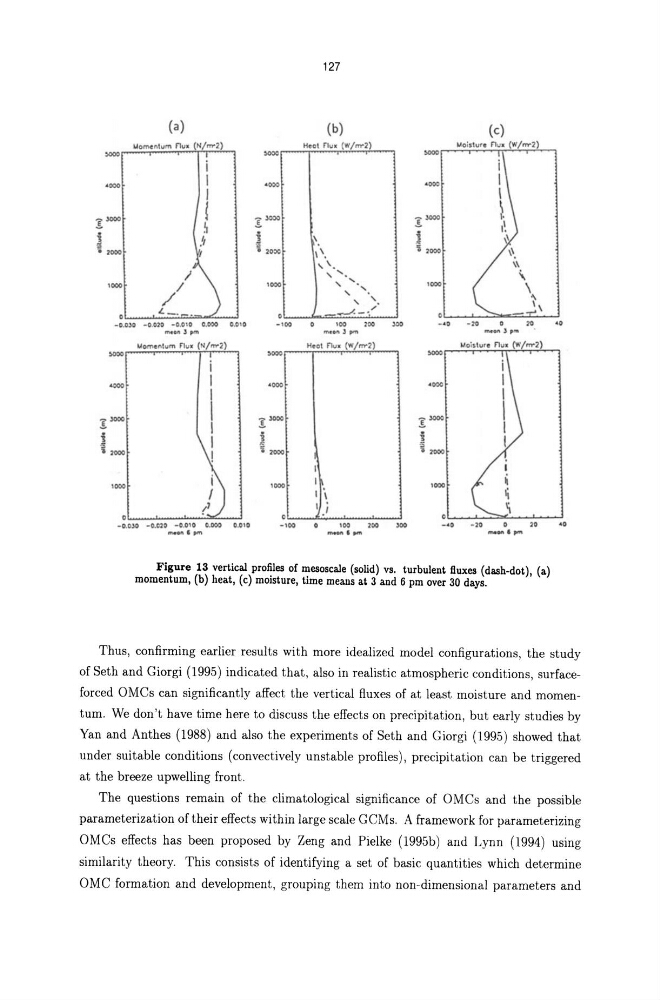
Figure 13 vertical profiles of mesoscale (solid) vs. t urbulent fluxes (dash-dot), (a)
momentum, (b) heat, (c) moisture, time means at 3 and 6 pm over 30 days.
..
. .
Thus, confirming earlier results with more idealized model configurations, the study
of Seth and Giorgi (1995) indicated that, also in realistic atmospheric conditions, surfaceforced OMCs can significantly affect the vertical fluxes of at least moisture and momentum. We don 't have t ime here to discuss the effects on precipitation, but early studies by
Yan and Anthes (1988) and also the experiments of Seth and Giorgi (1995 ) showed that
under suitable conditions (convectively unstable profiles), precipitation can be triggered
at the breeze upwelling front.
The questions remain of the climatological significance of OMCs and the possible
parameterization of t hei r effects within large scale GCMs. A framewor k for parameterizing
OMCs effects has been proposed by Zeng and Pielke (1995b) and Lynn (1994) using
similarity t heory. T his consists of ident ifying a set of basic quant ities which determine
OMC formation and development, grouping them into non-dimensional parameters and
1000
(a)
lwIomcn\urn nul. (N/"..,.2)
/
I
/
4_.
-D.030 -0.020 -0,010
0.0'30
0.0\0
,...." 3 pm
i
'000
I
I
I I
0
1
!lOOO
j
'i 2000
1000
'000
1000
-100
....
1000
-0.030 -O.C2'O -0.010 0 ,000
0.010
~'QO
mHlI\' ,"'
127
\
I'.
(b)
, '.
, '.
, '. ", .
, ' .
. .,--/. _.,"
'00
200
lOO
I
I
I ,
I I
100
'00
JOG
-' ....
(c)
>000
....
!lCK>O
i
i '0000
''''
_ .. -,a •
1nI' .... l ,"'
....
' .00
]:3000
i
i '000
I
1000
i
Ii
~
-.. -,. • ,.
rn. .... ,.,.
Figure 13 vertical profiles of mesoscale (solid) vs. t urbulent fluxes (dash-dot), (a)
momentum, (b) heat, (c) moisture, time means at 3 and 6 pm over 30 days.
..
. .
Thus, confirming earlier results with more idealized model configurations, the study
of Seth and Giorgi (1995) indicated that, also in realistic atmospheric conditions, surfaceforced OMCs can significantly affect the vertical fluxes of at least moisture and momentum. We don 't have t ime here to discuss the effects on precipitation, but early studies by
Yan and Anthes (1988) and also the experiments of Seth and Giorgi (1995 ) showed that
under suitable conditions (convectively unstable profiles), precipitation can be triggered
at the breeze upwelling front.
The questions remain of the climatological significance of OMCs and the possible
parameterization of t hei r effects within large scale GCMs. A framewor k for parameterizing
OMCs effects has been proposed by Zeng and Pielke (1995b) and Lynn (1994) using
similarity t heory. T his consists of ident ifying a set of basic quant ities which determine
OMC formation and development, grouping them into non-dimensional parameters and