

126
A measure of the intensity of the OMCs is given by the circulation integral, C, along
a closed path encompassing the OMC, which for the model translates into
1
Z2
lX2
C =
[W(X2, z) - w(Xj, z)jdz + [u(x, Z2) - u(x, zdjdx
q
~
(70)
where Xl, X2, Zj, z2 are the corners of a square integral path. For the present calculations,
Zl and Z2 are chosen at about 300 m and about 2500 m, respectively, while Xj and X2 are
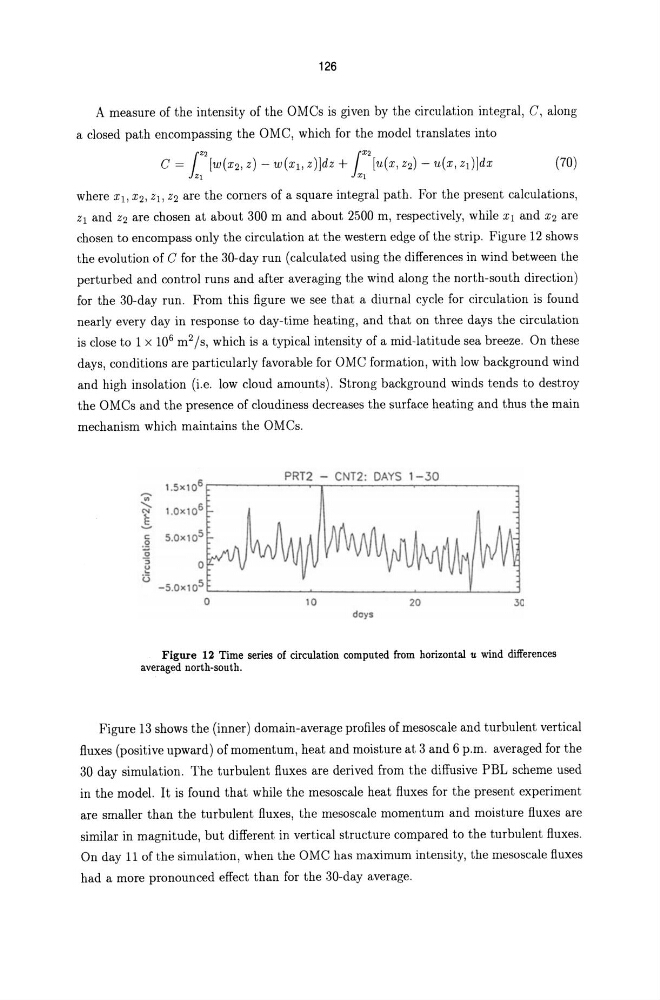
chosen to encompass only the circulation at the western edge of the strip. Figure 12 shows
the evolution of C for the 3D-day run (calculated using the differences in wind between the
perturbed and control runs and after averaging the wind along the north-south direction)
for the 3D-day run. From this figure we see that a diurnal cycle for circulation is found
nearly every day in response to day-time heating , and that on three days the circulation
is close to 1 x 10 6 m 2 /s, which is a typical intensity of a mid-latitude sea breeze. On these
days, conditions are particularly favorable for OMC formation , with low background wind
and high insolation (i.e. low cloud amounts). Strong background winds tends to destroy
the OMCs and the presence of cloudiness decreases the surface heating and thus the main
mechanism which maintains the OMCs.
1.5X10 6
PRT2 - CNT2: DAYS 1-30
--.
'"
"- l.oxlO 6
N
1
c
5.0X10 5
.!!
'0
~
~
U -5.0X10 5
0
10
20
30
days
Figure 12 Time series of circulation computed from horizontal 'U wind differences
averaged north-south.
Figure 13 shows the (inner) domain-average profiles of mesoscale and turbulent vertical
fluxes (positive upward) of momentum , heat and moisture at 3 and 6 p.m. averaged for the
30 day simulation. The turbulent fluxes are derived from the diffusive PBL scheme used
in the model. It is found that while the mesoscale heat fluxes for the present experiment
are smaller than the turbulent fluxes, the mesoscale momentum and moisture fluxes are
similar in magnitude, but different in vertical structure compared to the turbulent fluxes.
On day 11 of the simulation, when the OMC has maximum intensity, the mesoscale fluxes
had a more pronounced effect than for the 3D-day average.
A measure of the intensity of the OMCs is given by the circulation integral, C, along
a closed path encompassing the OMC, which for the model translates into
1
Z2
lX2
C =
[W(X2, z) - w(Xj, z)jdz + [u(x, Z2) - u(x, zdjdx
q
~
(70)
where Xl, X2, Zj, z2 are the corners of a square integral path. For the present calculations,
Zl and Z2 are chosen at about 300 m and about 2500 m, respectively, while Xj and X2 are
chosen to encompass only the circulation at the western edge of the strip. Figure 12 shows
the evolution of C for the 3D-day run (calculated using the differences in wind between the
perturbed and control runs and after averaging the wind along the north-south direction)
for the 3D-day run. From this figure we see that a diurnal cycle for circulation is found
nearly every day in response to day-time heating , and that on three days the circulation
is close to 1 x 10 6 m 2 /s, which is a typical intensity of a mid-latitude sea breeze. On these
days, conditions are particularly favorable for OMC formation , with low background wind
and high insolation (i.e. low cloud amounts). Strong background winds tends to destroy
the OMCs and the presence of cloudiness decreases the surface heating and thus the main
mechanism which maintains the OMCs.
1.5X10 6
PRT2 - CNT2: DAYS 1-30
--.
'"
"- l.oxlO 6
N
1
c
5.0X10 5
.!!
'0
~
~
U -5.0X10 5
0
10
20
30
days
Figure 12 Time series of circulation computed from horizontal 'U wind differences
averaged north-south.
Figure 13 shows the (inner) domain-average profiles of mesoscale and turbulent vertical
fluxes (positive upward) of momentum , heat and moisture at 3 and 6 p.m. averaged for the
30 day simulation. The turbulent fluxes are derived from the diffusive PBL scheme used
in the model. It is found that while the mesoscale heat fluxes for the present experiment
are smaller than the turbulent fluxes, the mesoscale momentum and moisture fluxes are
similar in magnitude, but different in vertical structure compared to the turbulent fluxes.
On day 11 of the simulation, when the OMC has maximum intensity, the mesoscale fluxes
had a more pronounced effect than for the 3D-day average.