

128
then seeking empirical relationships between these parameters based on series of model
simulations. For example, Zeng and Pielke (1995b) identify five dimensionless parameters:
the dimensionless height ((), the aspect ratio between the PBL height and L. (f), the
Richardson number (RiB), the ratio of eddy turnover time over advection time (Ad and
the ratio of kinetic energy of the large scale flow over the horizontal pressure gradient
which results from differential heating (A2). These parameters are then combined to
describe the vertical structure of the mesoscale momentum, heat and water vapor. The
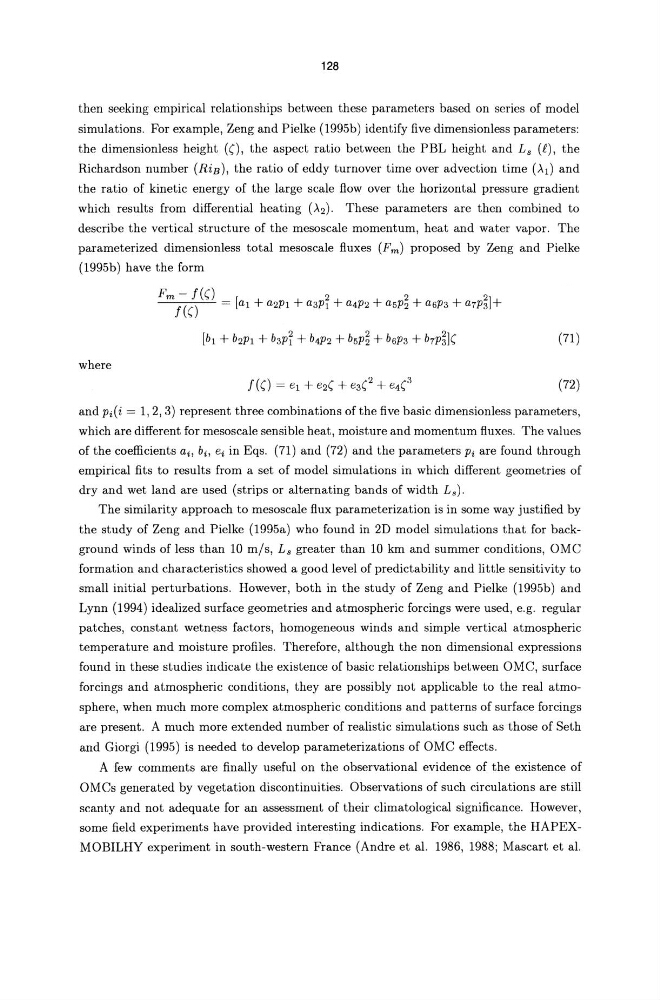
parameterized dimensionless total mesoscale fluxes (Fm) proposed by Zeng and Pielke
(1995b) have the form
Fm - f(()
[
2
2
2]
f(()
= al + a2PI + a3PI + a4P2 + a5P2 + aSP3 + a7P3 +
[bi + b2PI + b3Pi + b4P2 + b5P~ + bSP3 + b7P~](
(71)
where
(72)
and Pi(i = 1,2,3) represent three combinations of the five basic dimensionless parameters,
which are different for mesoscale sensible heat, moisture and momentum fluxes. The values
of the coefficients ai, bi , ei in Eqs. (71) and (72) and the parameters Pi are found through
empirical fits to results from a set of model simulations in which different geometries of
dry and wet land are used (strips or alternating bands of width L.).
The similarity approach to mesoscale flux parameterization is in some way justified by
the study of Zeng and Pielke (1995a) who found in 2D model simulations that for background winds of less than 10 mis, L. greater than 10 km and summer conditions, OMC
formation and characteristics showed a good level of predictability and little sensitivity to
small initial perturbations. However, both in the study of Zeng and Pielke (1995b) and
Lynn (1994) idealized surface geometries and atmospheric forcings were used, e.g. regular
patches, constant wetness factors, homogeneous winds and simple vertical atmospheric
temperature and moisture profiles. Therefore, although the non dimensional expressions
found in these studies indicate the existence of basic relationships between OMC, surface
forcings and atmospheric conditions, they are possibly not applicable to the real atmosphere, when much more complex atmospheric conditions and patterns of surface forcings
are present. A much more extended number of realistic simulations such as those of Seth
and Giorgi (1995) is needed to develop parameterizations of OMC effects.
A few comments are finally useful on the observational evidence of the existence of
OMCs generated by vegetation discontinuities. Observations of such circulations are still
scanty and not adequate for an assessment of their climatological significance. However,
some field experiments have provided interesting indications. For example, the HAPEXMOBILHY experiment in south-western France (Andre et al. 1986, 1988; Mascart et al.
then seeking empirical relationships between these parameters based on series of model
simulations. For example, Zeng and Pielke (1995b) identify five dimensionless parameters:
the dimensionless height ((), the aspect ratio between the PBL height and L. (f), the
Richardson number (RiB), the ratio of eddy turnover time over advection time (Ad and
the ratio of kinetic energy of the large scale flow over the horizontal pressure gradient
which results from differential heating (A2). These parameters are then combined to
describe the vertical structure of the mesoscale momentum, heat and water vapor. The
parameterized dimensionless total mesoscale fluxes (Fm) proposed by Zeng and Pielke
(1995b) have the form
Fm - f(()
[
2
2
2]
f(()
= al + a2PI + a3PI + a4P2 + a5P2 + aSP3 + a7P3 +
[bi + b2PI + b3Pi + b4P2 + b5P~ + bSP3 + b7P~](
(71)
where
(72)
and Pi(i = 1,2,3) represent three combinations of the five basic dimensionless parameters,
which are different for mesoscale sensible heat, moisture and momentum fluxes. The values
of the coefficients ai, bi , ei in Eqs. (71) and (72) and the parameters Pi are found through
empirical fits to results from a set of model simulations in which different geometries of
dry and wet land are used (strips or alternating bands of width L.).
The similarity approach to mesoscale flux parameterization is in some way justified by
the study of Zeng and Pielke (1995a) who found in 2D model simulations that for background winds of less than 10 mis, L. greater than 10 km and summer conditions, OMC
formation and characteristics showed a good level of predictability and little sensitivity to
small initial perturbations. However, both in the study of Zeng and Pielke (1995b) and
Lynn (1994) idealized surface geometries and atmospheric forcings were used, e.g. regular
patches, constant wetness factors, homogeneous winds and simple vertical atmospheric
temperature and moisture profiles. Therefore, although the non dimensional expressions
found in these studies indicate the existence of basic relationships between OMC, surface
forcings and atmospheric conditions, they are possibly not applicable to the real atmosphere, when much more complex atmospheric conditions and patterns of surface forcings
are present. A much more extended number of realistic simulations such as those of Seth
and Giorgi (1995) is needed to develop parameterizations of OMC effects.
A few comments are finally useful on the observational evidence of the existence of
OMCs generated by vegetation discontinuities. Observations of such circulations are still
scanty and not adequate for an assessment of their climatological significance. However,
some field experiments have provided interesting indications. For example, the HAPEXMOBILHY experiment in south-western France (Andre et al. 1986, 1988; Mascart et al.