

111
parameter values can be studied; iii ) the performance of different ESEMs when driven by
the same climatic fields can be intercompared; and iv ) the performance of ESEMS can
be evaluated when coupled wi t h AMs. All of the over :10 currently available ESEMs have
undergone at least some of these testing phases and a multilude of articles have been
published on ESEM testing, a review of which is beyond the purpose of this paper. It
is useful, however, to provide some general considerations on the performance of ESEMs
and problems related to ESEM validation.
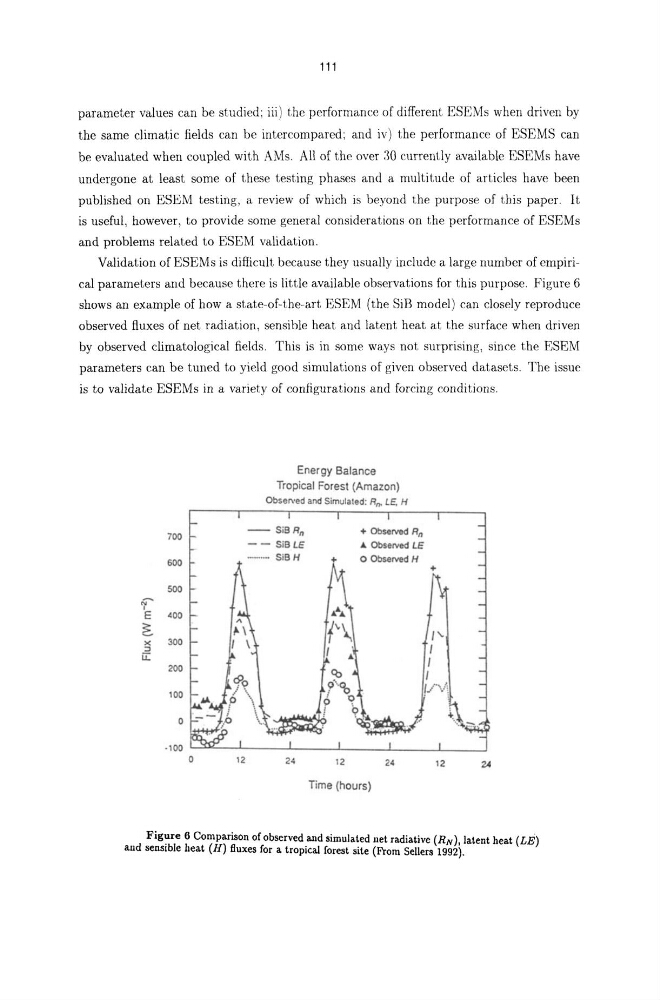
Validation of ESEMs is difficult because they usually include a large number of empirical parameters and because there is little available observations for this purpose. Figure 6
shows an example of how a state-of-the-art ESEM (the SiB model ) can closely reproduce
observed fluxes of net radiation, sensible heat and latent heat at t.he surface when driven
by observed climatological fields. This is in some ways not surprising, since the ESEM
parameters can be tuned to yield good simulations of given observed datasets. The issue
is to validate ESEMs in a variety of configurations and forcin g conditions.
700
600
500
N
I
E ~oo
~
x
300
~
u:
200
100
0
·100
0
12
Energy Balance
Tropical Forest (Amazon)
Obse"'ed and Simulated: R". LE. H
- - SiBRn
- - SiBLE
-_ ..... SIBH
24
+
12
+ Observed Rn
A ObseIVed LE
o Observed H
24
Time (h ours)
+
/'
/
/
I
12
Figure 6 Comparison of observed and simulated net radiative (R N ), latent heat (L.8)
and senSible heat (H) fluxes for a tropical forest site (From Sellers 1992).
parameter values can be studied; iii ) the performance of different ESEMs when driven by
the same climatic fields can be intercompared; and iv ) the performance of ESEMS can
be evaluated when coupled wi t h AMs. All of the over :10 currently available ESEMs have
undergone at least some of these testing phases and a multilude of articles have been
published on ESEM testing, a review of which is beyond the purpose of this paper. It
is useful, however, to provide some general considerations on the performance of ESEMs
and problems related to ESEM validation.
Validation of ESEMs is difficult because they usually include a large number of empirical parameters and because there is little available observations for this purpose. Figure 6
shows an example of how a state-of-the-art ESEM (the SiB model ) can closely reproduce
observed fluxes of net radiation, sensible heat and latent heat at t.he surface when driven
by observed climatological fields. This is in some ways not surprising, since the ESEM
parameters can be tuned to yield good simulations of given observed datasets. The issue
is to validate ESEMs in a variety of configurations and forcin g conditions.
700
600
500
N
I
E ~oo
~
x
300
~
u:
200
100
0
·100
0
12
Energy Balance
Tropical Forest (Amazon)
Obse"'ed and Simulated: R". LE. H
- - SiBRn
- - SiBLE
-_ ..... SIBH
24
+
12
+ Observed Rn
A ObseIVed LE
o Observed H
24
Time (h ours)
+
/'
/
/
I
12
Figure 6 Comparison of observed and simulated net radiative (R N ), latent heat (L.8)
and senSible heat (H) fluxes for a tropical forest site (From Sellers 1992).