

110
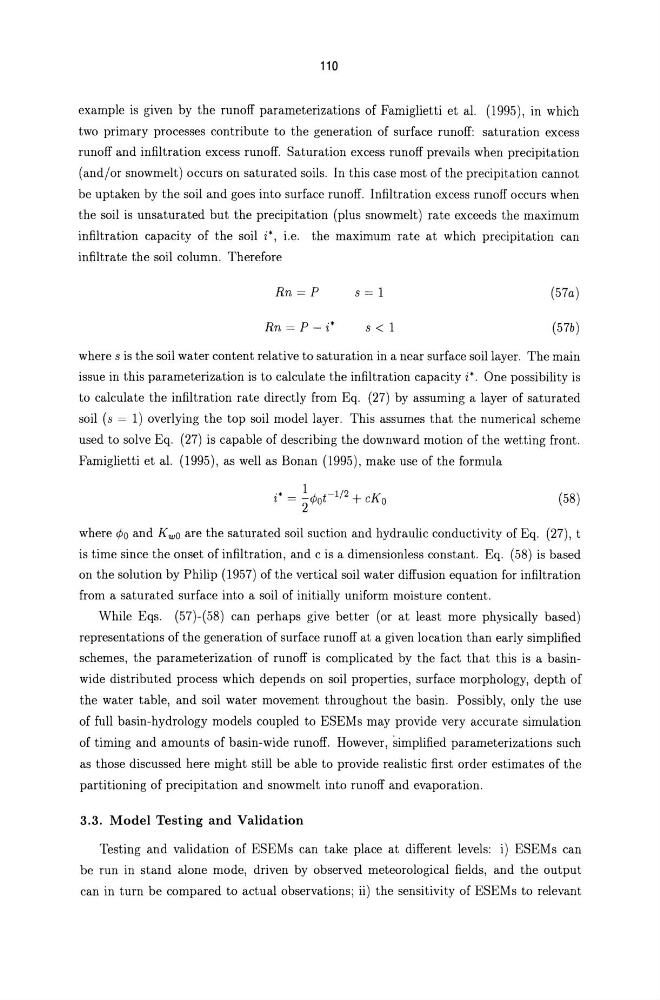
example is given by the runoff parameterizations of Famiglietti et al. (1995), in which
two primary processes contribute to the generation of surface runoff: saturation excess
runoff and infiltration excess runoff. Saturation excess runoff prevails when precipitation
(and/or snowmelt) occurs on saturated soils. In this case most of the precipitation cannot
be uptaken by the soil and goes into surface runoff. Infiltration excess runoff occurs when
the soil is unsaturated but the precipitation (plus snowmelt) rate exceeds the maximum
infiltration capacity of the soil i*, i.e. the maximum rate at which precipitation can
infiltrate the soil column. Therefore
Rn = P
s = 1
(57a)
Rn = P - i*
s < 1
(57b)
where s is the soil water content relative to saturation in a near surface soil layer. The main
issue in this parameterization is to calculate the infiltration capacity i*. One possibility is
to calculate the infiltration rate directly from Eq. (27) by assuming a layer of saturated
soil (s = 1) overlying the top soil model layer. This assumes that the numerical scheme
used to solve Eq. (27) is capable of describing the downward motion of the wetting front.
Famiglietti et al. (1995), as well as Bonan (1995), make use of the formula
1
i* = -¢ot- 1 / 2 + cKo
2
(58)
where ¢o and Kwo are the saturated soil suction and hydraulic conductivity ofEq. (27), t
is time since the onset of infiltration, and c is a dimensionless constant. Eq. (58) is based
on the solution by Philip (1957) of the vertical soil water diffusion equation for infiltration
from a saturated surface into a soil of initially uniform moisture content.
While Eqs. (57)-(58) can perhaps give better (or at least more physically based)
representations of the generation of surface runoff at a given location than early simplified
schemes, the parameterization of runoff is complicated by the fact that this is a basinwide distributed process which depends on soil properties, surface morphology, depth of
the water table, and soil water movement throughout the basin. Possibly, only the use
of full basin-hydrology models coupled to ESEMs may provide very accurate simulation
of timing and amounts of basin-wide runoff. However, simplified parameterizations such
as those discussed here might still be able to provide realistic first order estimates of the
partitioning of precipitation and snowmelt into runoff and evaporation.
3.3. Model Testing and Validation
Testing and validation of ESEMs can take place at different levels: i) ESEMs can
be run in stand alone mode, driven by observed meteorological fields, and the output
can in turn be compared to actual observations; ii) the sensitivity of ESEMs to relevant
example is given by the runoff parameterizations of Famiglietti et al. (1995), in which
two primary processes contribute to the generation of surface runoff: saturation excess
runoff and infiltration excess runoff. Saturation excess runoff prevails when precipitation
(and/or snowmelt) occurs on saturated soils. In this case most of the precipitation cannot
be uptaken by the soil and goes into surface runoff. Infiltration excess runoff occurs when
the soil is unsaturated but the precipitation (plus snowmelt) rate exceeds the maximum
infiltration capacity of the soil i*, i.e. the maximum rate at which precipitation can
infiltrate the soil column. Therefore
Rn = P
s = 1
(57a)
Rn = P - i*
s < 1
(57b)
where s is the soil water content relative to saturation in a near surface soil layer. The main
issue in this parameterization is to calculate the infiltration capacity i*. One possibility is
to calculate the infiltration rate directly from Eq. (27) by assuming a layer of saturated
soil (s = 1) overlying the top soil model layer. This assumes that the numerical scheme
used to solve Eq. (27) is capable of describing the downward motion of the wetting front.
Famiglietti et al. (1995), as well as Bonan (1995), make use of the formula
1
i* = -¢ot- 1 / 2 + cKo
2
(58)
where ¢o and Kwo are the saturated soil suction and hydraulic conductivity ofEq. (27), t
is time since the onset of infiltration, and c is a dimensionless constant. Eq. (58) is based
on the solution by Philip (1957) of the vertical soil water diffusion equation for infiltration
from a saturated surface into a soil of initially uniform moisture content.
While Eqs. (57)-(58) can perhaps give better (or at least more physically based)
representations of the generation of surface runoff at a given location than early simplified
schemes, the parameterization of runoff is complicated by the fact that this is a basinwide distributed process which depends on soil properties, surface morphology, depth of
the water table, and soil water movement throughout the basin. Possibly, only the use
of full basin-hydrology models coupled to ESEMs may provide very accurate simulation
of timing and amounts of basin-wide runoff. However, simplified parameterizations such
as those discussed here might still be able to provide realistic first order estimates of the
partitioning of precipitation and snowmelt into runoff and evaporation.
3.3. Model Testing and Validation
Testing and validation of ESEMs can take place at different levels: i) ESEMs can
be run in stand alone mode, driven by observed meteorological fields, and the output
can in turn be compared to actual observations; ii) the sensitivity of ESEMs to relevant