

112
Perhaps the primary framework today available for ESEM validation is the Project
for Intercomparison of Land Process Schemes, or PILPS (Pitman et al. 1993). The main
purpose of this project is to intercompare present ESEMs under controlled conditions
with the goal of i) quantify model differences; ii) determine the importance of these
differences for various applications; iii) understand the causes of the differences in terms of
theoretical basis for the parameterizations, numerical implementation and coding thereof,
and choice of parameters and parameter values. The project has so far been organized
in two phases, both of which entail running the ESEMs in stand alone mode driven by
specified dimatic forcings. In the first phase, the climatic forcing is obtained from output
of a GCM simulation for three surface types, tropical rainforest, midlatitude grassland
and high latitude tundra. In the second phase, observed data are used for model forcing
and validation. Two datasets are presently being used, one for a grassland site located
in Cabauw, The Nederlands, and one for a site of soya crop in the HAPEX-MOBILHY
experiment (Andre et al. 1986). Care is taken so that the parameter setting is done as
to keep as much consistency as possible between different models.
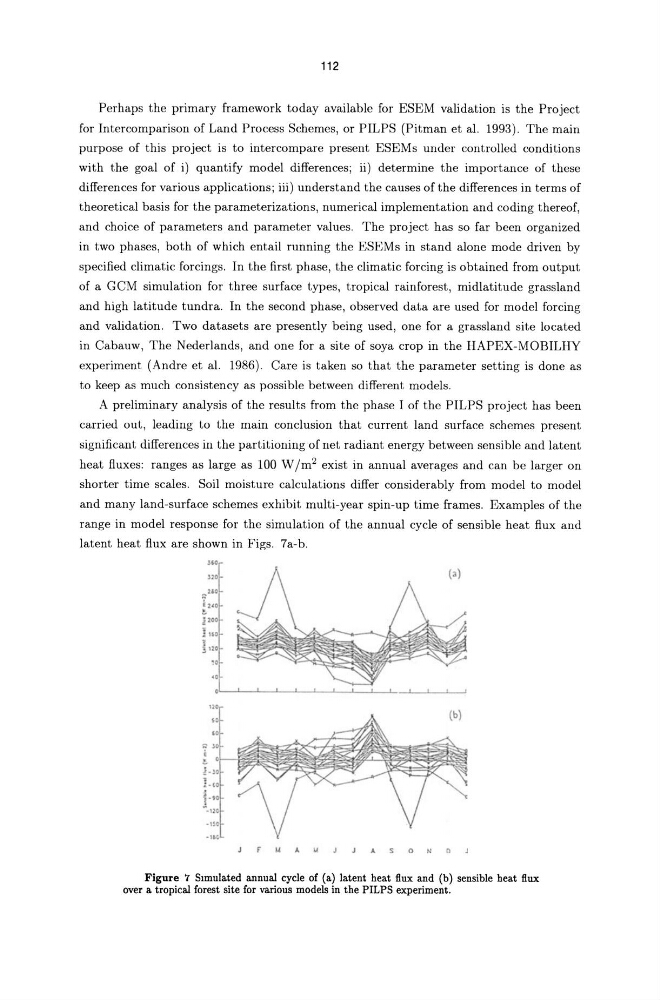
A preliminary analysis of the results from the phase I of the PILPS project has been
carried out, leading to the main conclusion that current land surface schemes present
significant differences in the partitioning of net radiant energy between sensible and latent
heat fluxes: ranges as large as 100 W 1m 2 exist in annual averages and can be larger on
shorter t ime scales. Soil moisture calculations differ considerably from model to model
and many land-surface schemes exhibit multi-year spin-up time frames. Examples of the
range in model response for the simulation of the annual cycle of sensible heat flux and
latent heat flux are shown in Figs. 7a-b.
>'.
, .
..
" . . "
o N
Figure'" SImulated annual cycle of (a) latent heat flux and (b) sensible heat flux
over a tropical forest site for various models in the PILPS experiment.
Perhaps the primary framework today available for ESEM validation is the Project
for Intercomparison of Land Process Schemes, or PILPS (Pitman et al. 1993). The main
purpose of this project is to intercompare present ESEMs under controlled conditions
with the goal of i) quantify model differences; ii) determine the importance of these
differences for various applications; iii) understand the causes of the differences in terms of
theoretical basis for the parameterizations, numerical implementation and coding thereof,
and choice of parameters and parameter values. The project has so far been organized
in two phases, both of which entail running the ESEMs in stand alone mode driven by
specified dimatic forcings. In the first phase, the climatic forcing is obtained from output
of a GCM simulation for three surface types, tropical rainforest, midlatitude grassland
and high latitude tundra. In the second phase, observed data are used for model forcing
and validation. Two datasets are presently being used, one for a grassland site located
in Cabauw, The Nederlands, and one for a site of soya crop in the HAPEX-MOBILHY
experiment (Andre et al. 1986). Care is taken so that the parameter setting is done as
to keep as much consistency as possible between different models.
A preliminary analysis of the results from the phase I of the PILPS project has been
carried out, leading to the main conclusion that current land surface schemes present
significant differences in the partitioning of net radiant energy between sensible and latent
heat fluxes: ranges as large as 100 W 1m 2 exist in annual averages and can be larger on
shorter t ime scales. Soil moisture calculations differ considerably from model to model
and many land-surface schemes exhibit multi-year spin-up time frames. Examples of the
range in model response for the simulation of the annual cycle of sensible heat flux and
latent heat flux are shown in Figs. 7a-b.
>'.
, .
..
" . . "
o N
Figure'" SImulated annual cycle of (a) latent heat flux and (b) sensible heat flux
over a tropical forest site for various models in the PILPS experiment.