

107
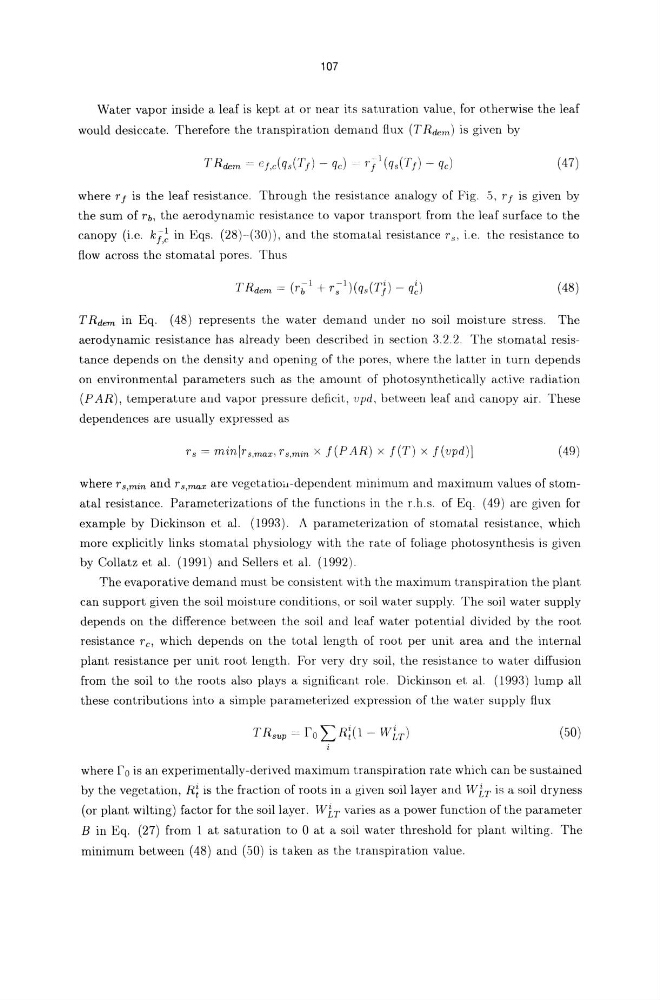
Water vapor inside a leaf is kept at or near its saturation value, for otherwise the leaf
would desiccate. Therefore the transpiration demand flux (T R dem ) is given by
(47)
where r f is the leaf resistance. Through the resistance analogy of Fig. 5, r f is given by
the sum of rb, the aerodynamic resistance to vapor transport from the leaf surface to the
canopy (i.e. ki.~ in Eqs. (28)-(30)), and the stomatal resistance r" i.e. the resistance to
flow across the stomatal pores. Thus
(48)
T Rdem in Eq. (48) represents the water demand under no soil moisture stress. The
aerodynamic resistance has already been described in section 3.2.2. The stomatal resistance depends on the density and opening of the pores, where the latter in turn depends
on environmental parameters such as the amount of photosynthetically active radiation
(P AR), temperature and vapor pressure deficit, vpd, between leaf and canopy air. These
dependences are usually expressed as
Ts = min[rs,max, Ts,min X [(P AR) x [(T) x [(vpd)]
(49)
where rs,min and rs,max are vegetatioil-dependent minimum and maximum values of stomatal resistance. Parameterizations of the fnnctions in the r.h.s. of Eq. (49) are given for
example by Dickinson et a1. (1993). A parameterization of stomatal resistance, which
more explicitly links stomatal physiology with the rate of foliage photosynthesis is given
by Collatz et a1. (1991) and Sellers et a1. (1992).
The evaporative demand must be consistent with the maximum transpiration the plant
can support given the soil moisture conditions, or soil water supply. The soil water supply
depends on the difference between the soil and leaf water potential divided by the root
resistance re , which depends on the total length of root per unit area and the internal
plant resistance per unit root length. For very dry soil, the resistance to water diffusion
from the soil to the roots also plays a significant role. Dickinson et a1. (1993) lump all
these contributions into a simple parameterized expression of the water supply flux
(50)
where ro is an experimentally-derived maximum transpiration rate which can be sustained
by the vegetation, R: is the fraction of roots in a given soil layer and WIT is a soil dryness
(or plant wilting) factor for the soil layer . WiT varies as a power function of the parameter
B in Eq. (27) from 1 at saturation to 0 at a soil water threshold for plant wilting. The
minimum between (48) and (50) is taken as the transpiration value.
Water vapor inside a leaf is kept at or near its saturation value, for otherwise the leaf
would desiccate. Therefore the transpiration demand flux (T R dem ) is given by
(47)
where r f is the leaf resistance. Through the resistance analogy of Fig. 5, r f is given by
the sum of rb, the aerodynamic resistance to vapor transport from the leaf surface to the
canopy (i.e. ki.~ in Eqs. (28)-(30)), and the stomatal resistance r" i.e. the resistance to
flow across the stomatal pores. Thus
(48)
T Rdem in Eq. (48) represents the water demand under no soil moisture stress. The
aerodynamic resistance has already been described in section 3.2.2. The stomatal resistance depends on the density and opening of the pores, where the latter in turn depends
on environmental parameters such as the amount of photosynthetically active radiation
(P AR), temperature and vapor pressure deficit, vpd, between leaf and canopy air. These
dependences are usually expressed as
Ts = min[rs,max, Ts,min X [(P AR) x [(T) x [(vpd)]
(49)
where rs,min and rs,max are vegetatioil-dependent minimum and maximum values of stomatal resistance. Parameterizations of the fnnctions in the r.h.s. of Eq. (49) are given for
example by Dickinson et a1. (1993). A parameterization of stomatal resistance, which
more explicitly links stomatal physiology with the rate of foliage photosynthesis is given
by Collatz et a1. (1991) and Sellers et a1. (1992).
The evaporative demand must be consistent with the maximum transpiration the plant
can support given the soil moisture conditions, or soil water supply. The soil water supply
depends on the difference between the soil and leaf water potential divided by the root
resistance re , which depends on the total length of root per unit area and the internal
plant resistance per unit root length. For very dry soil, the resistance to water diffusion
from the soil to the roots also plays a significant role. Dickinson et a1. (1993) lump all
these contributions into a simple parameterized expression of the water supply flux
(50)
where ro is an experimentally-derived maximum transpiration rate which can be sustained
by the vegetation, R: is the fraction of roots in a given soil layer and WIT is a soil dryness
(or plant wilting) factor for the soil layer . WiT varies as a power function of the parameter
B in Eq. (27) from 1 at saturation to 0 at a soil water threshold for plant wilting. The
minimum between (48) and (50) is taken as the transpiration value.