

106
Therefore, as we already mentioned, most often the vegetation is treated as one bulk
layer and the system (28)-(35) reduces to three coupled equations in three unknowns.
An important term in Eq. (28), which we have not yet examined, is the foliage
evaporative flux e j,c( qs(1J} - qc}. This is the sum of two contributions, transpiration from
dry foliage surfaces and evaporation of intercepted water. These two contributions are
separately treated in the next sub-sections.
3.2 .2 .1. Transpiration
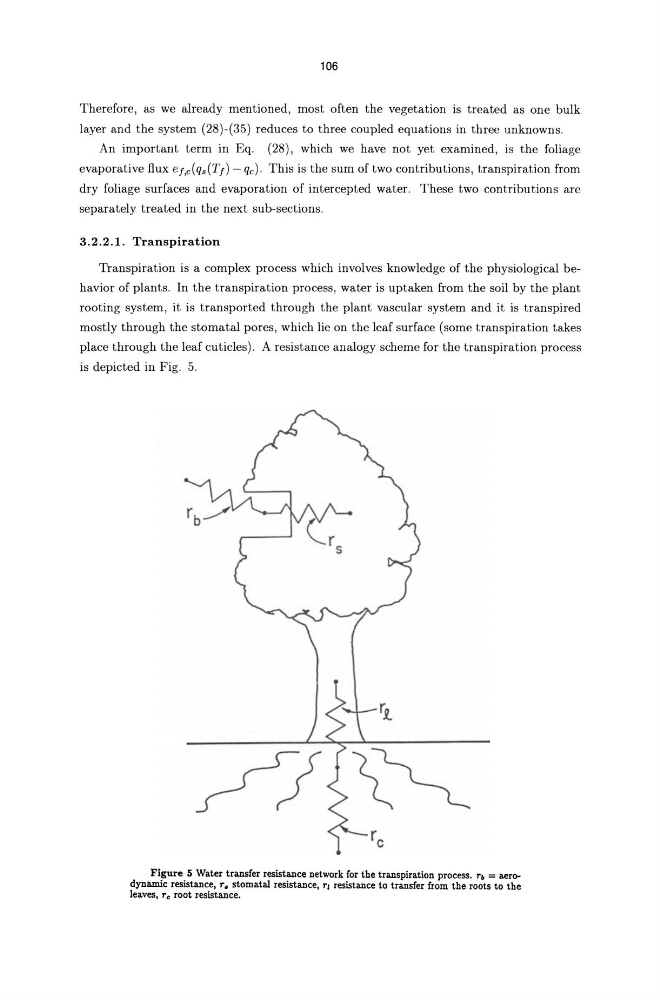
Transpiration is a complex process which involves knowledge of the physiological behavior of plants. In the transpiration process, water is uptaken from the soil by the plant
rooting system, it is transported through the plant vascular system and it is transpired
mostly through the stomatal pores, which lie on the leaf surface (some t ranspiration takes
place through the leaf cuticles). A resistance analogy scheme for the transpiration process
is depicted in Fig. 5.
Figure 5 Water transfer resistance network for the transpiration process. rb = aerodynamic resistance, r. stomatal resistance, r, resistance to transfer from the roots to the
leaves, r c root resistance.
Therefore, as we already mentioned, most often the vegetation is treated as one bulk
layer and the system (28)-(35) reduces to three coupled equations in three unknowns.
An important term in Eq. (28), which we have not yet examined, is the foliage
evaporative flux e j,c( qs(1J} - qc}. This is the sum of two contributions, transpiration from
dry foliage surfaces and evaporation of intercepted water. These two contributions are
separately treated in the next sub-sections.
3.2 .2 .1. Transpiration
Transpiration is a complex process which involves knowledge of the physiological behavior of plants. In the transpiration process, water is uptaken from the soil by the plant
rooting system, it is transported through the plant vascular system and it is transpired
mostly through the stomatal pores, which lie on the leaf surface (some t ranspiration takes
place through the leaf cuticles). A resistance analogy scheme for the transpiration process
is depicted in Fig. 5.
Figure 5 Water transfer resistance network for the transpiration process. rb = aerodynamic resistance, r. stomatal resistance, r, resistance to transfer from the roots to the
leaves, r c root resistance.