

95
terms of the vertical gradient of average quantities, i.e.
-
a7fi
w'' = -keaz
(13)
where ke is a vertical eddy diffusivity analogous to the molecular diffusivity in Fick's law.
Eq. (13) is usually referred to as a "first order closure" to turbulent flux representation,
whereby the turbulent fluxes are expressed in terms of grid-averaged values. Explicit
equations have also been developed for the turbulent fluxes in "second order closure"
models (e.g Mellor and Yamada 1982).
Regardless of how the vertical eddy transfer is treated in the PBL, the vertical discretization of the term Fv requires specification of the turbulent fluxes of momentum, sensible heat, water vapor and eventually other chemical species at the surface/atmosphere
interface as lower boundary condition. These fluxes are provided by the ESEM. A further,
indirect, way in which the ESEM affects the term Fv is that in many PBL parameterizations the structure of the boundary layer itself depends on the buoyancy produced by
the surface sensible heat flux.
The formal treatment of surface fluxes in climate models is mostly based on similarity
theory and makes use of dimensional analysis to express the fluxes in terms of dimensionless quantities. Dimensionless functional relationships between different quantities are
then basically derived from observations. We do not enter here in the details of similarity
theory as applied to PBL and surface flux modeling, which can be found, for example,
in the excellent text of Brutsaert (1978). As a result of similarity theory, in AMs it is
customary to express the surface stress (or momentum flux) for the u and v components
of the wind (TO,u and TO,v, respectively) as
Tu,O = -pw'u' = pCdVaUa
Tv,O = -pw'v' = pCdVaVa
(14)
(15)
In Eqs. (14)-(15) the subscript a indicates quantities calculated at a reference atmospheric
level, which usually lies a few tens of meters above the surface (i.e. in the surface layer),
Va is the wind speed at this level (equal to (u~ + v~)1/2) and Cd is referred to as surface
drag coefficient, which is a measure of the roughness of the surface. The higher the drag
coefficient, the greater the surface stress. Similarly, the higher the wind speed near the
surface, the greater the stress, since by the no-slip condition thc wind vanishes at the
surface.
The drag coefficient Cd is the product of two components, the neutral drag coefficient
CdO and a stability correction function f(Ri B ). CdO measures the mechanical roughness
of the surface in neutral conditions and, from similarity considerations, can be expressed
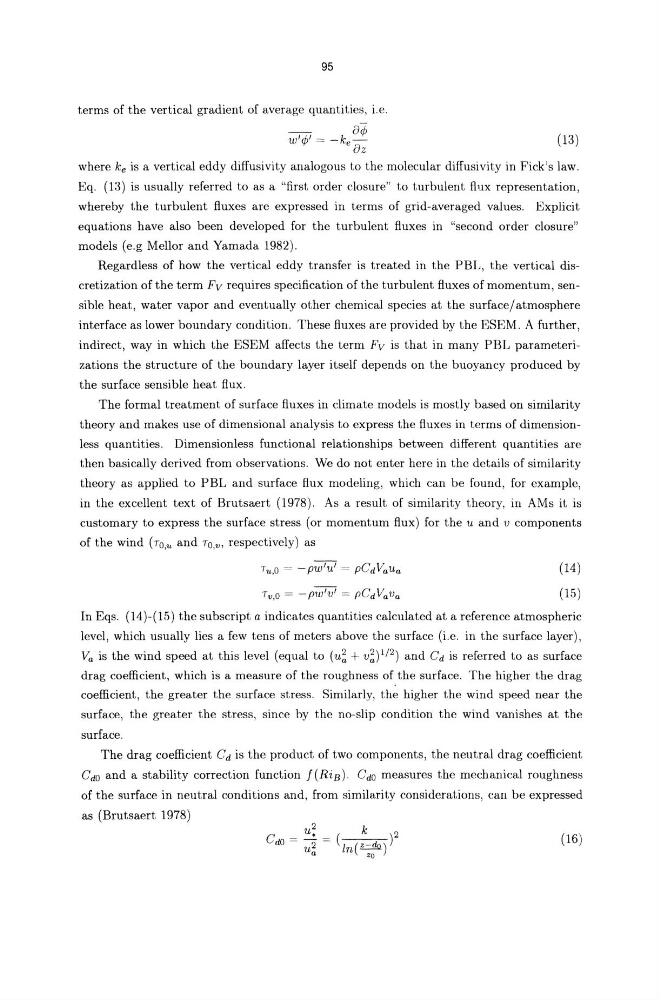
as (Brutsaert 1978)
(16)
terms of the vertical gradient of average quantities, i.e.
-
a7fi
w'' = -keaz
(13)
where ke is a vertical eddy diffusivity analogous to the molecular diffusivity in Fick's law.
Eq. (13) is usually referred to as a "first order closure" to turbulent flux representation,
whereby the turbulent fluxes are expressed in terms of grid-averaged values. Explicit
equations have also been developed for the turbulent fluxes in "second order closure"
models (e.g Mellor and Yamada 1982).
Regardless of how the vertical eddy transfer is treated in the PBL, the vertical discretization of the term Fv requires specification of the turbulent fluxes of momentum, sensible heat, water vapor and eventually other chemical species at the surface/atmosphere
interface as lower boundary condition. These fluxes are provided by the ESEM. A further,
indirect, way in which the ESEM affects the term Fv is that in many PBL parameterizations the structure of the boundary layer itself depends on the buoyancy produced by
the surface sensible heat flux.
The formal treatment of surface fluxes in climate models is mostly based on similarity
theory and makes use of dimensional analysis to express the fluxes in terms of dimensionless quantities. Dimensionless functional relationships between different quantities are
then basically derived from observations. We do not enter here in the details of similarity
theory as applied to PBL and surface flux modeling, which can be found, for example,
in the excellent text of Brutsaert (1978). As a result of similarity theory, in AMs it is
customary to express the surface stress (or momentum flux) for the u and v components
of the wind (TO,u and TO,v, respectively) as
Tu,O = -pw'u' = pCdVaUa
Tv,O = -pw'v' = pCdVaVa
(14)
(15)
In Eqs. (14)-(15) the subscript a indicates quantities calculated at a reference atmospheric
level, which usually lies a few tens of meters above the surface (i.e. in the surface layer),
Va is the wind speed at this level (equal to (u~ + v~)1/2) and Cd is referred to as surface
drag coefficient, which is a measure of the roughness of the surface. The higher the drag
coefficient, the greater the surface stress. Similarly, the higher the wind speed near the
surface, the greater the stress, since by the no-slip condition thc wind vanishes at the
surface.
The drag coefficient Cd is the product of two components, the neutral drag coefficient
CdO and a stability correction function f(Ri B ). CdO measures the mechanical roughness
of the surface in neutral conditions and, from similarity considerations, can be expressed
as (Brutsaert 1978)
(16)