

96
where k is an empirical constant (Von Karman constant approximately equal to 004) , u.
(the friction velocity equal to _W'U ' )! = (Tal p) ~) is a measure of the surface stress and do
and Zo are two empirical integration constants, the displacement height and the roughness
length , calculated from observations of vertical wind profiles in neutral boundary layers.
In particular, Zo measures the roughness of the surface and varies from less than 1 mm for
smooth surfaces (e.g. water) and about 1 cm for bare soil to 1-2 m for forested surfaces
(Brutsaert 1978).
Under non-neu tral condi tions, thermal stability plays an important role in determining
the vertical fluxes. Stable stratification tends to inhibit vertical eddy transport while
the buoyancy associated with thermally unstable conditions enhances the transport. A
common way to account for the effects of vertical stability is to multiply the neutral drag
coefficient by a correction function expressed in terms of the non-dimensional surface
Richardson number Ri B
(17)
where Za and Ta are the height and temperature at the reference atmospheric level, respectively. The Richardson number essentially measures the ratio of turbulent energy
production by buoyancy and mechanical processes. It is positive (negative) under stable
(unstable) conditions. The empirical correction function J(RiB) is greater than 1 and
increases with the magnitude of RiB in unstable conditions, while it is lower than 1 and
decreases with RiB in stable conditions. Several different formulations of J (RiB) have
been obtained from various field experiments (e.g. Businger et al. 1971 ; Louis 1979,
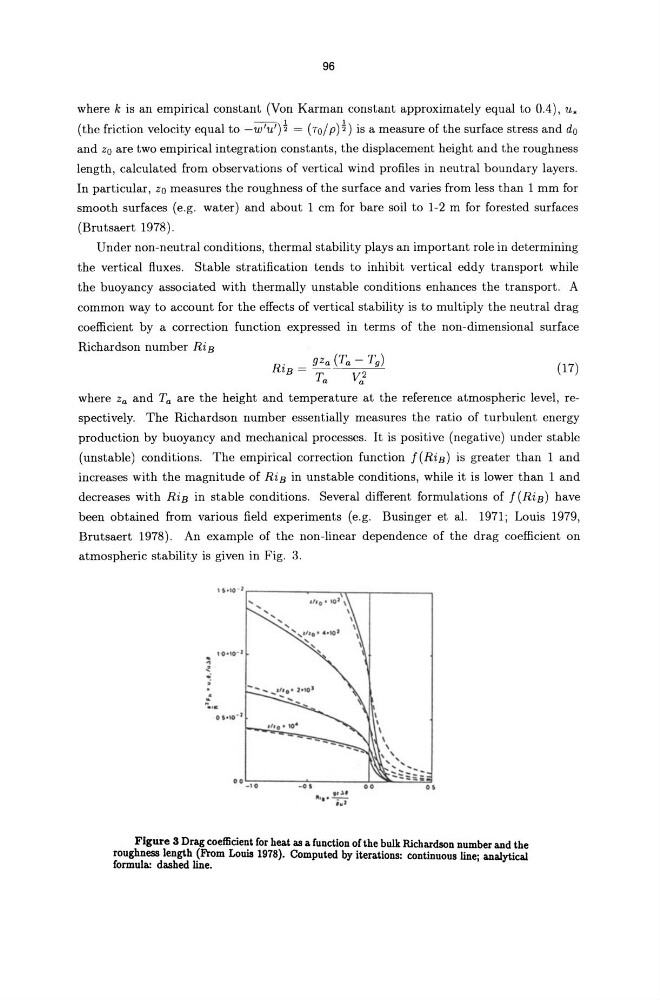
Brutsaert 1978). An example of the non-linear dependence of the drag coefficient on
atmospheric stability is given in Fig. 3.
, ... . lot
. '.- -=-'v'
Figure 3 Drag coefficient for heat as a function of the bulk Richardson number and the
roughness length (From Louis 1978). Computed by iterations: continuous line; analytical
formula: dashed line.
where k is an empirical constant (Von Karman constant approximately equal to 004) , u.
(the friction velocity equal to _W'U ' )! = (Tal p) ~) is a measure of the surface stress and do
and Zo are two empirical integration constants, the displacement height and the roughness
length , calculated from observations of vertical wind profiles in neutral boundary layers.
In particular, Zo measures the roughness of the surface and varies from less than 1 mm for
smooth surfaces (e.g. water) and about 1 cm for bare soil to 1-2 m for forested surfaces
(Brutsaert 1978).
Under non-neu tral condi tions, thermal stability plays an important role in determining
the vertical fluxes. Stable stratification tends to inhibit vertical eddy transport while
the buoyancy associated with thermally unstable conditions enhances the transport. A
common way to account for the effects of vertical stability is to multiply the neutral drag
coefficient by a correction function expressed in terms of the non-dimensional surface
Richardson number Ri B
(17)
where Za and Ta are the height and temperature at the reference atmospheric level, respectively. The Richardson number essentially measures the ratio of turbulent energy
production by buoyancy and mechanical processes. It is positive (negative) under stable
(unstable) conditions. The empirical correction function J(RiB) is greater than 1 and
increases with the magnitude of RiB in unstable conditions, while it is lower than 1 and
decreases with RiB in stable conditions. Several different formulations of J (RiB) have
been obtained from various field experiments (e.g. Businger et al. 1971 ; Louis 1979,
Brutsaert 1978). An example of the non-linear dependence of the drag coefficient on
atmospheric stability is given in Fig. 3.
, ... . lot
. '.- -=-'v'
Figure 3 Drag coefficient for heat as a function of the bulk Richardson number and the
roughness length (From Louis 1978). Computed by iterations: continuous line; analytical
formula: dashed line.