

94
-,.."..- atmosphe r•
[,0' ,.,0']- - - - - -1 _ - - - rOuter rot, ion
Ot
dt-hcl ,u~I.,ot'
GO~
- - ! 0 - - - -
-
_ _ -1 ~Io!.... _ _
_
_ _
_
Inner rtolon
.t
G O. '0 IO~- _ _ _ _ _ _ _ _ ~rfOCI I\I\loyer
Dynamic su'-Ioytr
tl.t.,ilhmlc ,fof i lu)
1 f\.J I ~~~l: l:::i:::;' ::;;!:;,;:~
, ~
S",O.,. I 81uII - ,.ut" I P""".bl. - t.u,"
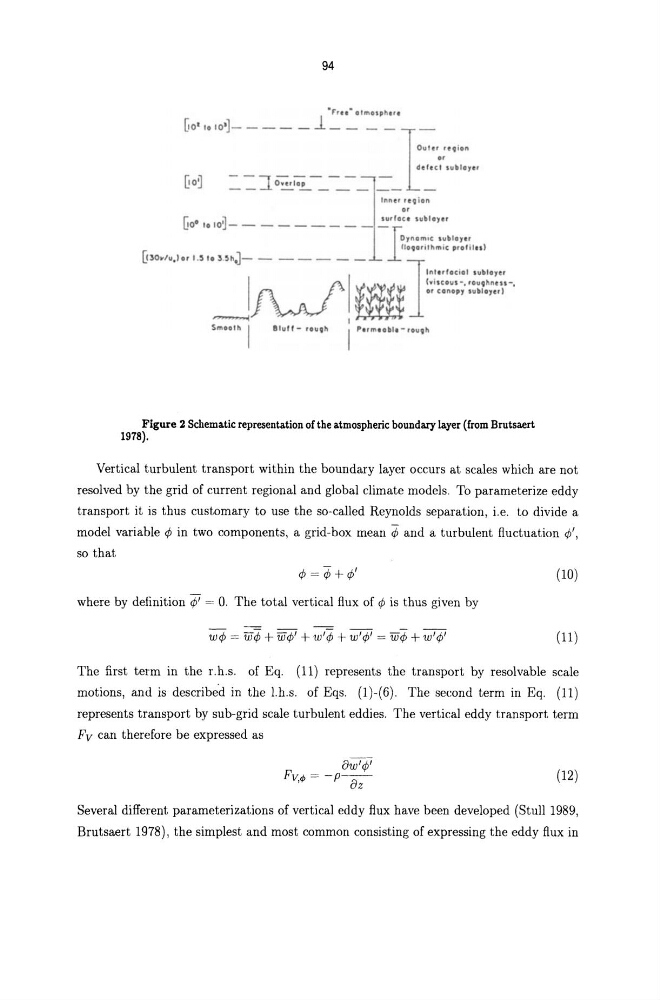
Figure 2 Schema.tic representa.tion of the atmospheric boundary layer (from Brutsaert
1978).
Vertical turbulent transport within the boundary layer occurs at scales which are not
resolved by the grid of current regional and global climate models. To parameterize eddy
transport it is thus customary to use the so-called Reynolds separation, i. e. to divide a
model variable ¢; in two components, a grid-box mean ¢, and a turbulent fluctuation ¢;',
so that
¢; = ¢, + r/J'
(10)
where by definition -;p = o. The total vertical flux of ¢; is thus given by
(11)
The first term in the r.h.s. of Eq. (11) represents the transport by resolvable scale
motions, and is describe· d in the l.h.s. of Eqs. (1)-(6). The second term in Eq. (11 )
represents transport by sub-grid scale turbulent eddies. The vertical eddy transport term
Fv can therefore be expressed as
8w'¢;'
Fvrp = - p - -
,
8z
(12)
Several different parameterizations of vertical eddy flux have been developed (Stull 1989,
Brutsaert 1978), the simplest and most common consisting of expressing the eddy flux in
-,.."..- atmosphe r•
[,0' ,.,0']- - - - - -1 _ - - - rOuter rot, ion
Ot
dt-hcl ,u~I.,ot'
GO~
- - ! 0 - - - -
-
_ _ -1 ~Io!.... _ _
_
_ _
_
Inner rtolon
.t
G O. '0 IO~- _ _ _ _ _ _ _ _ ~rfOCI I\I\loyer
Dynamic su'-Ioytr
tl.t.,ilhmlc ,fof i lu)
1 f\.J I ~~~l: l:::i:::;' ::;;!:;,;:~
, ~
S",O.,. I 81uII - ,.ut" I P""".bl. - t.u,"
Figure 2 Schema.tic representa.tion of the atmospheric boundary layer (from Brutsaert
1978).
Vertical turbulent transport within the boundary layer occurs at scales which are not
resolved by the grid of current regional and global climate models. To parameterize eddy
transport it is thus customary to use the so-called Reynolds separation, i. e. to divide a
model variable ¢; in two components, a grid-box mean ¢, and a turbulent fluctuation ¢;',
so that
¢; = ¢, + r/J'
(10)
where by definition -;p = o. The total vertical flux of ¢; is thus given by
(11)
The first term in the r.h.s. of Eq. (11) represents the transport by resolvable scale
motions, and is describe· d in the l.h.s. of Eqs. (1)-(6). The second term in Eq. (11 )
represents transport by sub-grid scale turbulent eddies. The vertical eddy transport term
Fv can therefore be expressed as
8w'¢;'
Fvrp = - p - -
,
8z
(12)
Several different parameterizations of vertical eddy flux have been developed (Stull 1989,
Brutsaert 1978), the simplest and most common consisting of expressing the eddy flux in