

Like human globin genes, the findings suggested that carp globin genes form
multigene families. In mammals, a-globins and b-globins are encoded in different
chromosomes; in the case of humans, the a-globin family is located on chromosome 14 and the b-globin family on chromosome 11.
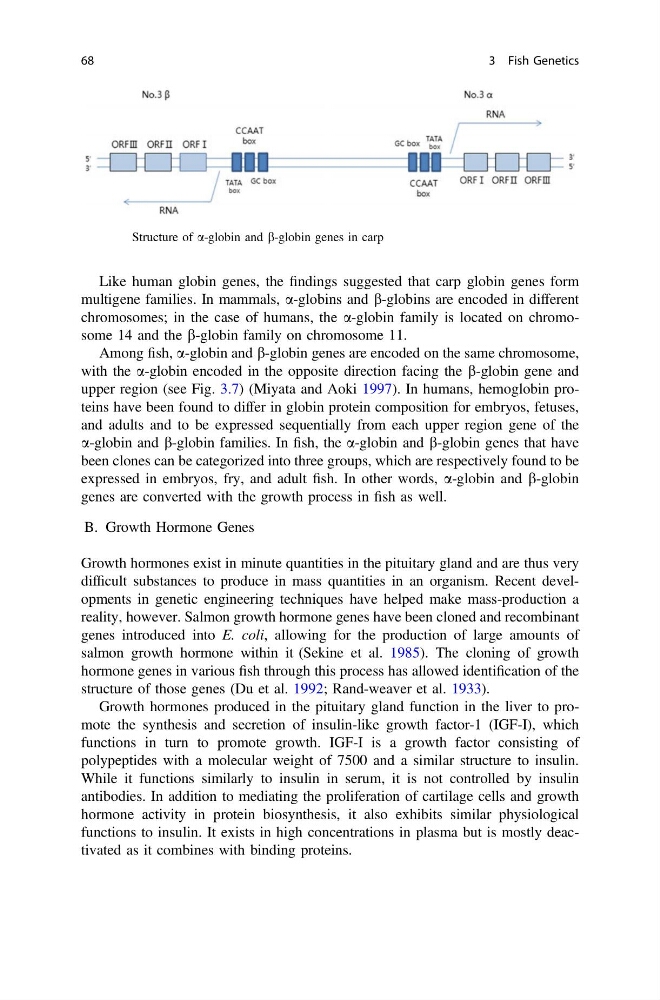
Among fish, a-globin and b-globin genes are encoded on the same chromosome,
with the a-globin encoded in the opposite direction facing the b-globin gene and
upper region (see Fig. 3.7) (Miyata and Aoki 1997). In humans, hemoglobin proteins have been found to differ in globin protein composition for embryos, fetuses,
and adults and to be expressed sequentially from each upper region gene of the
a-globin and b-globin families. In fish, the a-globin and b-globin genes that have
been clones can be categorized into three groups, which are respectively found to be
expressed in embryos, fry, and adult fish. In other words, a-globin and b-globin
genes are converted with the growth process in fish as well.
B. Growth Hormone Genes
Growth hormones exist in minute quantities in the pituitary gland and are thus very
difficult substances to produce in mass quantities in an organism. Recent developments in genetic engineering techniques have helped make mass-production a
reality, however. Salmon growth hormone genes have been cloned and recombinant
genes introduced into E. coli, allowing for the production of large amounts of
salmon growth hormone within it (Sekine et al. 1985). The cloning of growth
hormone genes in various fish through this process has allowed identification of the
structure of those genes (Du et al. 1992; Rand-weaver et al. 1933).
Growth hormones produced in the pituitary gland function in the liver to promote the synthesis and secretion of insulin-like growth factor-1 (IGF-I), which
functions in turn to promote growth. IGF-I is a growth factor consisting of
polypeptides with a molecular weight of 7500 and a similar structure to insulin.
While it functions similarly to insulin in serum, it is not controlled by insulin
antibodies. In addition to mediating the proliferation of cartilage cells and growth
hormone activity in protein biosynthesis, it also exhibits similar physiological
functions to insulin. It exists in high concentrations in plasma but is mostly deactivated as it combines with binding proteins.
Fig. 3.7 Structure of a-globin and b-globin genes in carp
68
3 Fish Genetics
multigene families. In mammals, a-globins and b-globins are encoded in different
chromosomes; in the case of humans, the a-globin family is located on chromosome 14 and the b-globin family on chromosome 11.
Among fish, a-globin and b-globin genes are encoded on the same chromosome,
with the a-globin encoded in the opposite direction facing the b-globin gene and
upper region (see Fig. 3.7) (Miyata and Aoki 1997). In humans, hemoglobin proteins have been found to differ in globin protein composition for embryos, fetuses,
and adults and to be expressed sequentially from each upper region gene of the
a-globin and b-globin families. In fish, the a-globin and b-globin genes that have
been clones can be categorized into three groups, which are respectively found to be
expressed in embryos, fry, and adult fish. In other words, a-globin and b-globin
genes are converted with the growth process in fish as well.
B. Growth Hormone Genes
Growth hormones exist in minute quantities in the pituitary gland and are thus very
difficult substances to produce in mass quantities in an organism. Recent developments in genetic engineering techniques have helped make mass-production a
reality, however. Salmon growth hormone genes have been cloned and recombinant
genes introduced into E. coli, allowing for the production of large amounts of
salmon growth hormone within it (Sekine et al. 1985). The cloning of growth
hormone genes in various fish through this process has allowed identification of the
structure of those genes (Du et al. 1992; Rand-weaver et al. 1933).
Growth hormones produced in the pituitary gland function in the liver to promote the synthesis and secretion of insulin-like growth factor-1 (IGF-I), which
functions in turn to promote growth. IGF-I is a growth factor consisting of
polypeptides with a molecular weight of 7500 and a similar structure to insulin.
While it functions similarly to insulin in serum, it is not controlled by insulin
antibodies. In addition to mediating the proliferation of cartilage cells and growth
hormone activity in protein biosynthesis, it also exhibits similar physiological
functions to insulin. It exists in high concentrations in plasma but is mostly deactivated as it combines with binding proteins.
Fig. 3.7 Structure of a-globin and b-globin genes in carp
68
3 Fish Genetics