

In salmonidae fish, growth hormones function not only in the liver but also in the
gills, performing a role in adjusting osmotic pressure to increase seawater adaptability.
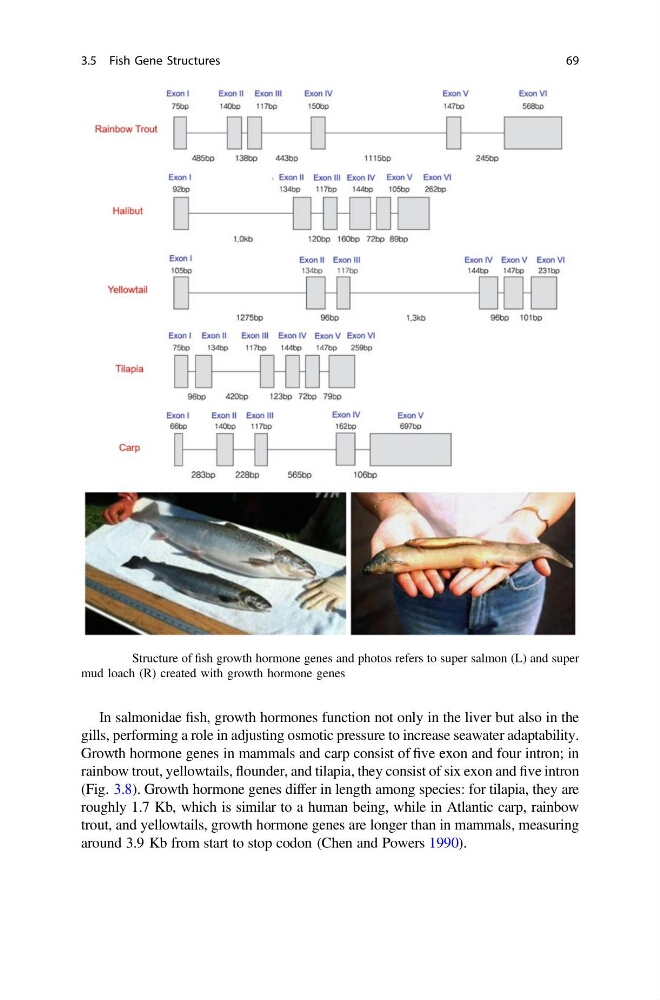
Growth hormone genes in mammals and carp consist of five exon and four intron; in
rainbow trout, yellowtails, flounder, and tilapia, they consist of six exon and five intron
(Fig. 3.8). Growth hormone genes differ in length among species: for tilapia, they are
roughly 1.7 Kb, which is similar to a human being, while in Atlantic carp, rainbow
trout, and yellowtails, growth hormone genes are longer than in mammals, measuring
around 3.9 Kb from start to stop codon (Chen and Powers 1990).
Fig. 3.8 Structure of fish growth hormone genes and photos refers to super salmon (L) and super
mud loach (R) created with growth hormone genes
3.5 Fish Gene Structures
69
gills, performing a role in adjusting osmotic pressure to increase seawater adaptability.
Growth hormone genes in mammals and carp consist of five exon and four intron; in
rainbow trout, yellowtails, flounder, and tilapia, they consist of six exon and five intron
(Fig. 3.8). Growth hormone genes differ in length among species: for tilapia, they are
roughly 1.7 Kb, which is similar to a human being, while in Atlantic carp, rainbow
trout, and yellowtails, growth hormone genes are longer than in mammals, measuring
around 3.9 Kb from start to stop codon (Chen and Powers 1990).
Fig. 3.8 Structure of fish growth hormone genes and photos refers to super salmon (L) and super
mud loach (R) created with growth hormone genes
3.5 Fish Gene Structures
69