

Methods studied in E. coli, Bacillus subtilis, and yeast can be applied in genetic
recombination for marine microorganisms. For example, plasmids isolated from
marine photosynthetic bacteria can be used as vectors for the cloning of fish growth
hormone genes, enabling their mass production.
The placement of marine bacteria responsible for plant hormones on the surface
of seaweed has been reported not only to influence growth and differentiation, but
also to help recover heavy metals and produce ultrafine magnetite particles. Magnetotactic bacteria produce ultrafine magnetite particles covered in organic thin-film
within their bodies. Other microorganisms produce energy in seawater, including
methane-producing bacteria and hydrogen-producing photosynthetic bacteria.
Reports show that these microorganisms can be fixed in highly polymerized gel for
serial bioreactor production of methane and hydrogen (Tarman et al. 2013).
11.4 Development of Biocatalysts from Microorganisms
As biocatalysts, enzymes promote various biochemical reactions within cells,
helping to sustain life activities. Enzymes exhibit strong activity under normal
temperature and pressure and neutral pH conditions and are highly
substrate-specific. These characteristics are strong advantageous in the use of
enzymes as catalyzing elements in industrial bioprocesses. Since low-purity substrates can be used in enzyme reactions without need for any special pressurizing or
heating equipment, costs can be saved in terms of reaction devices, operation
energy, and reaction resources (Böttcher et al. 2004).
Long before they were ever identified, human beings had used enzymes (or
enzyme-producing micoorganisms) for casting and the making of bread and cheese.
The range and amount of uses has expanded markedly as biotechnology has
advanced in recent years. An enzyme market established in the U.S. grew in scale
from roughly US$400,000 in 1997 to US$100 million by 2011, and the uses of
enzymes have expanded in research, pharmaceuticals, test reagents, food processing, starch processing, sugar manufacturing, detergents, fibers, paper making,
brewing, and the livestock and dairy industries (Zhao et al. 2002; Heux et al. 2015).
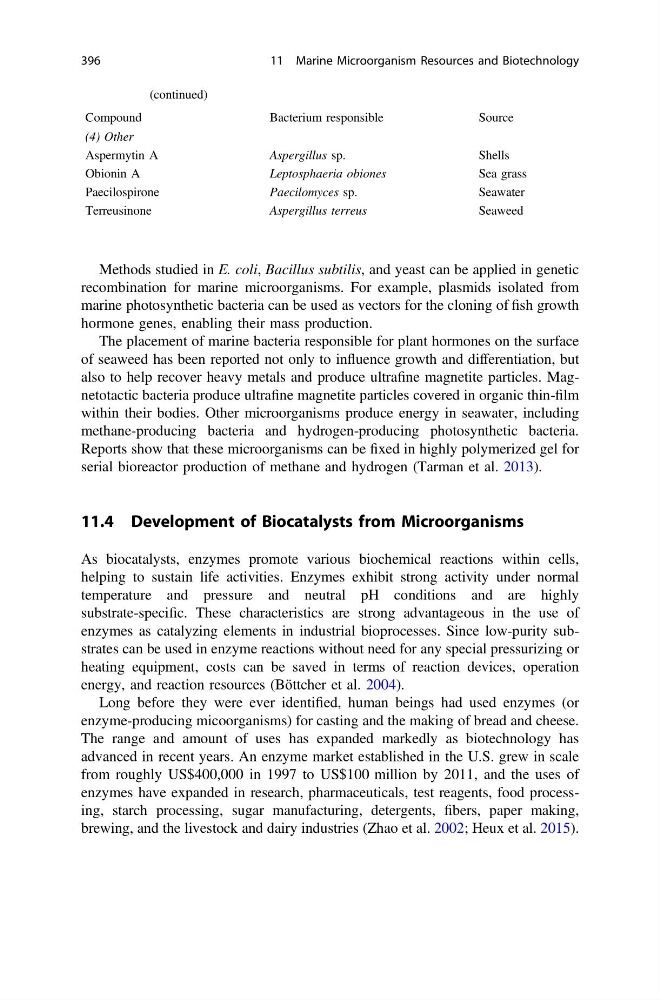
Table 11.9 (continued)
Compound
Bacterium responsible
Source
(4) Other
Aspermytin A
Aspergillus sp.
Shells
Obionin A
Leptosphaeria obiones
Sea grass
Paecilospirone
Paecilomyces sp.
Seawater
Terreusinone
Aspergillus terreus
Seaweed
396
11 Marine Microorganism Resources and Biotechnology
recombination for marine microorganisms. For example, plasmids isolated from
marine photosynthetic bacteria can be used as vectors for the cloning of fish growth
hormone genes, enabling their mass production.
The placement of marine bacteria responsible for plant hormones on the surface
of seaweed has been reported not only to influence growth and differentiation, but
also to help recover heavy metals and produce ultrafine magnetite particles. Magnetotactic bacteria produce ultrafine magnetite particles covered in organic thin-film
within their bodies. Other microorganisms produce energy in seawater, including
methane-producing bacteria and hydrogen-producing photosynthetic bacteria.
Reports show that these microorganisms can be fixed in highly polymerized gel for
serial bioreactor production of methane and hydrogen (Tarman et al. 2013).
11.4 Development of Biocatalysts from Microorganisms
As biocatalysts, enzymes promote various biochemical reactions within cells,
helping to sustain life activities. Enzymes exhibit strong activity under normal
temperature and pressure and neutral pH conditions and are highly
substrate-specific. These characteristics are strong advantageous in the use of
enzymes as catalyzing elements in industrial bioprocesses. Since low-purity substrates can be used in enzyme reactions without need for any special pressurizing or
heating equipment, costs can be saved in terms of reaction devices, operation
energy, and reaction resources (Böttcher et al. 2004).
Long before they were ever identified, human beings had used enzymes (or
enzyme-producing micoorganisms) for casting and the making of bread and cheese.
The range and amount of uses has expanded markedly as biotechnology has
advanced in recent years. An enzyme market established in the U.S. grew in scale
from roughly US$400,000 in 1997 to US$100 million by 2011, and the uses of
enzymes have expanded in research, pharmaceuticals, test reagents, food processing, starch processing, sugar manufacturing, detergents, fibers, paper making,
brewing, and the livestock and dairy industries (Zhao et al. 2002; Heux et al. 2015).
Table 11.9 (continued)
Compound
Bacterium responsible
Source
(4) Other
Aspermytin A
Aspergillus sp.
Shells
Obionin A
Leptosphaeria obiones
Sea grass
Paecilospirone
Paecilomyces sp.
Seawater
Terreusinone
Aspergillus terreus
Seaweed
396
11 Marine Microorganism Resources and Biotechnology