

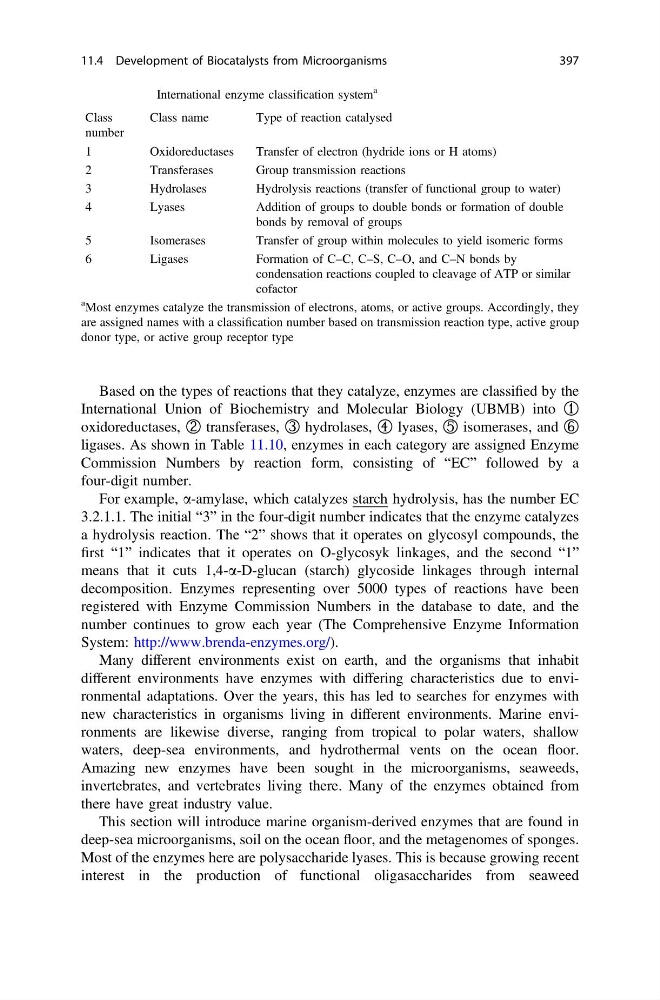
Based on the types of reactions that they catalyze, enzymes are classified by the
International Union of Biochemistry and Molecular Biology (UBMB) into ①
oxidoreductases, ② transferases, ③ hydrolases, ④ lyases, ⑤ isomerases, and ⑥
ligases. As shown in Table 11.10, enzymes in each category are assigned Enzyme
Commission Numbers by reaction form, consisting of “EC” followed by a
four-digit number.
For example, a-amylase, which catalyzes starch hydrolysis, has the number EC
3.2.1.1. The initial “3” in the four-digit number indicates that the enzyme catalyzes
a hydrolysis reaction. The “2” shows that it operates on glycosyl compounds, the
first “1” indicates that it operates on O-glycosyk linkages, and the second “1”
means that it cuts 1,4-a-D-glucan (starch) glycoside linkages through internal
decomposition. Enzymes representing over 5000 types of reactions have been
registered with Enzyme Commission Numbers in the database to date, and the
number continues to grow each year (The Comprehensive Enzyme Information
System: http://www.brenda-enzymes.org/).
Many different environments exist on earth, and the organisms that inhabit
different environments have enzymes with differing characteristics due to environmental adaptations. Over the years, this has led to searches for enzymes with
new characteristics in organisms living in different environments. Marine environments are likewise diverse, ranging from tropical to polar waters, shallow
waters, deep-sea environments, and hydrothermal vents on the ocean floor.
Amazing new enzymes have been sought in the microorganisms, seaweeds,
invertebrates, and vertebrates living there. Many of the enzymes obtained from
there have great industry value.
This section will introduce marine organism-derived enzymes that are found in
deep-sea microorganisms, soil on the ocean floor, and the metagenomes of sponges.
Most of the enzymes here are polysaccharide lyases. This is because growing recent
interest in the production of functional oligasaccharides from seaweed
Table 11.10 International enzyme classification system
a
Class
number
Class name
Type of reaction catalysed
1
Oxidoreductases
Transfer of electron (hydride ions or H atoms)
2
Transferases
Group transmission reactions
3
Hydrolases
Hydrolysis reactions (transfer of functional group to water)
4
Lyases
Addition of groups to double bonds or formation of double
bonds by removal of groups
5
Isomerases
Transfer of group within molecules to yield isomeric forms
6
Ligases
Formation of C–C, C–S, C–O, and C–N bonds by
condensation reactions coupled to cleavage of ATP or similar
cofactor
a Most enzymes catalyze the transmission of electrons, atoms, or active groups. Accordingly, they
are assigned names with a classification number based on transmission reaction type, active group
donor type, or active group receptor type
11.4 Development of Biocatalysts from Microorganisms
397
International Union of Biochemistry and Molecular Biology (UBMB) into ①
oxidoreductases, ② transferases, ③ hydrolases, ④ lyases, ⑤ isomerases, and ⑥
ligases. As shown in Table 11.10, enzymes in each category are assigned Enzyme
Commission Numbers by reaction form, consisting of “EC” followed by a
four-digit number.
For example, a-amylase, which catalyzes starch hydrolysis, has the number EC
3.2.1.1. The initial “3” in the four-digit number indicates that the enzyme catalyzes
a hydrolysis reaction. The “2” shows that it operates on glycosyl compounds, the
first “1” indicates that it operates on O-glycosyk linkages, and the second “1”
means that it cuts 1,4-a-D-glucan (starch) glycoside linkages through internal
decomposition. Enzymes representing over 5000 types of reactions have been
registered with Enzyme Commission Numbers in the database to date, and the
number continues to grow each year (The Comprehensive Enzyme Information
System: http://www.brenda-enzymes.org/).
Many different environments exist on earth, and the organisms that inhabit
different environments have enzymes with differing characteristics due to environmental adaptations. Over the years, this has led to searches for enzymes with
new characteristics in organisms living in different environments. Marine environments are likewise diverse, ranging from tropical to polar waters, shallow
waters, deep-sea environments, and hydrothermal vents on the ocean floor.
Amazing new enzymes have been sought in the microorganisms, seaweeds,
invertebrates, and vertebrates living there. Many of the enzymes obtained from
there have great industry value.
This section will introduce marine organism-derived enzymes that are found in
deep-sea microorganisms, soil on the ocean floor, and the metagenomes of sponges.
Most of the enzymes here are polysaccharide lyases. This is because growing recent
interest in the production of functional oligasaccharides from seaweed
Table 11.10 International enzyme classification system
a
Class
number
Class name
Type of reaction catalysed
1
Oxidoreductases
Transfer of electron (hydride ions or H atoms)
2
Transferases
Group transmission reactions
3
Hydrolases
Hydrolysis reactions (transfer of functional group to water)
4
Lyases
Addition of groups to double bonds or formation of double
bonds by removal of groups
5
Isomerases
Transfer of group within molecules to yield isomeric forms
6
Ligases
Formation of C–C, C–S, C–O, and C–N bonds by
condensation reactions coupled to cleavage of ATP or similar
cofactor
a Most enzymes catalyze the transmission of electrons, atoms, or active groups. Accordingly, they
are assigned names with a classification number based on transmission reaction type, active group
donor type, or active group receptor type
11.4 Development of Biocatalysts from Microorganisms
397