

the ocean exhibit higher activity under higher pressure. While the mechanism of
this resistance to pressure is not fully understood, it is believed to result from
differences in the arrangement or three-dimensional structure of amino acids relative to ordinary enzymes.
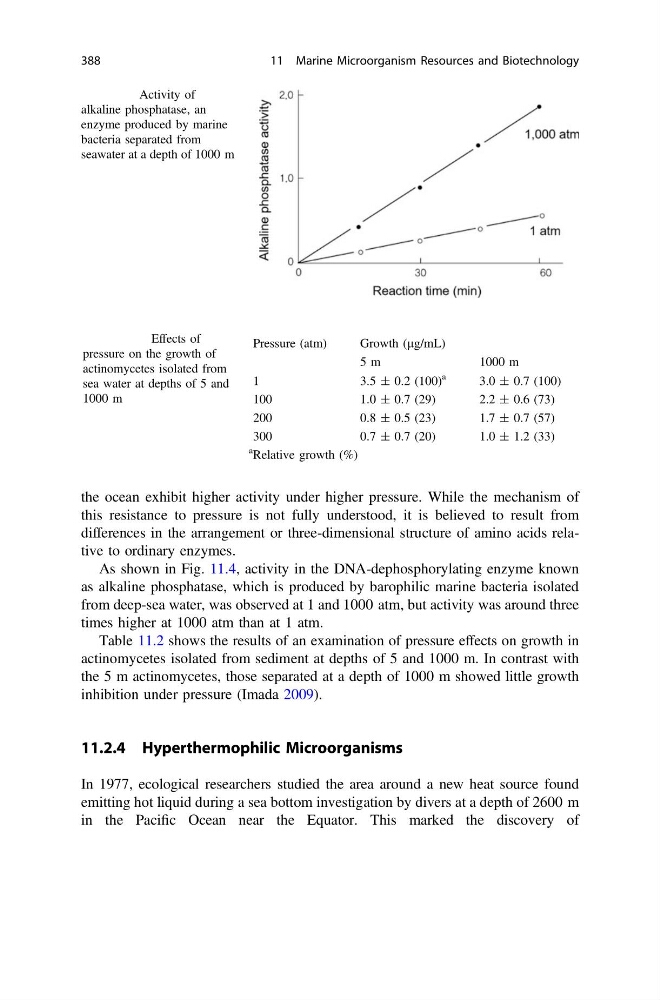
As shown in Fig. 11.4, activity in the DNA-dephosphorylating enzyme known
as alkaline phosphatase, which is produced by barophilic marine bacteria isolated
from deep-sea water, was observed at 1 and 1000 atm, but activity was around three
times higher at 1000 atm than at 1 atm.
Table 11.2 shows the results of an examination of pressure effects on growth in
actinomycetes isolated from sediment at depths of 5 and 1000 m. In contrast with
the 5 m actinomycetes, those separated at a depth of 1000 m showed little growth
inhibition under pressure (Imada 2009).
11.2.4 Hyperthermophilic Microorganisms
In 1977, ecological researchers studied the area around a new heat source found
emitting hot liquid during a sea bottom investigation by divers at a depth of 2600 m
in the Pacific Ocean near the Equator. This marked the discovery of
Fig. 11.4 Activity of
alkaline phosphatase, an
enzyme produced by marine
bacteria separated from
seawater at a depth of 1000 m
Table 11.2 Effects of
pressure on the growth of
actinomycetes isolated from
sea water at depths of 5 and
1000 m
Pressure (atm)
Growth (lg/mL)
5 m
1000 m
1
3.5 ± 0.2 (100)
a
3.0 ± 0.7 (100)
100
1.0 ± 0.7 (29)
2.2 ± 0.6 (73)
200
0.8 ± 0.5 (23)
1.7 ± 0.7 (57)
300
0.7 ± 0.7 (20)
1.0 ± 1.2 (33)
a Relative growth (%)
388
11 Marine Microorganism Resources and Biotechnology
this resistance to pressure is not fully understood, it is believed to result from
differences in the arrangement or three-dimensional structure of amino acids relative to ordinary enzymes.
As shown in Fig. 11.4, activity in the DNA-dephosphorylating enzyme known
as alkaline phosphatase, which is produced by barophilic marine bacteria isolated
from deep-sea water, was observed at 1 and 1000 atm, but activity was around three
times higher at 1000 atm than at 1 atm.
Table 11.2 shows the results of an examination of pressure effects on growth in
actinomycetes isolated from sediment at depths of 5 and 1000 m. In contrast with
the 5 m actinomycetes, those separated at a depth of 1000 m showed little growth
inhibition under pressure (Imada 2009).
11.2.4 Hyperthermophilic Microorganisms
In 1977, ecological researchers studied the area around a new heat source found
emitting hot liquid during a sea bottom investigation by divers at a depth of 2600 m
in the Pacific Ocean near the Equator. This marked the discovery of
Fig. 11.4 Activity of
alkaline phosphatase, an
enzyme produced by marine
bacteria separated from
seawater at a depth of 1000 m
Table 11.2 Effects of
pressure on the growth of
actinomycetes isolated from
sea water at depths of 5 and
1000 m
Pressure (atm)
Growth (lg/mL)
5 m
1000 m
1
3.5 ± 0.2 (100)
a
3.0 ± 0.7 (100)
100
1.0 ± 0.7 (29)
2.2 ± 0.6 (73)
200
0.8 ± 0.5 (23)
1.7 ± 0.7 (57)
300
0.7 ± 0.7 (20)
1.0 ± 1.2 (33)
a Relative growth (%)
388
11 Marine Microorganism Resources and Biotechnology