

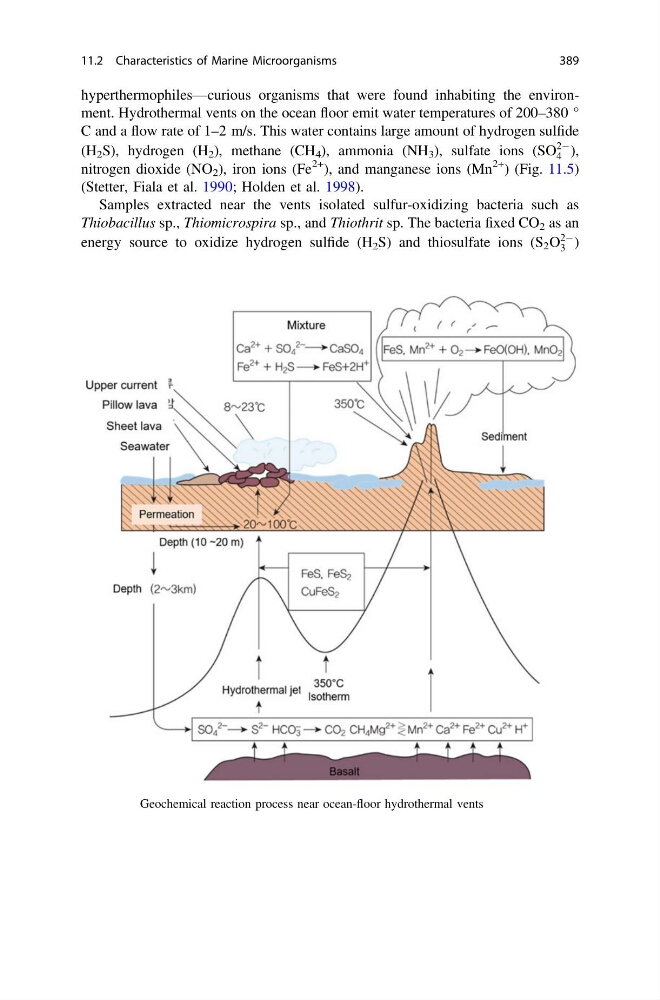
hyperthermophiles—curious organisms that were found inhabiting the environment. Hydrothermal vents on the ocean floor emit water temperatures of 200–380 °
C and a flow rate of 1–2 m/s. This water contains large amount of hydrogen sulfide
(H 2 S), hydrogen (H 2 ), methane (CH 4 ), ammonia (NH 3 ), sulfate ions (SO
2À
4 ),
nitrogen dioxide (NO 2 ), iron ions (Fe
2+ ), and manganese ions (Mn
2+ ) (Fig. 11.5)
(Stetter, Fiala et al. 1990; Holden et al. 1998).
Samples extracted near the vents isolated sulfur-oxidizing bacteria such as
Thiobacillus sp., Thiomicrospira sp., and Thiothrit sp. The bacteria fixed CO 2 as an
energy source to oxidize hydrogen sulfide (H 2 S) and thiosulfate ions (S 2 O
2À
3 )
Fig. 11.5 Geochemical reaction process near ocean-floor hydrothermal vents
11.2 Characteristics of Marine Microorganisms
389
C and a flow rate of 1–2 m/s. This water contains large amount of hydrogen sulfide
(H 2 S), hydrogen (H 2 ), methane (CH 4 ), ammonia (NH 3 ), sulfate ions (SO
2À
4 ),
nitrogen dioxide (NO 2 ), iron ions (Fe
2+ ), and manganese ions (Mn
2+ ) (Fig. 11.5)
(Stetter, Fiala et al. 1990; Holden et al. 1998).
Samples extracted near the vents isolated sulfur-oxidizing bacteria such as
Thiobacillus sp., Thiomicrospira sp., and Thiothrit sp. The bacteria fixed CO 2 as an
energy source to oxidize hydrogen sulfide (H 2 S) and thiosulfate ions (S 2 O
2À
3 )
Fig. 11.5 Geochemical reaction process near ocean-floor hydrothermal vents
11.2 Characteristics of Marine Microorganisms
389