

11.2.3 Pressure-Resistent and Barophilic Microorganisms
Seawater pressure increases by 1 atm for every additional 10 m of depth. This
translates into pressure of 100 atm at deep-sea depths of 1000 m.
An open empty cola bottle will shatter from the pressure at a depth of around
4000 m. Because they are not filled with air like the cola bottle, microorganisms
will not immediately rupture at such depths, but their propagation typically halts as
pressure increases, resulting in death at high pressure levels. Why do microorganisms die when subjected to pressure? Most bacterial enzymes are vulnerable to
pressure. Enzymes extracted from shallow-sea marine bacteria will stop functioning
at pressures of around 100 atm. Yet some enzymes are capable of withstanding
pressures of 1000 atm. This difference in resistance to pressure is explained by
differences in the sizes and structures of enzyme protein molecules. In general, large
enzymes and enzymes made up of several different protein molecules tend to be
vulnerable to pressure. Changes in the cell membrane under pressure prevent them
from taking in nutrients, causing the cell to die. The ability of certain bacteria to
adapt to deep-sea environments and survive under high pressures is thus believed to
be the result of special enzymes.
The deep ocean is an extreme environment with low temperatures and high
pressure. Microorganisms that inhabit this environment are typically barophilic,
although some are pressure-resistant as well. Barophilic bacteria are microorganisms that generally exhibit high metabolic activity and fast growth at pressures of
400 atm rather than 1 atm.
Enzymes are made up of proteins, and their activity will be diminished or halted
under pressure due to changes in those proteins’ three-dimensional structure. Some
of the enzymes produced by microorganisms that inhabit depths of over 1000 m in
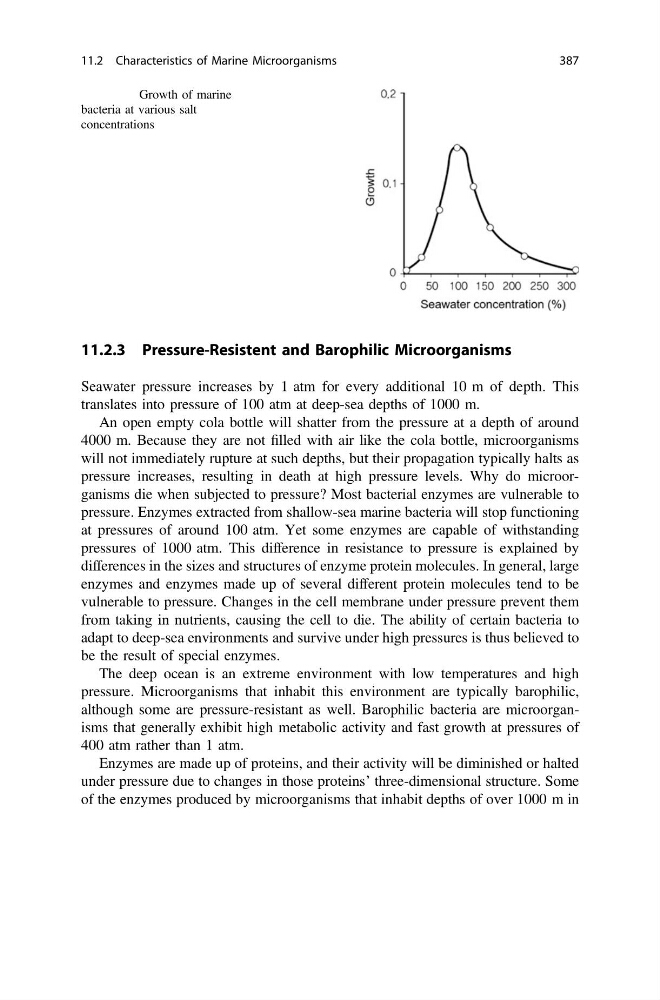
Fig. 11.3 Growth of marine
bacteria at various salt
concentrations
11.2 Characteristics of Marine Microorganisms
387
Seawater pressure increases by 1 atm for every additional 10 m of depth. This
translates into pressure of 100 atm at deep-sea depths of 1000 m.
An open empty cola bottle will shatter from the pressure at a depth of around
4000 m. Because they are not filled with air like the cola bottle, microorganisms
will not immediately rupture at such depths, but their propagation typically halts as
pressure increases, resulting in death at high pressure levels. Why do microorganisms die when subjected to pressure? Most bacterial enzymes are vulnerable to
pressure. Enzymes extracted from shallow-sea marine bacteria will stop functioning
at pressures of around 100 atm. Yet some enzymes are capable of withstanding
pressures of 1000 atm. This difference in resistance to pressure is explained by
differences in the sizes and structures of enzyme protein molecules. In general, large
enzymes and enzymes made up of several different protein molecules tend to be
vulnerable to pressure. Changes in the cell membrane under pressure prevent them
from taking in nutrients, causing the cell to die. The ability of certain bacteria to
adapt to deep-sea environments and survive under high pressures is thus believed to
be the result of special enzymes.
The deep ocean is an extreme environment with low temperatures and high
pressure. Microorganisms that inhabit this environment are typically barophilic,
although some are pressure-resistant as well. Barophilic bacteria are microorganisms that generally exhibit high metabolic activity and fast growth at pressures of
400 atm rather than 1 atm.
Enzymes are made up of proteins, and their activity will be diminished or halted
under pressure due to changes in those proteins’ three-dimensional structure. Some
of the enzymes produced by microorganisms that inhabit depths of over 1000 m in
Fig. 11.3 Growth of marine
bacteria at various salt
concentrations
11.2 Characteristics of Marine Microorganisms
387