

radiated light to the nucleus. The resulting change in the nucleus’s spin is known as
resonance. It is similar to the way a falling top gradually rights itself forcefully
when spurred from outside, spinning upright once maximum external force is
reached.
The follow information can be obtained from NMR:
• A substance’s molecular structure can be ascertained. In natural substances, this
is an efficient means of analyzing the number of hydrogen and carbon atoms
within a molecule; the form in which they are present; branching and ring
structures; multiple linkages; and isomers.
• Substances can be identified through comparative analysis with the spectra of
previously known substances.
• Compound quantities can be determined.
(1) 1H NMR
In NMR, chemically different protons exhibit different absorption peaks. 1H
NMR provides a way of determining the presence of different kinds of protons,
where absorption peaks are exhibited in the range of 0–10 ppm. When they have the
same positional relationship within the molecule, this is known as chemical
equivalence: they have the same resonance frequencies and typically manifest
through a single signal. Coupling occurs when they exhibit mutual influence with
other nearby nuclei. In this case, signals appear in divided forms, including singlet,
doublet, triplet, quartet, and multiplet peaks. The gap between these signals is known
as the coupling constant J, which is represented in hertz (Hz). Typically, the number
of separate hydrogen peaks equals n + 1, depending on the number of equivalent
hydrogens right next to the hydrogen and attached to carbon atoms. The area for each
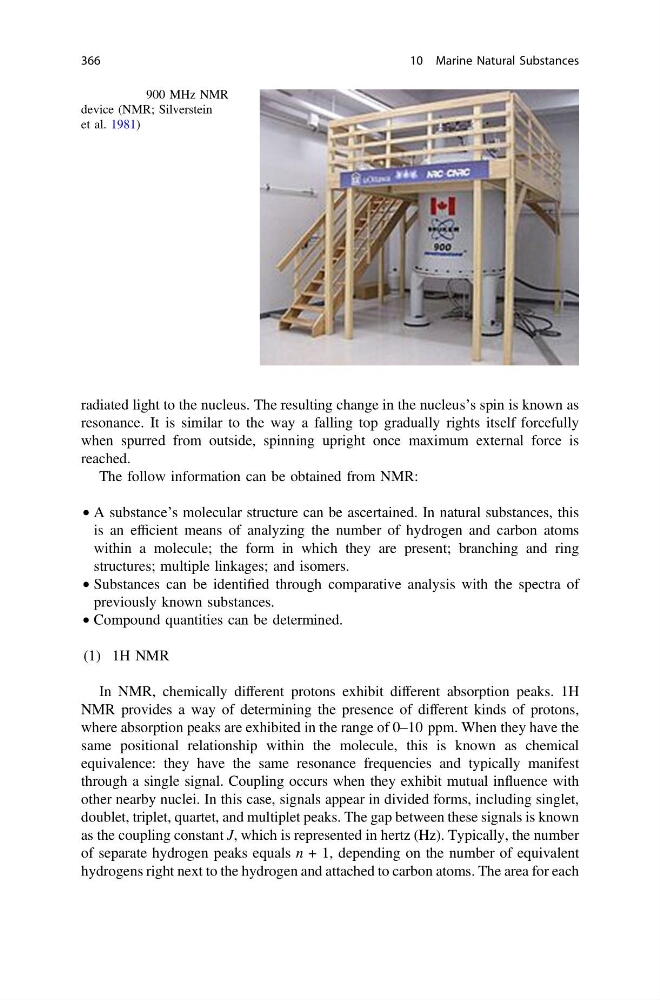
Fig. 10.13 900 MHz NMR
device (NMR; Silverstein
et al. 1981)
366
10 Marine Natural Substances
resonance. It is similar to the way a falling top gradually rights itself forcefully
when spurred from outside, spinning upright once maximum external force is
reached.
The follow information can be obtained from NMR:
• A substance’s molecular structure can be ascertained. In natural substances, this
is an efficient means of analyzing the number of hydrogen and carbon atoms
within a molecule; the form in which they are present; branching and ring
structures; multiple linkages; and isomers.
• Substances can be identified through comparative analysis with the spectra of
previously known substances.
• Compound quantities can be determined.
(1) 1H NMR
In NMR, chemically different protons exhibit different absorption peaks. 1H
NMR provides a way of determining the presence of different kinds of protons,
where absorption peaks are exhibited in the range of 0–10 ppm. When they have the
same positional relationship within the molecule, this is known as chemical
equivalence: they have the same resonance frequencies and typically manifest
through a single signal. Coupling occurs when they exhibit mutual influence with
other nearby nuclei. In this case, signals appear in divided forms, including singlet,
doublet, triplet, quartet, and multiplet peaks. The gap between these signals is known
as the coupling constant J, which is represented in hertz (Hz). Typically, the number
of separate hydrogen peaks equals n + 1, depending on the number of equivalent
hydrogens right next to the hydrogen and attached to carbon atoms. The area for each
Fig. 10.13 900 MHz NMR
device (NMR; Silverstein
et al. 1981)
366
10 Marine Natural Substances