

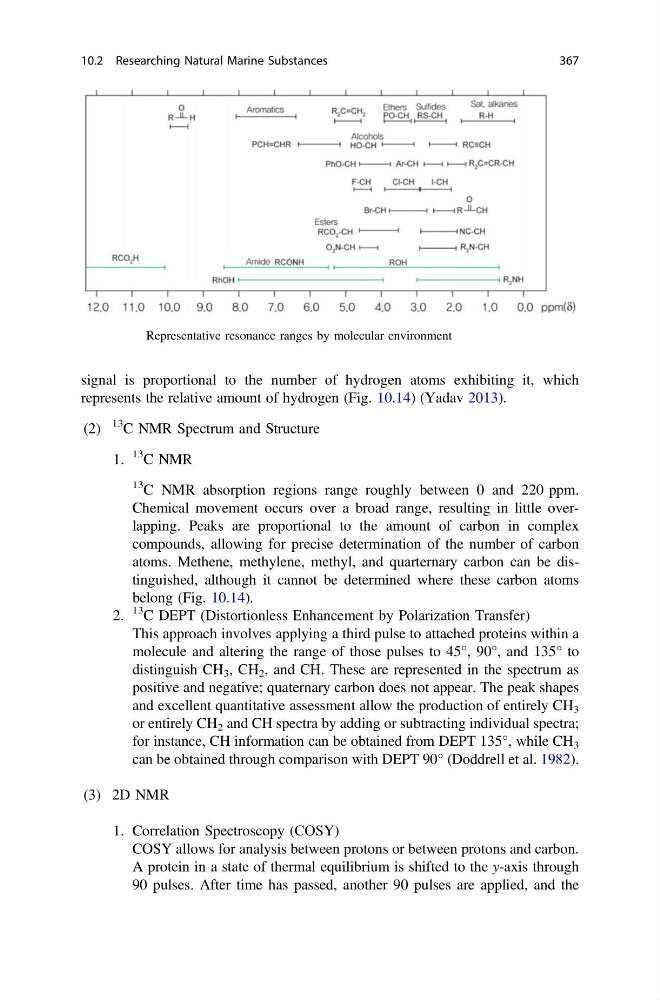
signal is proportional to the number of hydrogen atoms exhibiting it, which
represents the relative amount of hydrogen (Fig. 10.14) (Yadav 2013).
(2)
13 C NMR Spectrum and Structure
1.
13 C NMR
13 C NMR absorption regions range roughly between 0 and 220 ppm.
Chemical movement occurs over a broad range, resulting in little overlapping. Peaks are proportional to the amount of carbon in complex
compounds, allowing for precise determination of the number of carbon
atoms. Methene, methylene, methyl, and quarternary carbon can be distinguished, although it cannot be determined where these carbon atoms
belong (Fig. 10.14).
2.
13 C DEPT (Distortionless Enhancement by Polarization Transfer)
This approach involves applying a third pulse to attached proteins within a
molecule and altering the range of those pulses to 45°, 90°, and 135° to
distinguish CH 3 , CH 2 , and CH. These are represented in the spectrum as
positive and negative; quaternary carbon does not appear. The peak shapes
and excellent quantitative assessment allow the production of entirely CH 3
or entirely CH 2 and CH spectra by adding or subtracting individual spectra;
for instance, CH information can be obtained from DEPT 135°, while CH 3
can be obtained through comparison with DEPT 90° (Doddrell et al. 1982).
(3) 2D NMR
1. Correlation Spectroscopy (COSY)
COSY allows for analysis between protons or between protons and carbon.
A protein in a state of thermal equilibrium is shifted to the y-axis through
90 pulses. After time has passed, another 90 pulses are applied, and the
Fig. 10.14 Representative resonance ranges by molecular environment
10.2 Researching Natural Marine Substances
367
represents the relative amount of hydrogen (Fig. 10.14) (Yadav 2013).
(2)
13 C NMR Spectrum and Structure
1.
13 C NMR
13 C NMR absorption regions range roughly between 0 and 220 ppm.
Chemical movement occurs over a broad range, resulting in little overlapping. Peaks are proportional to the amount of carbon in complex
compounds, allowing for precise determination of the number of carbon
atoms. Methene, methylene, methyl, and quarternary carbon can be distinguished, although it cannot be determined where these carbon atoms
belong (Fig. 10.14).
2.
13 C DEPT (Distortionless Enhancement by Polarization Transfer)
This approach involves applying a third pulse to attached proteins within a
molecule and altering the range of those pulses to 45°, 90°, and 135° to
distinguish CH 3 , CH 2 , and CH. These are represented in the spectrum as
positive and negative; quaternary carbon does not appear. The peak shapes
and excellent quantitative assessment allow the production of entirely CH 3
or entirely CH 2 and CH spectra by adding or subtracting individual spectra;
for instance, CH information can be obtained from DEPT 135°, while CH 3
can be obtained through comparison with DEPT 90° (Doddrell et al. 1982).
(3) 2D NMR
1. Correlation Spectroscopy (COSY)
COSY allows for analysis between protons or between protons and carbon.
A protein in a state of thermal equilibrium is shifted to the y-axis through
90 pulses. After time has passed, another 90 pulses are applied, and the
Fig. 10.14 Representative resonance ranges by molecular environment
10.2 Researching Natural Marine Substances
367