

While tens of thousands of microalgae species are known to exist, only a few
have been applied successfully to industrialization through outdoor culturing. Most
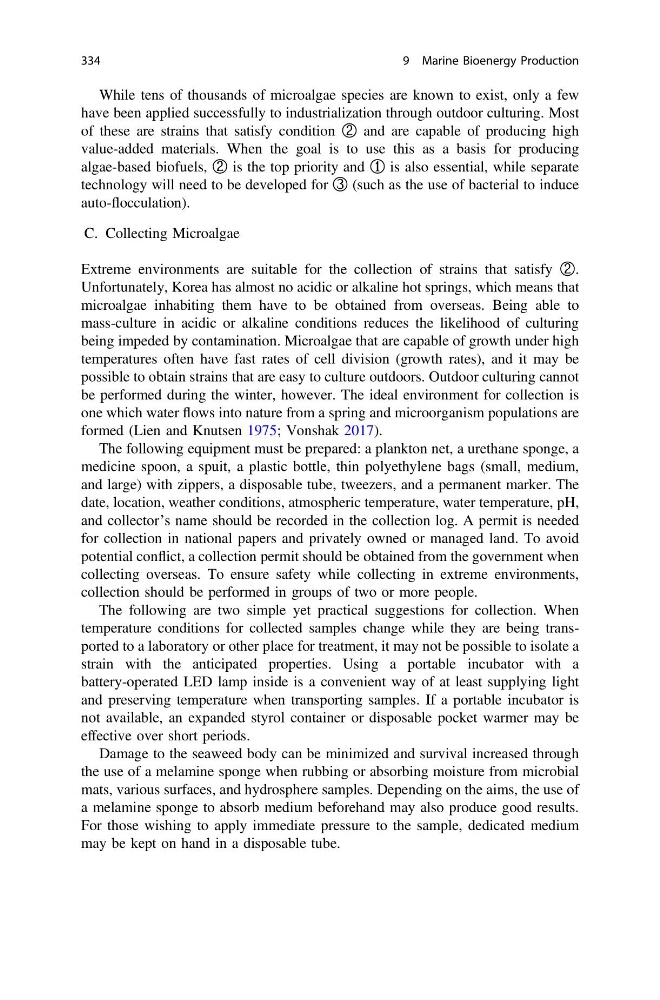
of these are strains that satisfy condition ② and are capable of producing high
value-added materials. When the goal is to use this as a basis for producing
algae-based biofuels, ② is the top priority and ① is also essential, while separate
technology will need to be developed for ③ (such as the use of bacterial to induce
auto-flocculation).
C. Collecting Microalgae
Extreme environments are suitable for the collection of strains that satisfy ②.
Unfortunately, Korea has almost no acidic or alkaline hot springs, which means that
microalgae inhabiting them have to be obtained from overseas. Being able to
mass-culture in acidic or alkaline conditions reduces the likelihood of culturing
being impeded by contamination. Microalgae that are capable of growth under high
temperatures often have fast rates of cell division (growth rates), and it may be
possible to obtain strains that are easy to culture outdoors. Outdoor culturing cannot
be performed during the winter, however. The ideal environment for collection is
one which water flows into nature from a spring and microorganism populations are
formed (Lien and Knutsen 1975; Vonshak 2017).
The following equipment must be prepared: a plankton net, a urethane sponge, a
medicine spoon, a spuit, a plastic bottle, thin polyethylene bags (small, medium,
and large) with zippers, a disposable tube, tweezers, and a permanent marker. The
date, location, weather conditions, atmospheric temperature, water temperature, pH,
and collector’s name should be recorded in the collection log. A permit is needed
for collection in national papers and privately owned or managed land. To avoid
potential conflict, a collection permit should be obtained from the government when
collecting overseas. To ensure safety while collecting in extreme environments,
collection should be performed in groups of two or more people.
The following are two simple yet practical suggestions for collection. When
temperature conditions for collected samples change while they are being transported to a laboratory or other place for treatment, it may not be possible to isolate a
strain with the anticipated properties. Using a portable incubator with a
battery-operated LED lamp inside is a convenient way of at least supplying light
and preserving temperature when transporting samples. If a portable incubator is
not available, an expanded styrol container or disposable pocket warmer may be
effective over short periods.
Damage to the seaweed body can be minimized and survival increased through
the use of a melamine sponge when rubbing or absorbing moisture from microbial
mats, various surfaces, and hydrosphere samples. Depending on the aims, the use of
a melamine sponge to absorb medium beforehand may also produce good results.
For those wishing to apply immediate pressure to the sample, dedicated medium
may be kept on hand in a disposable tube.
334
9 Marine Bioenergy Production
have been applied successfully to industrialization through outdoor culturing. Most
of these are strains that satisfy condition ② and are capable of producing high
value-added materials. When the goal is to use this as a basis for producing
algae-based biofuels, ② is the top priority and ① is also essential, while separate
technology will need to be developed for ③ (such as the use of bacterial to induce
auto-flocculation).
C. Collecting Microalgae
Extreme environments are suitable for the collection of strains that satisfy ②.
Unfortunately, Korea has almost no acidic or alkaline hot springs, which means that
microalgae inhabiting them have to be obtained from overseas. Being able to
mass-culture in acidic or alkaline conditions reduces the likelihood of culturing
being impeded by contamination. Microalgae that are capable of growth under high
temperatures often have fast rates of cell division (growth rates), and it may be
possible to obtain strains that are easy to culture outdoors. Outdoor culturing cannot
be performed during the winter, however. The ideal environment for collection is
one which water flows into nature from a spring and microorganism populations are
formed (Lien and Knutsen 1975; Vonshak 2017).
The following equipment must be prepared: a plankton net, a urethane sponge, a
medicine spoon, a spuit, a plastic bottle, thin polyethylene bags (small, medium,
and large) with zippers, a disposable tube, tweezers, and a permanent marker. The
date, location, weather conditions, atmospheric temperature, water temperature, pH,
and collector’s name should be recorded in the collection log. A permit is needed
for collection in national papers and privately owned or managed land. To avoid
potential conflict, a collection permit should be obtained from the government when
collecting overseas. To ensure safety while collecting in extreme environments,
collection should be performed in groups of two or more people.
The following are two simple yet practical suggestions for collection. When
temperature conditions for collected samples change while they are being transported to a laboratory or other place for treatment, it may not be possible to isolate a
strain with the anticipated properties. Using a portable incubator with a
battery-operated LED lamp inside is a convenient way of at least supplying light
and preserving temperature when transporting samples. If a portable incubator is
not available, an expanded styrol container or disposable pocket warmer may be
effective over short periods.
Damage to the seaweed body can be minimized and survival increased through
the use of a melamine sponge when rubbing or absorbing moisture from microbial
mats, various surfaces, and hydrosphere samples. Depending on the aims, the use of
a melamine sponge to absorb medium beforehand may also produce good results.
For those wishing to apply immediate pressure to the sample, dedicated medium
may be kept on hand in a disposable tube.
334
9 Marine Bioenergy Production