

1. Oil content must be high: The higher the oil content, the greater the oil
productivity.
2. Resistance to pollution even in extensive outdoor environments must be strong:
Extensive culturing is essential to suit the goal of providing low-cost fuel, but
raises issues concerning contamination by similar organisms or predators. To
withstand pollution, a species must have a fast growth rate and be capable of
growing in extreme environments.
3. The species should be easy to harvest: For large-scale production, cells must be
recovered at a concentration of at least 1 g/L. This results in massive amounts of
liquid that must be handled. Self-cohesion is an extremely beneficial property
for cell recovery. Harvesting is also easier when the algae are rod-shaped (such
as Spirulina).
As was learned with the American Selling Price, it can be difficult to find a strain
that satisfies all of these characteristics. For instance, B. braunii, which secretes
straight-chain hydrocarbons outside the cell, satisfies ① with oil content of around
50% and ③ with its ability to produce masses of dozens to hundreds of cells, but
falls short in terms of ② because of its slow growth rate. The cyanobacterium
Spirulina platensis (Arthrospira platensis) has been cultured very successfully
outdoors, is fast-growing, and thrives in alkaline environments, satisfying ② and
③, but has never accumulated much oil.
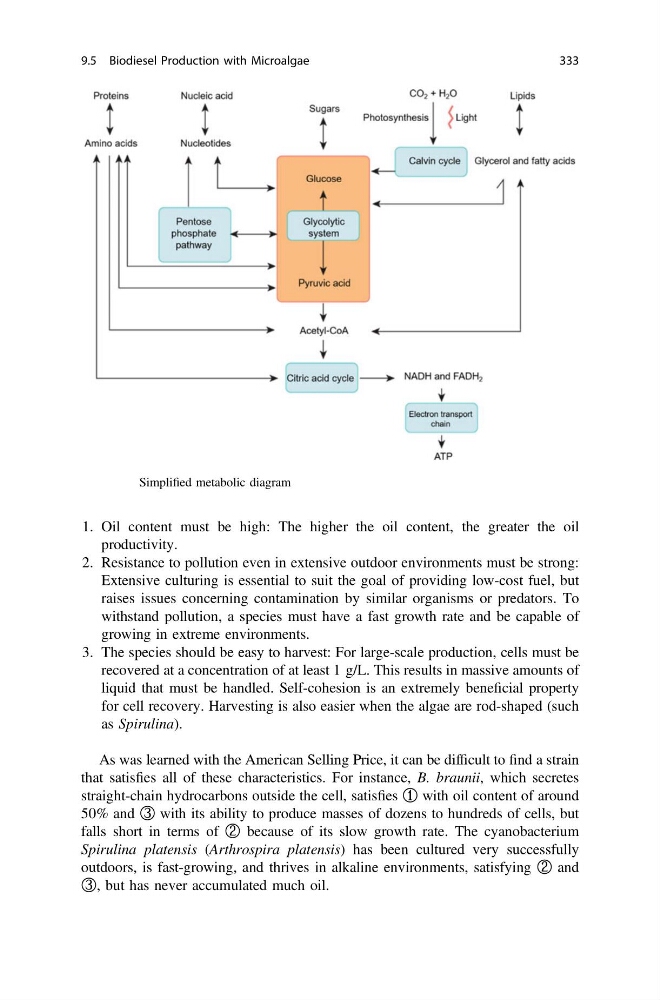
Fig. 9.10 Simplified metabolic diagram
9.5 Biodiesel Production with Microalgae
333
productivity.
2. Resistance to pollution even in extensive outdoor environments must be strong:
Extensive culturing is essential to suit the goal of providing low-cost fuel, but
raises issues concerning contamination by similar organisms or predators. To
withstand pollution, a species must have a fast growth rate and be capable of
growing in extreme environments.
3. The species should be easy to harvest: For large-scale production, cells must be
recovered at a concentration of at least 1 g/L. This results in massive amounts of
liquid that must be handled. Self-cohesion is an extremely beneficial property
for cell recovery. Harvesting is also easier when the algae are rod-shaped (such
as Spirulina).
As was learned with the American Selling Price, it can be difficult to find a strain
that satisfies all of these characteristics. For instance, B. braunii, which secretes
straight-chain hydrocarbons outside the cell, satisfies ① with oil content of around
50% and ③ with its ability to produce masses of dozens to hundreds of cells, but
falls short in terms of ② because of its slow growth rate. The cyanobacterium
Spirulina platensis (Arthrospira platensis) has been cultured very successfully
outdoors, is fast-growing, and thrives in alkaline environments, satisfying ② and
③, but has never accumulated much oil.
Fig. 9.10 Simplified metabolic diagram
9.5 Biodiesel Production with Microalgae
333