

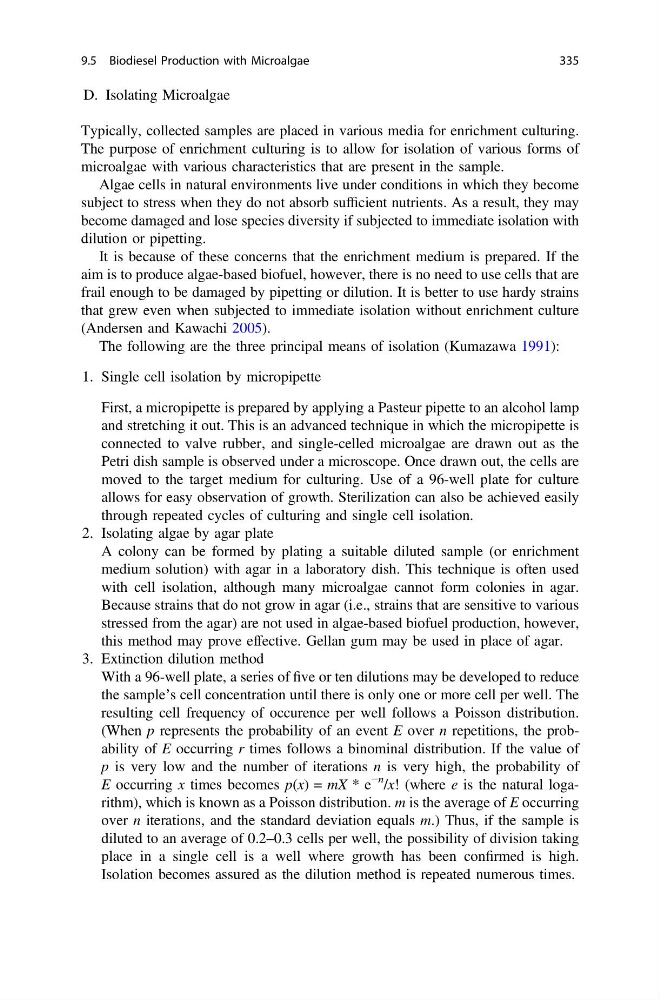
D. Isolating Microalgae
Typically, collected samples are placed in various media for enrichment culturing.
The purpose of enrichment culturing is to allow for isolation of various forms of
microalgae with various characteristics that are present in the sample.
Algae cells in natural environments live under conditions in which they become
subject to stress when they do not absorb sufficient nutrients. As a result, they may
become damaged and lose species diversity if subjected to immediate isolation with
dilution or pipetting.
It is because of these concerns that the enrichment medium is prepared. If the
aim is to produce algae-based biofuel, however, there is no need to use cells that are
frail enough to be damaged by pipetting or dilution. It is better to use hardy strains
that grew even when subjected to immediate isolation without enrichment culture
(Andersen and Kawachi 2005).
The following are the three principal means of isolation (Kumazawa 1991):
1. Single cell isolation by micropipette
First, a micropipette is prepared by applying a Pasteur pipette to an alcohol lamp
and stretching it out. This is an advanced technique in which the micropipette is
connected to valve rubber, and single-celled microalgae are drawn out as the
Petri dish sample is observed under a microscope. Once drawn out, the cells are
moved to the target medium for culturing. Use of a 96-well plate for culture
allows for easy observation of growth. Sterilization can also be achieved easily
through repeated cycles of culturing and single cell isolation.
2. Isolating algae by agar plate
A colony can be formed by plating a suitable diluted sample (or enrichment
medium solution) with agar in a laboratory dish. This technique is often used
with cell isolation, although many microalgae cannot form colonies in agar.
Because strains that do not grow in agar (i.e., strains that are sensitive to various
stressed from the agar) are not used in algae-based biofuel production, however,
this method may prove effective. Gellan gum may be used in place of agar.
3. Extinction dilution method
With a 96-well plate, a series of five or ten dilutions may be developed to reduce
the sample’s cell concentration until there is only one or more cell per well. The
resulting cell frequency of occurence per well follows a Poisson distribution.
(When p represents the probability of an event E over n repetitions, the probability of E occurring r times follows a binominal distribution. If the value of
p is very low and the number of iterations n is very high, the probability of
E occurring x times becomes p(x) = mX * e
−n /x! (where e is the natural logarithm), which is known as a Poisson distribution. m is the average of E occurring
over n iterations, and the standard deviation equals m.) Thus, if the sample is
diluted to an average of 0.2–0.3 cells per well, the possibility of division taking
place in a single cell is a well where growth has been confirmed is high.
Isolation becomes assured as the dilution method is repeated numerous times.
9.5 Biodiesel Production with Microalgae
335
Typically, collected samples are placed in various media for enrichment culturing.
The purpose of enrichment culturing is to allow for isolation of various forms of
microalgae with various characteristics that are present in the sample.
Algae cells in natural environments live under conditions in which they become
subject to stress when they do not absorb sufficient nutrients. As a result, they may
become damaged and lose species diversity if subjected to immediate isolation with
dilution or pipetting.
It is because of these concerns that the enrichment medium is prepared. If the
aim is to produce algae-based biofuel, however, there is no need to use cells that are
frail enough to be damaged by pipetting or dilution. It is better to use hardy strains
that grew even when subjected to immediate isolation without enrichment culture
(Andersen and Kawachi 2005).
The following are the three principal means of isolation (Kumazawa 1991):
1. Single cell isolation by micropipette
First, a micropipette is prepared by applying a Pasteur pipette to an alcohol lamp
and stretching it out. This is an advanced technique in which the micropipette is
connected to valve rubber, and single-celled microalgae are drawn out as the
Petri dish sample is observed under a microscope. Once drawn out, the cells are
moved to the target medium for culturing. Use of a 96-well plate for culture
allows for easy observation of growth. Sterilization can also be achieved easily
through repeated cycles of culturing and single cell isolation.
2. Isolating algae by agar plate
A colony can be formed by plating a suitable diluted sample (or enrichment
medium solution) with agar in a laboratory dish. This technique is often used
with cell isolation, although many microalgae cannot form colonies in agar.
Because strains that do not grow in agar (i.e., strains that are sensitive to various
stressed from the agar) are not used in algae-based biofuel production, however,
this method may prove effective. Gellan gum may be used in place of agar.
3. Extinction dilution method
With a 96-well plate, a series of five or ten dilutions may be developed to reduce
the sample’s cell concentration until there is only one or more cell per well. The
resulting cell frequency of occurence per well follows a Poisson distribution.
(When p represents the probability of an event E over n repetitions, the probability of E occurring r times follows a binominal distribution. If the value of
p is very low and the number of iterations n is very high, the probability of
E occurring x times becomes p(x) = mX * e
−n /x! (where e is the natural logarithm), which is known as a Poisson distribution. m is the average of E occurring
over n iterations, and the standard deviation equals m.) Thus, if the sample is
diluted to an average of 0.2–0.3 cells per well, the possibility of division taking
place in a single cell is a well where growth has been confirmed is high.
Isolation becomes assured as the dilution method is repeated numerous times.
9.5 Biodiesel Production with Microalgae
335