

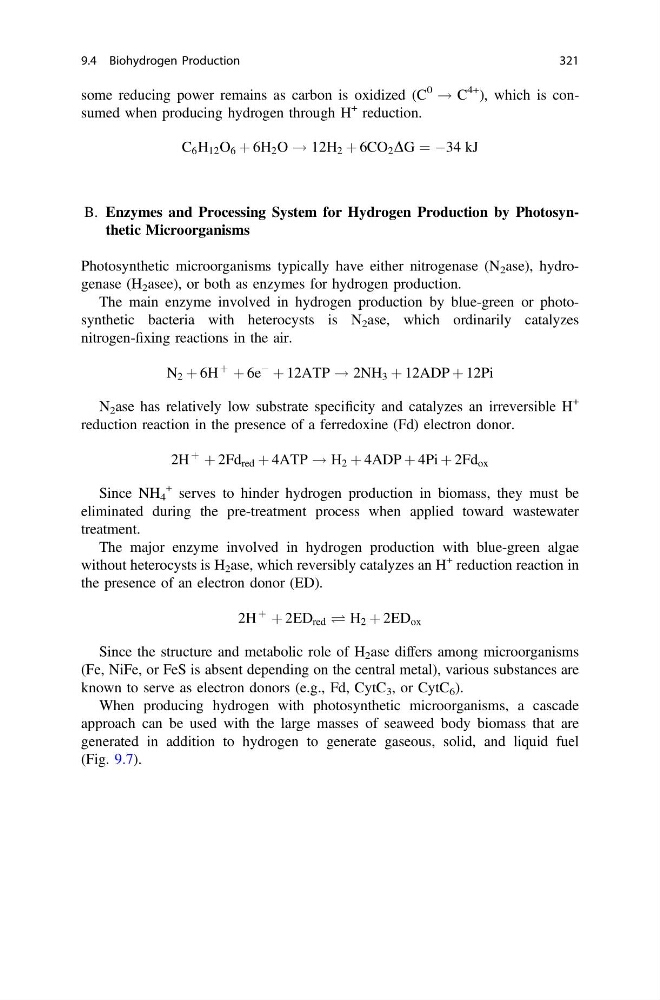
some reducing power remains as carbon is oxidized (C
0
! C
4+ ), which is consumed when producing hydrogen through H
+ reduction.
C 6 H 12 O 6 þ 6H 2 O ! 12H 2 þ 6CO 2 DG ¼ À34 kJ
B. Enzymes and Processing System for Hydrogen Production by Photosynthetic Microorganisms
Photosynthetic microorganisms typically have either nitrogenase (N 2 ase), hydrogenase (H 2 asee), or both as enzymes for hydrogen production.
The main enzyme involved in hydrogen production by blue-green or photosynthetic bacteria with heterocysts is N 2 ase, which ordinarily catalyzes
nitrogen-fixing reactions in the air.
N 2 þ 6H
þ
þ 6e
À
þ 12ATP ! 2NH 3 þ 12ADP þ 12Pi
N 2 ase has relatively low substrate specificity and catalyzes an irreversible H
+
reduction reaction in the presence of a ferredoxine (Fd) electron donor.
2H
þ
þ 2Fd red þ 4ATP ! H 2 þ 4ADP þ 4Pi þ 2Fd ox
Since NH 4
+ serves to hinder hydrogen production in biomass, they must be
eliminated during the pre-treatment process when applied toward wastewater
treatment.
The major enzyme involved in hydrogen production with blue-green algae
without heterocysts is H 2 ase, which reversibly catalyzes an H
+ reduction reaction in
the presence of an electron donor (ED).
2H
þ
þ 2ED red H 2 þ 2ED ox
Since the structure and metabolic role of H 2 ase differs among microorganisms
(Fe, NiFe, or FeS is absent depending on the central metal), various substances are
known to serve as electron donors (e.g., Fd, CytC 3 , or CytC 6 ).
When producing hydrogen with photosynthetic microorganisms, a cascade
approach can be used with the large masses of seaweed body biomass that are
generated in addition to hydrogen to generate gaseous, solid, and liquid fuel
(Fig. 9.7).
9.4 Biohydrogen Production
321
0
! C
4+ ), which is consumed when producing hydrogen through H
+ reduction.
C 6 H 12 O 6 þ 6H 2 O ! 12H 2 þ 6CO 2 DG ¼ À34 kJ
B. Enzymes and Processing System for Hydrogen Production by Photosynthetic Microorganisms
Photosynthetic microorganisms typically have either nitrogenase (N 2 ase), hydrogenase (H 2 asee), or both as enzymes for hydrogen production.
The main enzyme involved in hydrogen production by blue-green or photosynthetic bacteria with heterocysts is N 2 ase, which ordinarily catalyzes
nitrogen-fixing reactions in the air.
N 2 þ 6H
þ
þ 6e
À
þ 12ATP ! 2NH 3 þ 12ADP þ 12Pi
N 2 ase has relatively low substrate specificity and catalyzes an irreversible H
+
reduction reaction in the presence of a ferredoxine (Fd) electron donor.
2H
þ
þ 2Fd red þ 4ATP ! H 2 þ 4ADP þ 4Pi þ 2Fd ox
Since NH 4
+ serves to hinder hydrogen production in biomass, they must be
eliminated during the pre-treatment process when applied toward wastewater
treatment.
The major enzyme involved in hydrogen production with blue-green algae
without heterocysts is H 2 ase, which reversibly catalyzes an H
+ reduction reaction in
the presence of an electron donor (ED).
2H
þ
þ 2ED red H 2 þ 2ED ox
Since the structure and metabolic role of H 2 ase differs among microorganisms
(Fe, NiFe, or FeS is absent depending on the central metal), various substances are
known to serve as electron donors (e.g., Fd, CytC 3 , or CytC 6 ).
When producing hydrogen with photosynthetic microorganisms, a cascade
approach can be used with the large masses of seaweed body biomass that are
generated in addition to hydrogen to generate gaseous, solid, and liquid fuel
(Fig. 9.7).
9.4 Biohydrogen Production
321