

The juice, in turn, is separated into water-soluble sugars and salts. In the case of
sugars, mannitol is abundant and can be recovered for energy use through methane
fermentation, but another approach that has been considered involves enzymatic
conversion to produce syrup and other higher value-added products. Other products
that are expected to prove useful include fucoidan, chlorophyll, polyphenols,
vitamins, and carotenes. The remaining brine contains inorganic salts concentrated
in the seaweed body. For example, dried kelp contains 5.3 g for every 100 g, while
dried sea mustard contains 5.2 g. Potassium recovery from brine is assumed to take
place in the production process. Algae also have large amounts of ionic groups such
as carbonyl and sulfate groups in the high-molecular weight polysaccharides of
their cell wells. Since these adsorb heavy metals, they can be used for the recovery
of rare and other heavy metals. The algae usage process can thus be divided into the
extraction and use of high value-added materials from the seaweed bodies and
energy recovery from the extract residue through methane fermentation (Chen and
Oswald 1998).
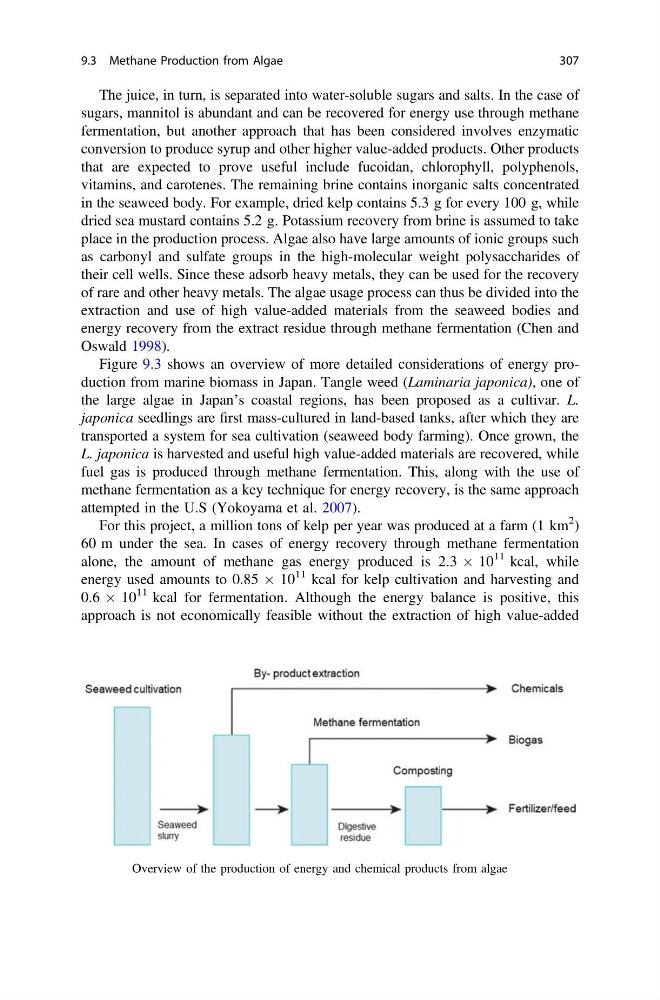
Figure 9.3 shows an overview of more detailed considerations of energy production from marine biomass in Japan. Tangle weed (Laminaria japonica), one of
the large algae in Japan’s coastal regions, has been proposed as a cultivar. L.
japonica seedlings are first mass-cultured in land-based tanks, after which they are
transported a system for sea cultivation (seaweed body farming). Once grown, the
L. japonica is harvested and useful high value-added materials are recovered, while
fuel gas is produced through methane fermentation. This, along with the use of
methane fermentation as a key technique for energy recovery, is the same approach
attempted in the U.S (Yokoyama et al. 2007).
For this project, a million tons of kelp per year was produced at a farm (1 km
2 )
60 m under the sea. In cases of energy recovery through methane fermentation
alone, the amount of methane gas energy produced is 2.3 Â 10
11 kcal, while
energy used amounts to 0.85 Â 10
11 kcal for kelp cultivation and harvesting and
0.6 Â 10
11 kcal for fermentation. Although the energy balance is positive, this
approach is not economically feasible without the extraction of high value-added
Fig. 9.3 Overview of the production of energy and chemical products from algae
9.3 Methane Production from Algae
307
sugars, mannitol is abundant and can be recovered for energy use through methane
fermentation, but another approach that has been considered involves enzymatic
conversion to produce syrup and other higher value-added products. Other products
that are expected to prove useful include fucoidan, chlorophyll, polyphenols,
vitamins, and carotenes. The remaining brine contains inorganic salts concentrated
in the seaweed body. For example, dried kelp contains 5.3 g for every 100 g, while
dried sea mustard contains 5.2 g. Potassium recovery from brine is assumed to take
place in the production process. Algae also have large amounts of ionic groups such
as carbonyl and sulfate groups in the high-molecular weight polysaccharides of
their cell wells. Since these adsorb heavy metals, they can be used for the recovery
of rare and other heavy metals. The algae usage process can thus be divided into the
extraction and use of high value-added materials from the seaweed bodies and
energy recovery from the extract residue through methane fermentation (Chen and
Oswald 1998).
Figure 9.3 shows an overview of more detailed considerations of energy production from marine biomass in Japan. Tangle weed (Laminaria japonica), one of
the large algae in Japan’s coastal regions, has been proposed as a cultivar. L.
japonica seedlings are first mass-cultured in land-based tanks, after which they are
transported a system for sea cultivation (seaweed body farming). Once grown, the
L. japonica is harvested and useful high value-added materials are recovered, while
fuel gas is produced through methane fermentation. This, along with the use of
methane fermentation as a key technique for energy recovery, is the same approach
attempted in the U.S (Yokoyama et al. 2007).
For this project, a million tons of kelp per year was produced at a farm (1 km
2 )
60 m under the sea. In cases of energy recovery through methane fermentation
alone, the amount of methane gas energy produced is 2.3 Â 10
11 kcal, while
energy used amounts to 0.85 Â 10
11 kcal for kelp cultivation and harvesting and
0.6 Â 10
11 kcal for fermentation. Although the energy balance is positive, this
approach is not economically feasible without the extraction of high value-added
Fig. 9.3 Overview of the production of energy and chemical products from algae
9.3 Methane Production from Algae
307