

In the case of methane fermentation of algae, one approach long considered in
the U.S. has involved the use of fermentation from the farming stages to produce
fuel from giant kelp (Nakashimada and Nishio 2011).
9.3.2 The Role of Methane Fermentation in Algae Systems
Using Cascades
The idea of using marine biomass for energy was first proposed in 1968 by the U.S.
scientist Howard Wilcox. By 1990, government agencies, universities, and private
enterprises were collaborating on a marine biomass energy program. For this
program, giant kelp (Macrocystis pyrifera) was proposed as a cultivar. A species of
brown algae, giant kelp is fast-growing and reaches lengths of up to 43 m.
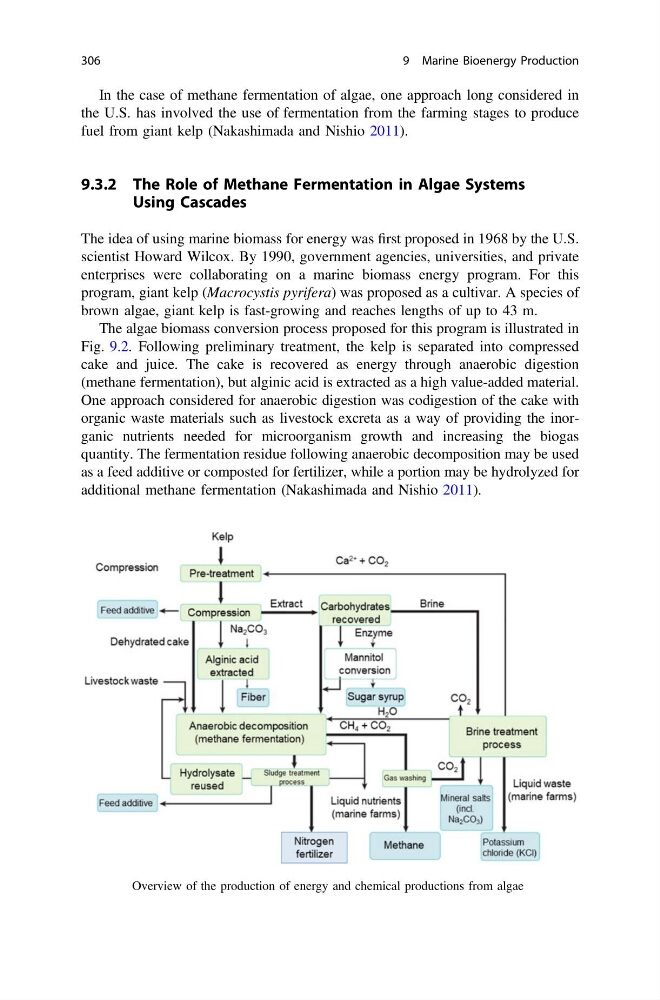
The algae biomass conversion process proposed for this program is illustrated in
Fig. 9.2. Following preliminary treatment, the kelp is separated into compressed
cake and juice. The cake is recovered as energy through anaerobic digestion
(methane fermentation), but alginic acid is extracted as a high value-added material.
One approach considered for anaerobic digestion was codigestion of the cake with
organic waste materials such as livestock excreta as a way of providing the inorganic nutrients needed for microorganism growth and increasing the biogas
quantity. The fermentation residue following anaerobic decomposition may be used
as a feed additive or composted for fertilizer, while a portion may be hydrolyzed for
additional methane fermentation (Nakashimada and Nishio 2011).
Fig. 9.2 Overview of the production of energy and chemical productions from algae
306
9 Marine Bioenergy Production
the U.S. has involved the use of fermentation from the farming stages to produce
fuel from giant kelp (Nakashimada and Nishio 2011).
9.3.2 The Role of Methane Fermentation in Algae Systems
Using Cascades
The idea of using marine biomass for energy was first proposed in 1968 by the U.S.
scientist Howard Wilcox. By 1990, government agencies, universities, and private
enterprises were collaborating on a marine biomass energy program. For this
program, giant kelp (Macrocystis pyrifera) was proposed as a cultivar. A species of
brown algae, giant kelp is fast-growing and reaches lengths of up to 43 m.
The algae biomass conversion process proposed for this program is illustrated in
Fig. 9.2. Following preliminary treatment, the kelp is separated into compressed
cake and juice. The cake is recovered as energy through anaerobic digestion
(methane fermentation), but alginic acid is extracted as a high value-added material.
One approach considered for anaerobic digestion was codigestion of the cake with
organic waste materials such as livestock excreta as a way of providing the inorganic nutrients needed for microorganism growth and increasing the biogas
quantity. The fermentation residue following anaerobic decomposition may be used
as a feed additive or composted for fertilizer, while a portion may be hydrolyzed for
additional methane fermentation (Nakashimada and Nishio 2011).
Fig. 9.2 Overview of the production of energy and chemical productions from algae
306
9 Marine Bioenergy Production