

byproducts. The prices of crude oil and other energy sources have risen sharply
since then, but this has not translated into large improvements in economic feasibility (Ni et al. 2006).
That feasibility improved if byproducts can be extracted and sold, but generation of
high value-added requires large energy consumption amounting to 3.7 Â 10
11 kcal for
the recovery and refinement process. This results in a minus value for actual energy
production, indicating that this cannot practically be used as an energy production
system. When one considers that energy issues will only grow more severe in the
future, however, the importance of building systems for exploiting methane fermentation of algae and its positive energy recovery rate becomes great. An important part of
this is optimizing the methane fermentation approach in terms of algae biomass.
9.3.3 Process of Methane Fermentation of Algae
The process of methane fermentation has long been a subject of research, and the
ultimate conversion of organic matter in algae into methane and carbon dioxide is
understood to take place through the combined efforts of groups of microorganisms.
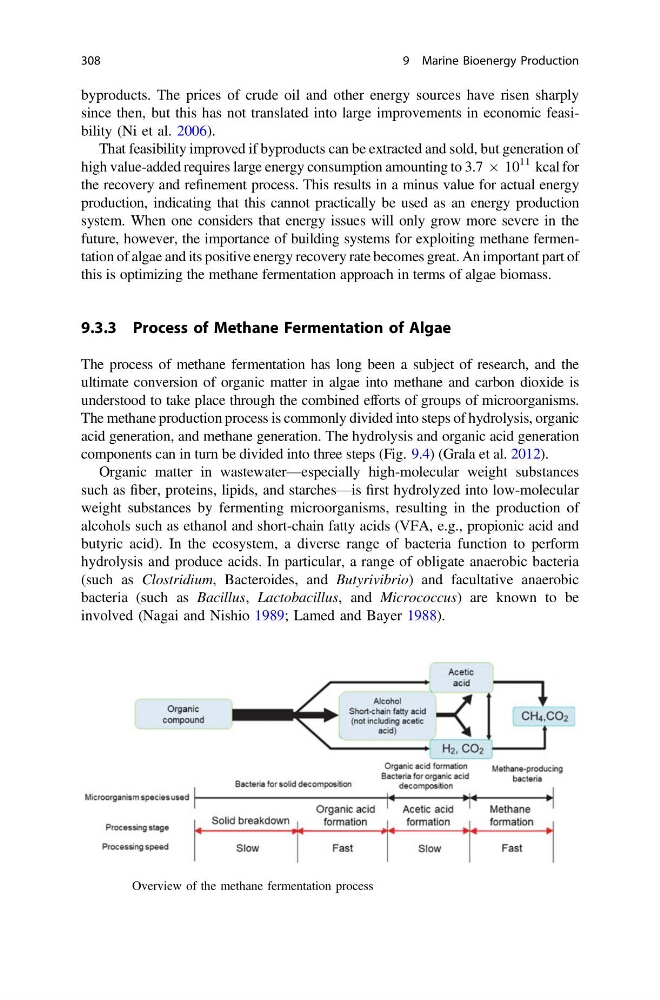
The methane production process is commonly divided into steps of hydrolysis, organic
acid generation, and methane generation. The hydrolysis and organic acid generation
components can in turn be divided into three steps (Fig. 9.4) (Grala et al. 2012).
Organic matter in wastewater—especially high-molecular weight substances
such as fiber, proteins, lipids, and starches—is first hydrolyzed into low-molecular
weight substances by fermenting microorganisms, resulting in the production of
alcohols such as ethanol and short-chain fatty acids (VFA, e.g., propionic acid and
butyric acid). In the ecosystem, a diverse range of bacteria function to perform
hydrolysis and produce acids. In particular, a range of obligate anaerobic bacteria
(such as Clostridium, Bacteroides, and Butyrivibrio) and facultative anaerobic
bacteria (such as Bacillus, Lactobacillus, and Micrococcus) are known to be
involved (Nagai and Nishio 1989; Lamed and Bayer 1988).
Fig. 9.4 Overview of the methane fermentation process
308
9 Marine Bioenergy Production
since then, but this has not translated into large improvements in economic feasibility (Ni et al. 2006).
That feasibility improved if byproducts can be extracted and sold, but generation of
high value-added requires large energy consumption amounting to 3.7 Â 10
11 kcal for
the recovery and refinement process. This results in a minus value for actual energy
production, indicating that this cannot practically be used as an energy production
system. When one considers that energy issues will only grow more severe in the
future, however, the importance of building systems for exploiting methane fermentation of algae and its positive energy recovery rate becomes great. An important part of
this is optimizing the methane fermentation approach in terms of algae biomass.
9.3.3 Process of Methane Fermentation of Algae
The process of methane fermentation has long been a subject of research, and the
ultimate conversion of organic matter in algae into methane and carbon dioxide is
understood to take place through the combined efforts of groups of microorganisms.
The methane production process is commonly divided into steps of hydrolysis, organic
acid generation, and methane generation. The hydrolysis and organic acid generation
components can in turn be divided into three steps (Fig. 9.4) (Grala et al. 2012).
Organic matter in wastewater—especially high-molecular weight substances
such as fiber, proteins, lipids, and starches—is first hydrolyzed into low-molecular
weight substances by fermenting microorganisms, resulting in the production of
alcohols such as ethanol and short-chain fatty acids (VFA, e.g., propionic acid and
butyric acid). In the ecosystem, a diverse range of bacteria function to perform
hydrolysis and produce acids. In particular, a range of obligate anaerobic bacteria
(such as Clostridium, Bacteroides, and Butyrivibrio) and facultative anaerobic
bacteria (such as Bacillus, Lactobacillus, and Micrococcus) are known to be
involved (Nagai and Nishio 1989; Lamed and Bayer 1988).
Fig. 9.4 Overview of the methane fermentation process
308
9 Marine Bioenergy Production