

been shown to exhibit the strongest activity. With the use of chitin in the recent
commercialization of absorbent sutures, wound treatment accelerators, and artificial
skin, the potential for additional uses in future medicines appears great.
(4) Diagnostics
Chitin oligosaccharides have long been known to degrade in the presence of
lysozymes. Attempts are currently being made to create the q-nitrophenyl
penta-N-acetyl-b-chitopentaoxide derivative (q-nitrophenol bonded to the hexose
lysate produced by lysozymes) for use as a lysozyme substrate. In addition to being
widely used in medicine as an antiphlogistic agent, lysozymes have been used as a
food preservative. They are also present in the blood and urine, where they are
reported to show higher than normal values when a person has contracted a disease.
Chitin oligosaccharide derivatives may therefore have potential applications in
clinic diagnosis of lysozyme activity, medicine, and food quality management.
(5) Cholesterol Improvement
When people consume lipids such as cholesterols, the lipids are typically not
absorbed in their regular state, but broken down by lipase (a fatty acid hydrolase
secreted by the pancreas), with the resulting products absorbed by the viscera.
Because lipids does not dissolve in solutions such as water, however, most lipidss
cluster together within the body (similar in principle to the way that vegetable oils
and water do not mix). Since these cannot be broken down by lipase, they tend not
to be absorbed by the body. Here, bile acid secreted by the duodenum plays a role
in helping to loosen the clusters of lipid so they can be broken down by lipase
(Fig. 8.31).
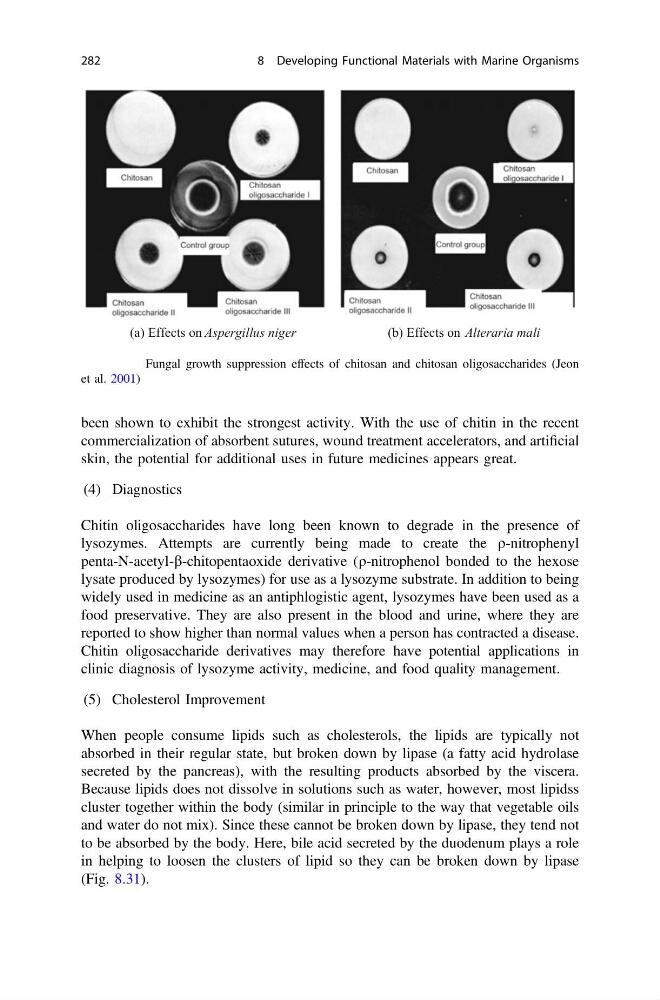
(a) Effects on Aspergillus niger
(b) Effects on Alteraria mali
Photo 8.1 Fungal growth suppression effects of chitosan and chitosan oligosaccharides (Jeon
et al. 2001)
282
8 Developing Functional Materials with Marine Organisms
commercialization of absorbent sutures, wound treatment accelerators, and artificial
skin, the potential for additional uses in future medicines appears great.
(4) Diagnostics
Chitin oligosaccharides have long been known to degrade in the presence of
lysozymes. Attempts are currently being made to create the q-nitrophenyl
penta-N-acetyl-b-chitopentaoxide derivative (q-nitrophenol bonded to the hexose
lysate produced by lysozymes) for use as a lysozyme substrate. In addition to being
widely used in medicine as an antiphlogistic agent, lysozymes have been used as a
food preservative. They are also present in the blood and urine, where they are
reported to show higher than normal values when a person has contracted a disease.
Chitin oligosaccharide derivatives may therefore have potential applications in
clinic diagnosis of lysozyme activity, medicine, and food quality management.
(5) Cholesterol Improvement
When people consume lipids such as cholesterols, the lipids are typically not
absorbed in their regular state, but broken down by lipase (a fatty acid hydrolase
secreted by the pancreas), with the resulting products absorbed by the viscera.
Because lipids does not dissolve in solutions such as water, however, most lipidss
cluster together within the body (similar in principle to the way that vegetable oils
and water do not mix). Since these cannot be broken down by lipase, they tend not
to be absorbed by the body. Here, bile acid secreted by the duodenum plays a role
in helping to loosen the clusters of lipid so they can be broken down by lipase
(Fig. 8.31).
(a) Effects on Aspergillus niger
(b) Effects on Alteraria mali
Photo 8.1 Fungal growth suppression effects of chitosan and chitosan oligosaccharides (Jeon
et al. 2001)
282
8 Developing Functional Materials with Marine Organisms