

(1) Dietary Fiber
Recent recognition of the importance of dietary fiber has led to active research in
the field. Since chitin and chitosan are not hydrolyzed by human digestive enzymes,
they may be used as sources of dietary fiber. Mice that were fed high-cholesterol
feed (0.5% cholesterol) with 5% added chitosan powder for 20 days showed no
effects on growth, but marked reductions in blood and liver cholesterol.
Chitosan has also been shown to have functions in terms of processing harmful
toxins present in food. If has been found to exhibit toxicity prevention effects with
food dyes Red No. 2 and Red No. 105 that were not present in dietary fiber. This is
the result of pigments binding strongly with the chitosan, resulting in reduced
absorption.
(2) Antibacterial and Antifungal Agents
Chitosan and its lysates have already been shown to inhibit the growth of fungi that
are pathogenic to plants. They have also demonstrated marked growth suppression
effects on E. coli, B. subius, S. aureus, and other bacteria. At the same time,
bacterial and fungal growth suppression efforts have been shown to differ according
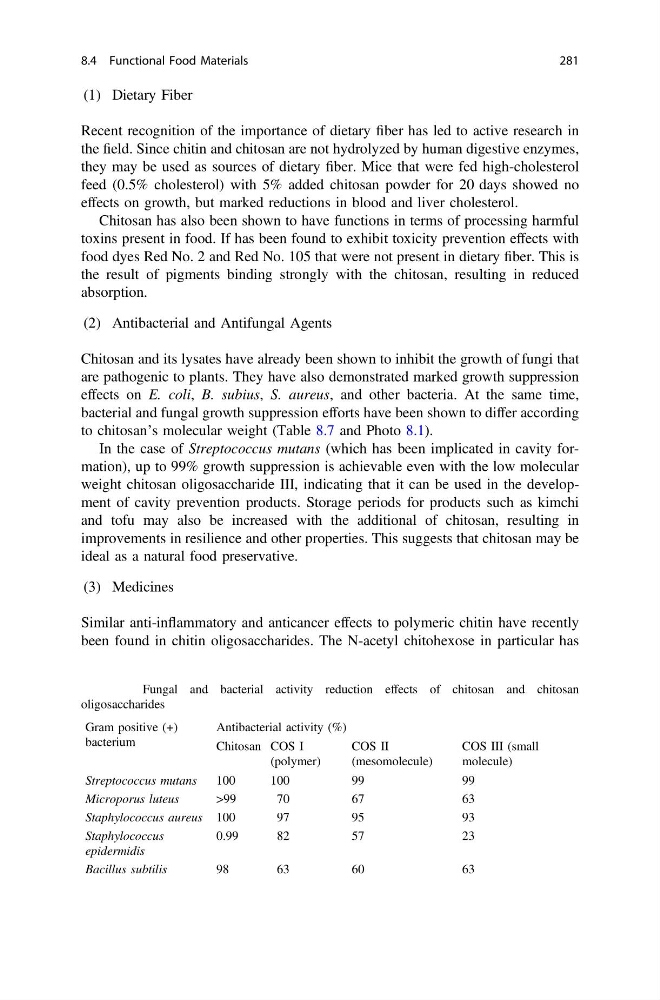
to chitosan’s molecular weight (Table 8.7 and Photo 8.1).
In the case of Streptococcus mutans (which has been implicated in cavity formation), up to 99% growth suppression is achievable even with the low molecular
weight chitosan oligosaccharide III, indicating that it can be used in the development of cavity prevention products. Storage periods for products such as kimchi
and tofu may also be increased with the additional of chitosan, resulting in
improvements in resilience and other properties. This suggests that chitosan may be
ideal as a natural food preservative.
(3) Medicines
Similar anti-inflammatory and anticancer effects to polymeric chitin have recently
been found in chitin oligosaccharides. The N-acetyl chitohexose in particular has
Table 8.7 Fungal and bacterial activity reduction effects of chitosan and chitosan
oligosaccharides
Gram positive (+)
bacterium
Antibacterial activity (%)
Chitosan COS I
(polymer)
COS II
(mesomolecule)
COS III (small
molecule)
Streptococcus mutans
100
100
99
99
Microporus luteus
>99
70
67
63
Staphylococcus aureus 100
97
95
93
Staphylococcus
epidermidis
0.99
82
57
23
Bacillus subtilis
98
63
60
63
8.4 Functional Food Materials
281
Recent recognition of the importance of dietary fiber has led to active research in
the field. Since chitin and chitosan are not hydrolyzed by human digestive enzymes,
they may be used as sources of dietary fiber. Mice that were fed high-cholesterol
feed (0.5% cholesterol) with 5% added chitosan powder for 20 days showed no
effects on growth, but marked reductions in blood and liver cholesterol.
Chitosan has also been shown to have functions in terms of processing harmful
toxins present in food. If has been found to exhibit toxicity prevention effects with
food dyes Red No. 2 and Red No. 105 that were not present in dietary fiber. This is
the result of pigments binding strongly with the chitosan, resulting in reduced
absorption.
(2) Antibacterial and Antifungal Agents
Chitosan and its lysates have already been shown to inhibit the growth of fungi that
are pathogenic to plants. They have also demonstrated marked growth suppression
effects on E. coli, B. subius, S. aureus, and other bacteria. At the same time,
bacterial and fungal growth suppression efforts have been shown to differ according
to chitosan’s molecular weight (Table 8.7 and Photo 8.1).
In the case of Streptococcus mutans (which has been implicated in cavity formation), up to 99% growth suppression is achievable even with the low molecular
weight chitosan oligosaccharide III, indicating that it can be used in the development of cavity prevention products. Storage periods for products such as kimchi
and tofu may also be increased with the additional of chitosan, resulting in
improvements in resilience and other properties. This suggests that chitosan may be
ideal as a natural food preservative.
(3) Medicines
Similar anti-inflammatory and anticancer effects to polymeric chitin have recently
been found in chitin oligosaccharides. The N-acetyl chitohexose in particular has
Table 8.7 Fungal and bacterial activity reduction effects of chitosan and chitosan
oligosaccharides
Gram positive (+)
bacterium
Antibacterial activity (%)
Chitosan COS I
(polymer)
COS II
(mesomolecule)
COS III (small
molecule)
Streptococcus mutans
100
100
99
99
Microporus luteus
>99
70
67
63
Staphylococcus aureus 100
97
95
93
Staphylococcus
epidermidis
0.99
82
57
23
Bacillus subtilis
98
63
60
63
8.4 Functional Food Materials
281