

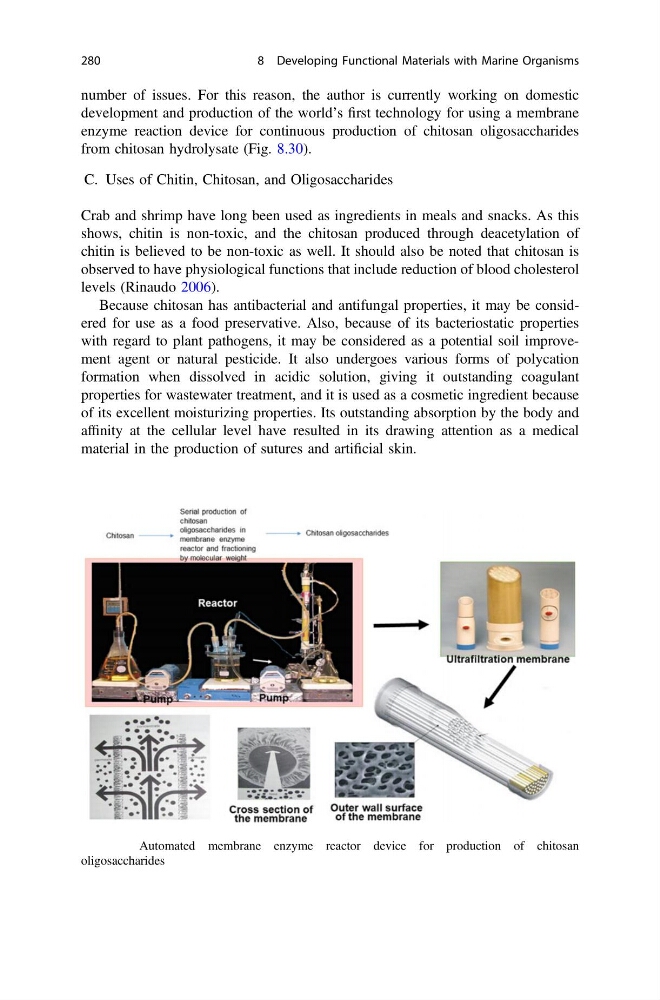
number of issues. For this reason, the author is currently working on domestic
development and production of the world’s first technology for using a membrane
enzyme reaction device for continuous production of chitosan oligosaccharides
from chitosan hydrolysate (Fig. 8.30).
C. Uses of Chitin, Chitosan, and Oligosaccharides
Crab and shrimp have long been used as ingredients in meals and snacks. As this
shows, chitin is non-toxic, and the chitosan produced through deacetylation of
chitin is believed to be non-toxic as well. It should also be noted that chitosan is
observed to have physiological functions that include reduction of blood cholesterol
levels (Rinaudo 2006).
Because chitosan has antibacterial and antifungal properties, it may be considered for use as a food preservative. Also, because of its bacteriostatic properties
with regard to plant pathogens, it may be considered as a potential soil improvement agent or natural pesticide. It also undergoes various forms of polycation
formation when dissolved in acidic solution, giving it outstanding coagulant
properties for wastewater treatment, and it is used as a cosmetic ingredient because
of its excellent moisturizing properties. Its outstanding absorption by the body and
affinity at the cellular level have resulted in its drawing attention as a medical
material in the production of sutures and artificial skin.
Fig. 8.30 Automated membrane enzyme reactor device for production of chitosan
oligosaccharides
280
8 Developing Functional Materials with Marine Organisms
development and production of the world’s first technology for using a membrane
enzyme reaction device for continuous production of chitosan oligosaccharides
from chitosan hydrolysate (Fig. 8.30).
C. Uses of Chitin, Chitosan, and Oligosaccharides
Crab and shrimp have long been used as ingredients in meals and snacks. As this
shows, chitin is non-toxic, and the chitosan produced through deacetylation of
chitin is believed to be non-toxic as well. It should also be noted that chitosan is
observed to have physiological functions that include reduction of blood cholesterol
levels (Rinaudo 2006).
Because chitosan has antibacterial and antifungal properties, it may be considered for use as a food preservative. Also, because of its bacteriostatic properties
with regard to plant pathogens, it may be considered as a potential soil improvement agent or natural pesticide. It also undergoes various forms of polycation
formation when dissolved in acidic solution, giving it outstanding coagulant
properties for wastewater treatment, and it is used as a cosmetic ingredient because
of its excellent moisturizing properties. Its outstanding absorption by the body and
affinity at the cellular level have resulted in its drawing attention as a medical
material in the production of sutures and artificial skin.
Fig. 8.30 Automated membrane enzyme reactor device for production of chitosan
oligosaccharides
280
8 Developing Functional Materials with Marine Organisms