

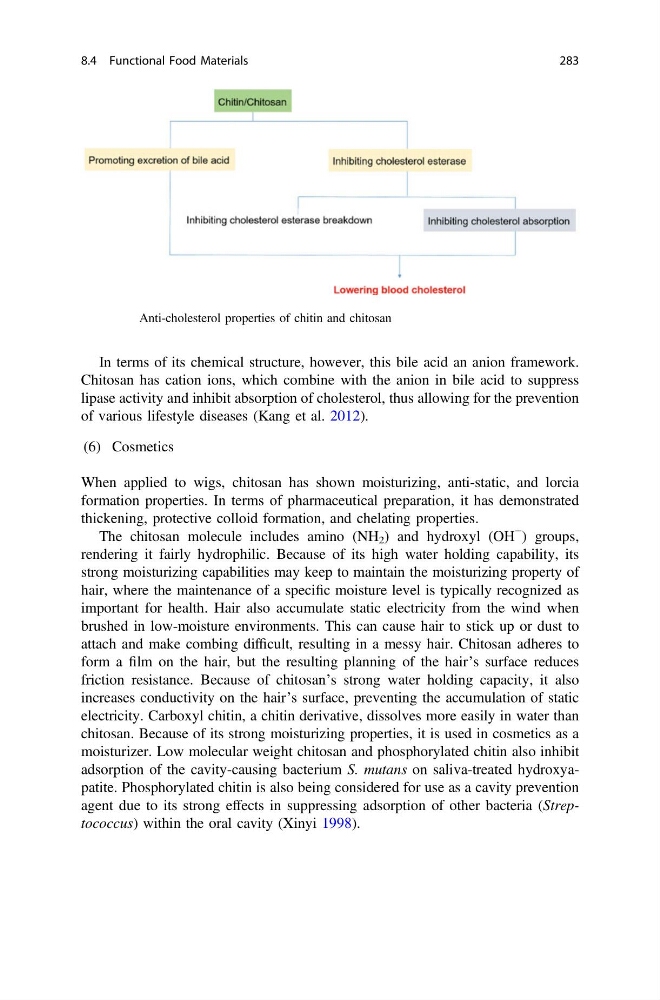
In terms of its chemical structure, however, this bile acid an anion framework.
Chitosan has cation ions, which combine with the anion in bile acid to suppress
lipase activity and inhibit absorption of cholesterol, thus allowing for the prevention
of various lifestyle diseases (Kang et al. 2012).
(6) Cosmetics
When applied to wigs, chitosan has shown moisturizing, anti-static, and lorcia
formation properties. In terms of pharmaceutical preparation, it has demonstrated
thickening, protective colloid formation, and chelating properties.
The chitosan molecule includes amino (NH 2 ) and hydroxyl (OH
− ) groups,
rendering it fairly hydrophilic. Because of its high water holding capability, its
strong moisturizing capabilities may keep to maintain the moisturizing property of
hair, where the maintenance of a specific moisture level is typically recognized as
important for health. Hair also accumulate static electricity from the wind when
brushed in low-moisture environments. This can cause hair to stick up or dust to
attach and make combing difficult, resulting in a messy hair. Chitosan adheres to
form a film on the hair, but the resulting planning of the hair’s surface reduces
friction resistance. Because of chitosan’s strong water holding capacity, it also
increases conductivity on the hair’s surface, preventing the accumulation of static
electricity. Carboxyl chitin, a chitin derivative, dissolves more easily in water than
chitosan. Because of its strong moisturizing properties, it is used in cosmetics as a
moisturizer. Low molecular weight chitosan and phosphorylated chitin also inhibit
adsorption of the cavity-causing bacterium S. mutans on saliva-treated hydroxyapatite. Phosphorylated chitin is also being considered for use as a cavity prevention
agent due to its strong effects in suppressing adsorption of other bacteria (Streptococcus) within the oral cavity (Xinyi 1998).
Fig. 8.31 Anti-cholesterol properties of chitin and chitosan
8.4 Functional Food Materials
283
Chitosan has cation ions, which combine with the anion in bile acid to suppress
lipase activity and inhibit absorption of cholesterol, thus allowing for the prevention
of various lifestyle diseases (Kang et al. 2012).
(6) Cosmetics
When applied to wigs, chitosan has shown moisturizing, anti-static, and lorcia
formation properties. In terms of pharmaceutical preparation, it has demonstrated
thickening, protective colloid formation, and chelating properties.
The chitosan molecule includes amino (NH 2 ) and hydroxyl (OH
− ) groups,
rendering it fairly hydrophilic. Because of its high water holding capability, its
strong moisturizing capabilities may keep to maintain the moisturizing property of
hair, where the maintenance of a specific moisture level is typically recognized as
important for health. Hair also accumulate static electricity from the wind when
brushed in low-moisture environments. This can cause hair to stick up or dust to
attach and make combing difficult, resulting in a messy hair. Chitosan adheres to
form a film on the hair, but the resulting planning of the hair’s surface reduces
friction resistance. Because of chitosan’s strong water holding capacity, it also
increases conductivity on the hair’s surface, preventing the accumulation of static
electricity. Carboxyl chitin, a chitin derivative, dissolves more easily in water than
chitosan. Because of its strong moisturizing properties, it is used in cosmetics as a
moisturizer. Low molecular weight chitosan and phosphorylated chitin also inhibit
adsorption of the cavity-causing bacterium S. mutans on saliva-treated hydroxyapatite. Phosphorylated chitin is also being considered for use as a cavity prevention
agent due to its strong effects in suppressing adsorption of other bacteria (Streptococcus) within the oral cavity (Xinyi 1998).
Fig. 8.31 Anti-cholesterol properties of chitin and chitosan
8.4 Functional Food Materials
283