

fucoidans had previously been thought to have complex structures, Sasaki’s
research showed the structures to actually be relatively simple and repetitive.
The main focus of the structural research by Sakai et al. was on fucoidans
derived from Japanese kelp. To date, three types of fucoidans from Kagome seaweed have been broken down to identify enzymes providing oligosaccharides with
iterative structural units, which have then been used to analyze the fucoidans’
structure.
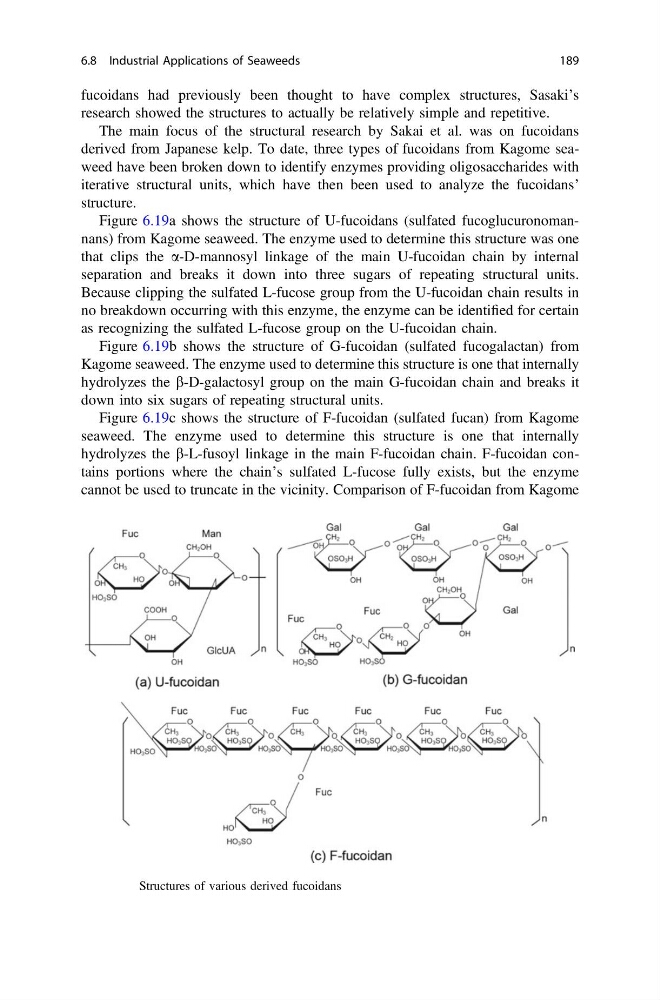
Figure 6.19a shows the structure of U-fucoidans (sulfated fucoglucuronomannans) from Kagome seaweed. The enzyme used to determine this structure was one
that clips the a-D-mannosyl linkage of the main U-fucoidan chain by internal
separation and breaks it down into three sugars of repeating structural units.
Because clipping the sulfated L-fucose group from the U-fucoidan chain results in
no breakdown occurring with this enzyme, the enzyme can be identified for certain
as recognizing the sulfated L-fucose group on the U-fucoidan chain.
Figure 6.19b shows the structure of G-fucoidan (sulfated fucogalactan) from
Kagome seaweed. The enzyme used to determine this structure is one that internally
hydrolyzes the b-D-galactosyl group on the main G-fucoidan chain and breaks it
down into six sugars of repeating structural units.
Figure 6.19c shows the structure of F-fucoidan (sulfated fucan) from Kagome
seaweed. The enzyme used to determine this structure is one that internally
hydrolyzes the b-L-fusoyl linkage in the main F-fucoidan chain. F-fucoidan contains portions where the chain’s sulfated L-fucose fully exists, but the enzyme
cannot be used to truncate in the vicinity. Comparison of F-fucoidan from Kagome
Fig. 6.19 Structures of various derived fucoidans
6.8 Industrial Applications of Seaweeds
189
research showed the structures to actually be relatively simple and repetitive.
The main focus of the structural research by Sakai et al. was on fucoidans
derived from Japanese kelp. To date, three types of fucoidans from Kagome seaweed have been broken down to identify enzymes providing oligosaccharides with
iterative structural units, which have then been used to analyze the fucoidans’
structure.
Figure 6.19a shows the structure of U-fucoidans (sulfated fucoglucuronomannans) from Kagome seaweed. The enzyme used to determine this structure was one
that clips the a-D-mannosyl linkage of the main U-fucoidan chain by internal
separation and breaks it down into three sugars of repeating structural units.
Because clipping the sulfated L-fucose group from the U-fucoidan chain results in
no breakdown occurring with this enzyme, the enzyme can be identified for certain
as recognizing the sulfated L-fucose group on the U-fucoidan chain.
Figure 6.19b shows the structure of G-fucoidan (sulfated fucogalactan) from
Kagome seaweed. The enzyme used to determine this structure is one that internally
hydrolyzes the b-D-galactosyl group on the main G-fucoidan chain and breaks it
down into six sugars of repeating structural units.
Figure 6.19c shows the structure of F-fucoidan (sulfated fucan) from Kagome
seaweed. The enzyme used to determine this structure is one that internally
hydrolyzes the b-L-fusoyl linkage in the main F-fucoidan chain. F-fucoidan contains portions where the chain’s sulfated L-fucose fully exists, but the enzyme
cannot be used to truncate in the vicinity. Comparison of F-fucoidan from Kagome
Fig. 6.19 Structures of various derived fucoidans
6.8 Industrial Applications of Seaweeds
189