

Failure to at least state the name of the source seaweed when discussing the
structure and bioactivity of fucoidans may result in a profusion of differing structures or the belief in bioactivity that cannot be identified within fucoidans of a
particular seaweed, which are ultimately detrimental to healthy development of the
fucoidan industry.
B. Fucoidan Structure
While fucoidan structure has been reported in the literature as universal, this has
generally been one of the average fucoidan structures derived from the brown alga
Fucus vesiculosus as determined around 1950.
While the structure of fucoidans derived from F. vesiculosus has been subjected
to repeated analysis since then, the principal chain chemical structure was only
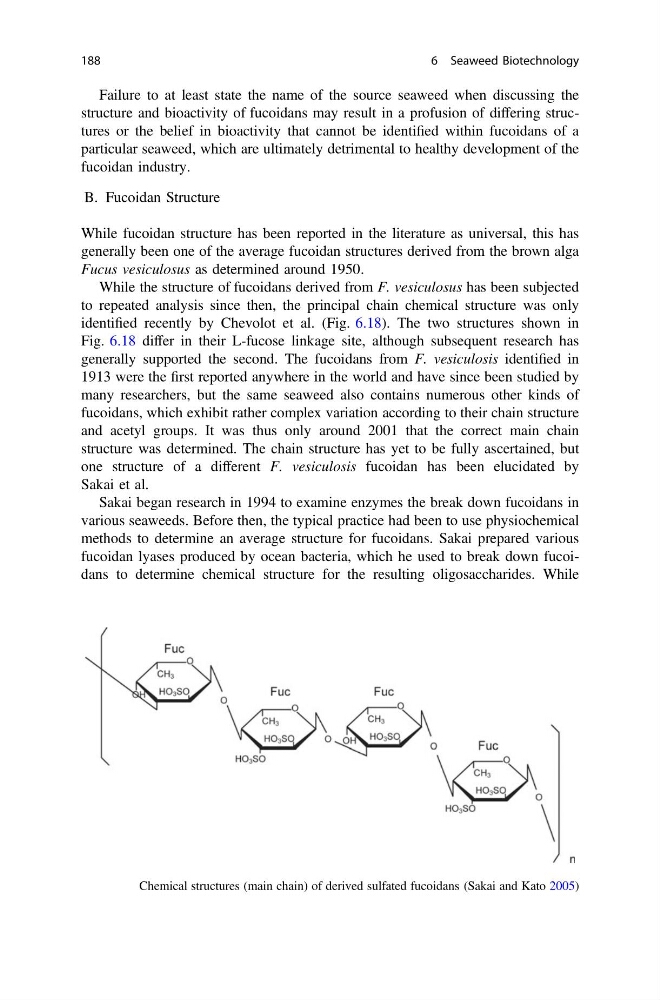
identified recently by Chevolot et al. (Fig. 6.18). The two structures shown in
Fig. 6.18 differ in their L-fucose linkage site, although subsequent research has
generally supported the second. The fucoidans from F. vesiculosis identified in
1913 were the first reported anywhere in the world and have since been studied by
many researchers, but the same seaweed also contains numerous other kinds of
fucoidans, which exhibit rather complex variation according to their chain structure
and acetyl groups. It was thus only around 2001 that the correct main chain
structure was determined. The chain structure has yet to be fully ascertained, but
one structure of a different F. vesiculosis fucoidan has been elucidated by
Sakai et al.
Sakai began research in 1994 to examine enzymes the break down fucoidans in
various seaweeds. Before then, the typical practice had been to use physiochemical
methods to determine an average structure for fucoidans. Sakai prepared various
fucoidan lyases produced by ocean bacteria, which he used to break down fucoidans to determine chemical structure for the resulting oligosaccharides. While
Fig. 6.18 Chemical structures (main chain) of derived sulfated fucoidans (Sakai and Kato 2005)
188
6 Seaweed Biotechnology
structure and bioactivity of fucoidans may result in a profusion of differing structures or the belief in bioactivity that cannot be identified within fucoidans of a
particular seaweed, which are ultimately detrimental to healthy development of the
fucoidan industry.
B. Fucoidan Structure
While fucoidan structure has been reported in the literature as universal, this has
generally been one of the average fucoidan structures derived from the brown alga
Fucus vesiculosus as determined around 1950.
While the structure of fucoidans derived from F. vesiculosus has been subjected
to repeated analysis since then, the principal chain chemical structure was only
identified recently by Chevolot et al. (Fig. 6.18). The two structures shown in
Fig. 6.18 differ in their L-fucose linkage site, although subsequent research has
generally supported the second. The fucoidans from F. vesiculosis identified in
1913 were the first reported anywhere in the world and have since been studied by
many researchers, but the same seaweed also contains numerous other kinds of
fucoidans, which exhibit rather complex variation according to their chain structure
and acetyl groups. It was thus only around 2001 that the correct main chain
structure was determined. The chain structure has yet to be fully ascertained, but
one structure of a different F. vesiculosis fucoidan has been elucidated by
Sakai et al.
Sakai began research in 1994 to examine enzymes the break down fucoidans in
various seaweeds. Before then, the typical practice had been to use physiochemical
methods to determine an average structure for fucoidans. Sakai prepared various
fucoidan lyases produced by ocean bacteria, which he used to break down fucoidans to determine chemical structure for the resulting oligosaccharides. While
Fig. 6.18 Chemical structures (main chain) of derived sulfated fucoidans (Sakai and Kato 2005)
188
6 Seaweed Biotechnology