

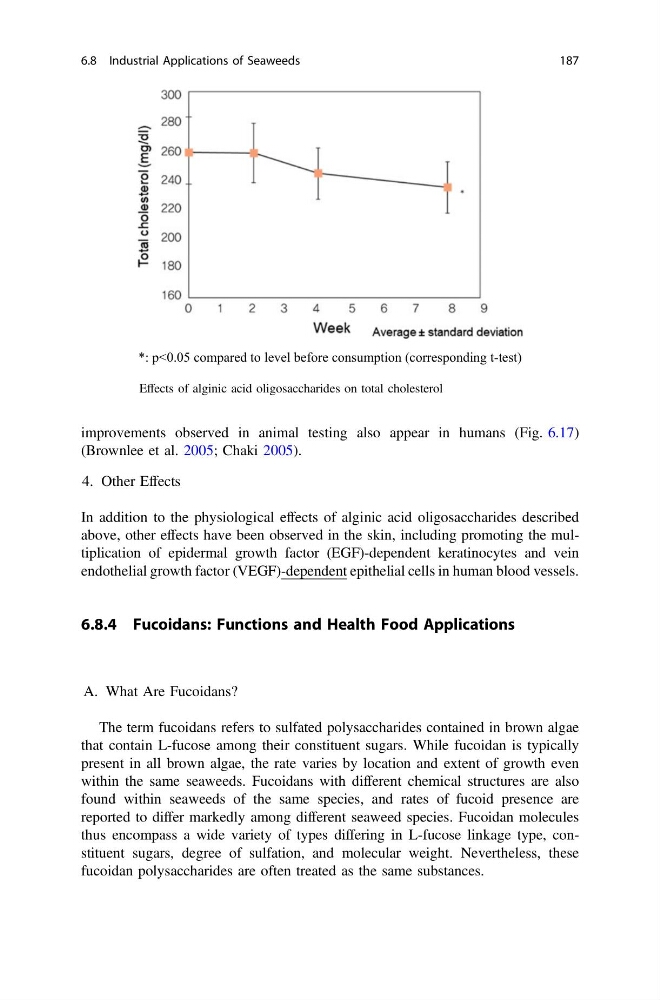
improvements observed in animal testing also appear in humans (Fig. 6.17)
(Brownlee et al. 2005; Chaki 2005).
4. Other Effects
In addition to the physiological effects of alginic acid oligosaccharides described
above, other effects have been observed in the skin, including promoting the multiplication of epidermal growth factor (EGF)-dependent keratinocytes and vein
endothelial growth factor (VEGF)-dependent epithelial cells in human blood vessels.
6.8.4 Fucoidans: Functions and Health Food Applications
A. What Are Fucoidans?
The term fucoidans refers to sulfated polysaccharides contained in brown algae
that contain L-fucose among their constituent sugars. While fucoidan is typically
present in all brown algae, the rate varies by location and extent of growth even
within the same seaweeds. Fucoidans with different chemical structures are also
found within seaweeds of the same species, and rates of fucoid presence are
reported to differ markedly among different seaweed species. Fucoidan molecules
thus encompass a wide variety of types differing in L-fucose linkage type, constituent sugars, degree of sulfation, and molecular weight. Nevertheless, these
fucoidan polysaccharides are often treated as the same substances.
*: p<0.05 compared to level before consumption (corresponding t-test)
Fig. 6.17 Effects of alginic acid oligosaccharides on total cholesterol
6.8 Industrial Applications of Seaweeds
187
(Brownlee et al. 2005; Chaki 2005).
4. Other Effects
In addition to the physiological effects of alginic acid oligosaccharides described
above, other effects have been observed in the skin, including promoting the multiplication of epidermal growth factor (EGF)-dependent keratinocytes and vein
endothelial growth factor (VEGF)-dependent epithelial cells in human blood vessels.
6.8.4 Fucoidans: Functions and Health Food Applications
A. What Are Fucoidans?
The term fucoidans refers to sulfated polysaccharides contained in brown algae
that contain L-fucose among their constituent sugars. While fucoidan is typically
present in all brown algae, the rate varies by location and extent of growth even
within the same seaweeds. Fucoidans with different chemical structures are also
found within seaweeds of the same species, and rates of fucoid presence are
reported to differ markedly among different seaweed species. Fucoidan molecules
thus encompass a wide variety of types differing in L-fucose linkage type, constituent sugars, degree of sulfation, and molecular weight. Nevertheless, these
fucoidan polysaccharides are often treated as the same substances.
*: p<0.05 compared to level before consumption (corresponding t-test)
Fig. 6.17 Effects of alginic acid oligosaccharides on total cholesterol
6.8 Industrial Applications of Seaweeds
187