

ions in the absorbed salts breaks down. As with other foods containing salts, when
potassium alginate is absorbed in the body, potassium is removed from the alginates
due to gastric acid within the stomach. Because the small intestine is weak alkaline,
alginic acid transferred to the intestines combined with some of the sodium ions
also consumed and expelled from the body as waste. This occurs due to the ion
exchange reactions chemically characteristic of alginic acid that take place in
digestive organs. Potassium ions removed from alginic acid are absorbed by the
interests and drive out sodium from the blood. Alginic salts thus reduce blood
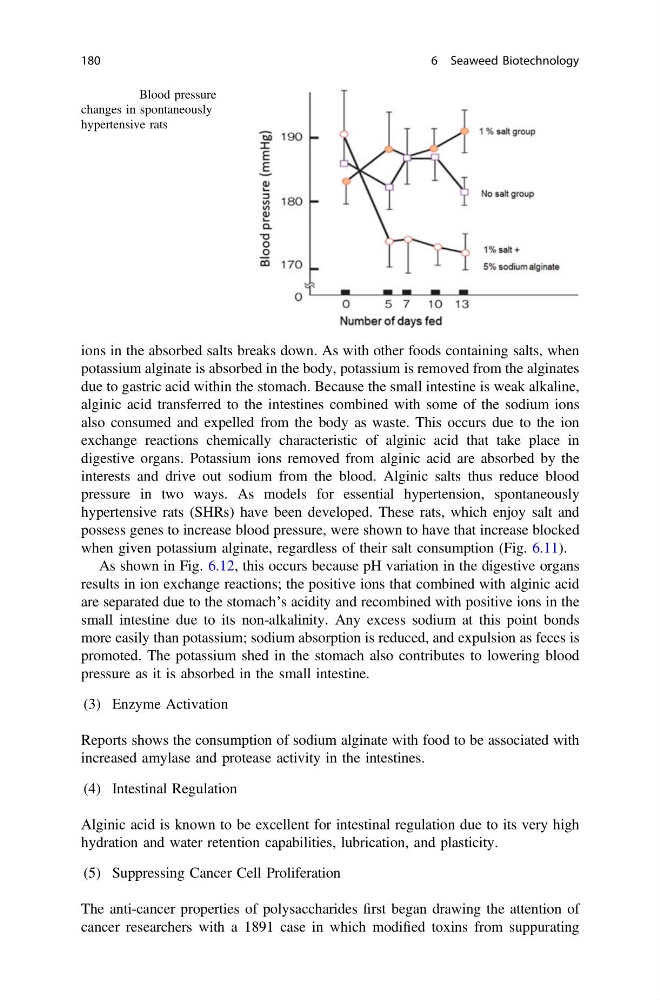
pressure in two ways. As models for essential hypertension, spontaneously
hypertensive rats (SHRs) have been developed. These rats, which enjoy salt and
possess genes to increase blood pressure, were shown to have that increase blocked
when given potassium alginate, regardless of their salt consumption (Fig. 6.11).
As shown in Fig. 6.12, this occurs because pH variation in the digestive organs
results in ion exchange reactions; the positive ions that combined with alginic acid
are separated due to the stomach’s acidity and recombined with positive ions in the
small intestine due to its non-alkalinity. Any excess sodium at this point bonds
more easily than potassium; sodium absorption is reduced, and expulsion as feces is
promoted. The potassium shed in the stomach also contributes to lowering blood
pressure as it is absorbed in the small intestine.
(3) Enzyme Activation
Reports shows the consumption of sodium alginate with food to be associated with
increased amylase and protease activity in the intestines.
(4) Intestinal Regulation
Alginic acid is known to be excellent for intestinal regulation due to its very high
hydration and water retention capabilities, lubrication, and plasticity.
(5) Suppressing Cancer Cell Proliferation
The anti-cancer properties of polysaccharides first began drawing the attention of
cancer researchers with a 1891 case in which modified toxins from suppurating
Fig. 6.11 Blood pressure
changes in spontaneously
hypertensive rats
180
6 Seaweed Biotechnology
potassium alginate is absorbed in the body, potassium is removed from the alginates
due to gastric acid within the stomach. Because the small intestine is weak alkaline,
alginic acid transferred to the intestines combined with some of the sodium ions
also consumed and expelled from the body as waste. This occurs due to the ion
exchange reactions chemically characteristic of alginic acid that take place in
digestive organs. Potassium ions removed from alginic acid are absorbed by the
interests and drive out sodium from the blood. Alginic salts thus reduce blood
pressure in two ways. As models for essential hypertension, spontaneously
hypertensive rats (SHRs) have been developed. These rats, which enjoy salt and
possess genes to increase blood pressure, were shown to have that increase blocked
when given potassium alginate, regardless of their salt consumption (Fig. 6.11).
As shown in Fig. 6.12, this occurs because pH variation in the digestive organs
results in ion exchange reactions; the positive ions that combined with alginic acid
are separated due to the stomach’s acidity and recombined with positive ions in the
small intestine due to its non-alkalinity. Any excess sodium at this point bonds
more easily than potassium; sodium absorption is reduced, and expulsion as feces is
promoted. The potassium shed in the stomach also contributes to lowering blood
pressure as it is absorbed in the small intestine.
(3) Enzyme Activation
Reports shows the consumption of sodium alginate with food to be associated with
increased amylase and protease activity in the intestines.
(4) Intestinal Regulation
Alginic acid is known to be excellent for intestinal regulation due to its very high
hydration and water retention capabilities, lubrication, and plasticity.
(5) Suppressing Cancer Cell Proliferation
The anti-cancer properties of polysaccharides first began drawing the attention of
cancer researchers with a 1891 case in which modified toxins from suppurating
Fig. 6.11 Blood pressure
changes in spontaneously
hypertensive rats
180
6 Seaweed Biotechnology