

Streptococcus and Serratia macescens culturing filtrate were shown to have a
marked effect when used with inoperable cancer patients, and with a 1936 study
showing the effective ingredient to be polysaccharides contained with the bacteria.
In terms of anti-cancer polysaccharides found in seaweeds, anti-cancer activity
screening tests of various seaweed-derived polysaccharides in 1959 reported
marked effects when alginic acid (prepared from kelp) and mesogloea (a polysaccharide from Mesogloea divaricate) were introduced within the abdominal cavities
of cancerous mice (which had sarcoma 37 cells transplanted in them).
Injection of alginic acid refined from sargassum into the abdominal cavities of
mice implanted with sarcoma 180 solid tumor cells resulted in a 50% reduction in
growth for those cells. Proliferation of sarcoma solid tumor cells was also found to
be suppressed when alginic acid marketed as reagent was introduced in the
abdominal cavity (Yamada 2001).
D. Alginic Acid Oligosaccharide Functions
The alginic acid polysaccharides that are the source of alginic acid oligosaccharides
are found in brown algae (most notably kelp, sea mustard, and hijiki). They are
naturally acidic with a characteristic molecular weight of 2.7 million, and exist mostly
between the seaweed’s tissue cells in calcium salt form, keeping the seaweed flexible
and tough. Alginic acid polysaccharide content is between 20 and 50% of the dry
seaweed mass and consists of straight chain polymers made up of two types of uronic
acids, namely D-mannuronic acid with a b-1,4 linkage (M) and L-guluronic acid with
an a-1,4 linkage (G).
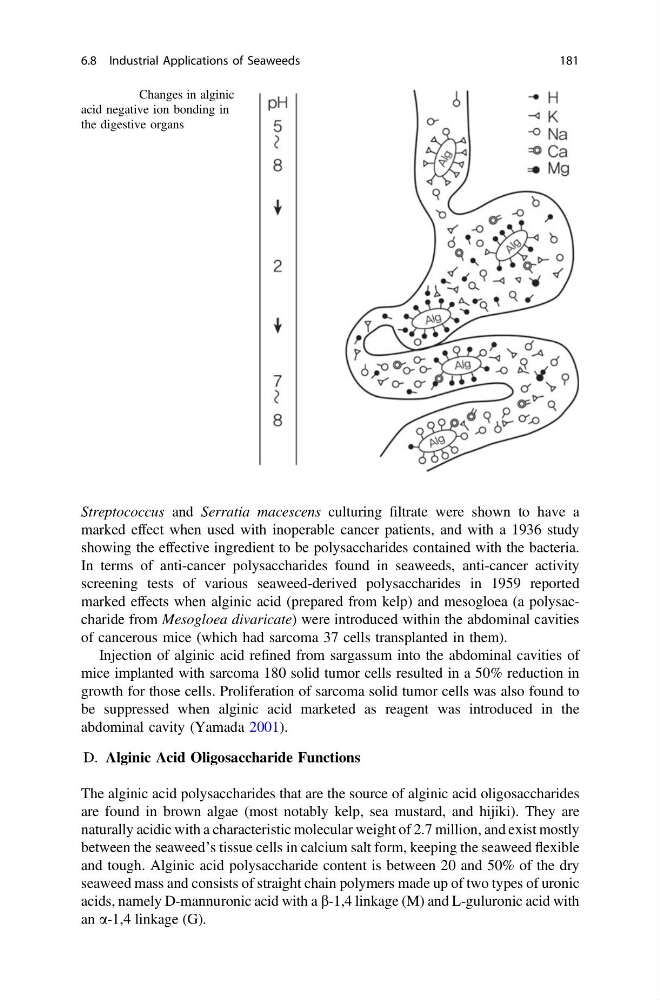
Fig. 6.12 Changes in alginic
acid negative ion bonding in
the digestive organs
6.8 Industrial Applications of Seaweeds
181
marked effect when used with inoperable cancer patients, and with a 1936 study
showing the effective ingredient to be polysaccharides contained with the bacteria.
In terms of anti-cancer polysaccharides found in seaweeds, anti-cancer activity
screening tests of various seaweed-derived polysaccharides in 1959 reported
marked effects when alginic acid (prepared from kelp) and mesogloea (a polysaccharide from Mesogloea divaricate) were introduced within the abdominal cavities
of cancerous mice (which had sarcoma 37 cells transplanted in them).
Injection of alginic acid refined from sargassum into the abdominal cavities of
mice implanted with sarcoma 180 solid tumor cells resulted in a 50% reduction in
growth for those cells. Proliferation of sarcoma solid tumor cells was also found to
be suppressed when alginic acid marketed as reagent was introduced in the
abdominal cavity (Yamada 2001).
D. Alginic Acid Oligosaccharide Functions
The alginic acid polysaccharides that are the source of alginic acid oligosaccharides
are found in brown algae (most notably kelp, sea mustard, and hijiki). They are
naturally acidic with a characteristic molecular weight of 2.7 million, and exist mostly
between the seaweed’s tissue cells in calcium salt form, keeping the seaweed flexible
and tough. Alginic acid polysaccharide content is between 20 and 50% of the dry
seaweed mass and consists of straight chain polymers made up of two types of uronic
acids, namely D-mannuronic acid with a b-1,4 linkage (M) and L-guluronic acid with
an a-1,4 linkage (G).
Fig. 6.12 Changes in alginic
acid negative ion bonding in
the digestive organs
6.8 Industrial Applications of Seaweeds
181