

Research has confirmed that raising white mice with food triggering hypercholesterolemia (including 1% cholesterol and 0.25% bile acid) combined with 5%
sodium alginate showed effects in preventing rises in concentrations of serum
cholesterol, cholesterol in the liver, and total lipids and fatty acids. PGA also has an
effect in suppressing an increase in serum cholesterol, but that effect has been
confirmed not to be present in propylene glycol itself. Reports have additionally
shown that rats given food mixed with cholesterol showed a rise in their cholesterol
level over the short term, but that the increase was suppressed (albeit weakly)
compared to konjac mannan or pectin when 5% sodium alginate was mixed in
(Jiménez-Escrig and Sánchez-Muniz 2000; Yoshida et al. 2004; Draget et al. Draget
2005).
To examine the effects of sodium alginate of different viscosities (high and low)
on intestinal flora and serum lipids, male rats were given food containing 2% alginic
acid salts for seven days. No significant effect was observed for the high viscosity
condition, but pH in the appendix was markedly reduced in the low-viscosity
condition, and serum triglyceride and cholesterol levels decreased (Fig. 6.10). The
findings suggest that food containing sodium alginate of different viscosity has
differ effects on intestinal flora and serum lipid levels.
(1) Reducing Hypertension
Hypertension is reported to result from excessive salt consumption. This results
from contraction of the blood vessels as the balance between sodium and calcium
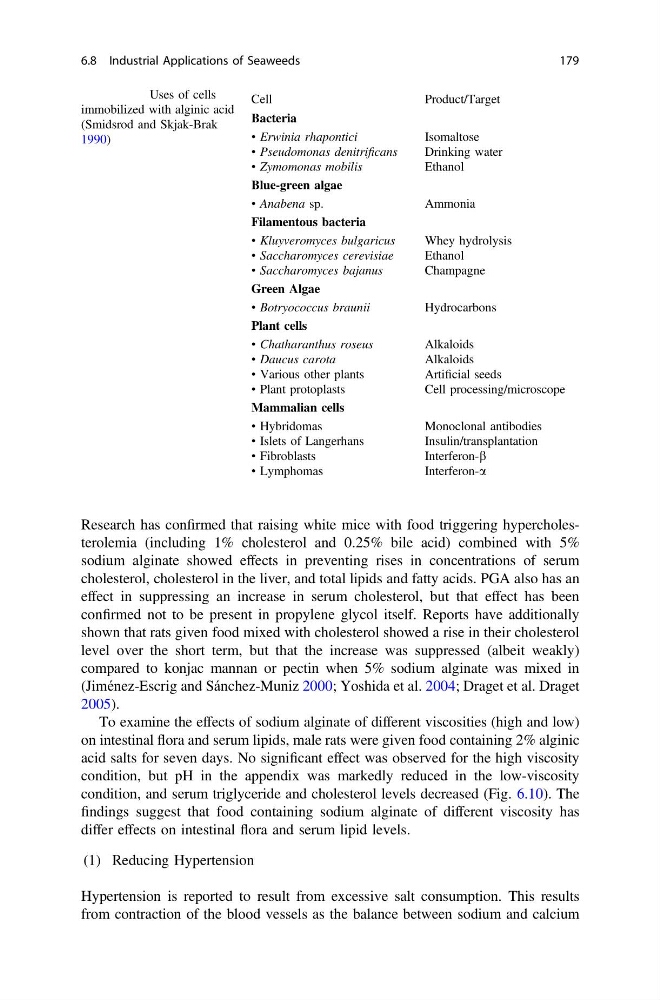
Table 6.14 Uses of cells
immobilized with alginic acid
(Smidsrod and Skjak-Brak
1990)
Cell
Product/Target
Bacteria
• Erwinia rhapontici
• Pseudomonas denitrificans
• Zymomonas mobilis
Isomaltose
Drinking water
Ethanol
Blue-green algae
• Anabena sp.
Ammonia
Filamentous bacteria
• Kluyveromyces bulgaricus
• Saccharomyces cerevisiae
• Saccharomyces bajanus
Whey hydrolysis
Ethanol
Champagne
Green Algae
• Botryococcus braunii
Hydrocarbons
Plant cells
• Chatharanthus roseus
• Daucus carota
• Various other plants
• Plant protoplasts
Alkaloids
Alkaloids
Artificial seeds
Cell processing/microscope
Mammalian cells
• Hybridomas
• Islets of Langerhans
• Fibroblasts
• Lymphomas
Monoclonal antibodies
Insulin/transplantation
Interferon-b
Interferon-a
6.8 Industrial Applications of Seaweeds
179
sodium alginate showed effects in preventing rises in concentrations of serum
cholesterol, cholesterol in the liver, and total lipids and fatty acids. PGA also has an
effect in suppressing an increase in serum cholesterol, but that effect has been
confirmed not to be present in propylene glycol itself. Reports have additionally
shown that rats given food mixed with cholesterol showed a rise in their cholesterol
level over the short term, but that the increase was suppressed (albeit weakly)
compared to konjac mannan or pectin when 5% sodium alginate was mixed in
(Jiménez-Escrig and Sánchez-Muniz 2000; Yoshida et al. 2004; Draget et al. Draget
2005).
To examine the effects of sodium alginate of different viscosities (high and low)
on intestinal flora and serum lipids, male rats were given food containing 2% alginic
acid salts for seven days. No significant effect was observed for the high viscosity
condition, but pH in the appendix was markedly reduced in the low-viscosity
condition, and serum triglyceride and cholesterol levels decreased (Fig. 6.10). The
findings suggest that food containing sodium alginate of different viscosity has
differ effects on intestinal flora and serum lipid levels.
(1) Reducing Hypertension
Hypertension is reported to result from excessive salt consumption. This results
from contraction of the blood vessels as the balance between sodium and calcium
Table 6.14 Uses of cells
immobilized with alginic acid
(Smidsrod and Skjak-Brak
1990)
Cell
Product/Target
Bacteria
• Erwinia rhapontici
• Pseudomonas denitrificans
• Zymomonas mobilis
Isomaltose
Drinking water
Ethanol
Blue-green algae
• Anabena sp.
Ammonia
Filamentous bacteria
• Kluyveromyces bulgaricus
• Saccharomyces cerevisiae
• Saccharomyces bajanus
Whey hydrolysis
Ethanol
Champagne
Green Algae
• Botryococcus braunii
Hydrocarbons
Plant cells
• Chatharanthus roseus
• Daucus carota
• Various other plants
• Plant protoplasts
Alkaloids
Alkaloids
Artificial seeds
Cell processing/microscope
Mammalian cells
• Hybridomas
• Islets of Langerhans
• Fibroblasts
• Lymphomas
Monoclonal antibodies
Insulin/transplantation
Interferon-b
Interferon-a
6.8 Industrial Applications of Seaweeds
179