

(3) Applications in Industrial-Related Areas
Because alginic acid binds optionally with iron ions, it has long been used for boiler
management and the removal of sediment and extraneous matter. Sodium alginate
is used at concentrations of 1–3 ppm. Recently, however, the use of alginic acid
salts has been threatened by the emergence of outstanding chelating agents that
include surfactants.
(4) Bioreactor Immobilizing Agent
Alginic acid’s properties as a cell inclusion agent are being put to use as an
immobilization agent for bioreactors. Cells are suspended in a sodium alginate
solution and added to a multivalent metal ion solution to form beads. Research has
been reported on this method’s use in producing ethyl alcohol and vinegar.
Examples are shown in Table 6.14.
(5) Uses in Artificial Seeds
Alginic acid is used to embed adventitious embryos and buds propagated by
tissue culturing into capsules that confer seed functions and can be sown directly in
fields.
C. Physiological Functions of Alginic Acid
(1) Lowering Cholesterol
The cholesterol contained in the food that we consume can be encircled by a
network of sodium alginate molecules and expelled from the body, thereby suppressing its absorption by the intestines and lowering cholesterol in the blood.
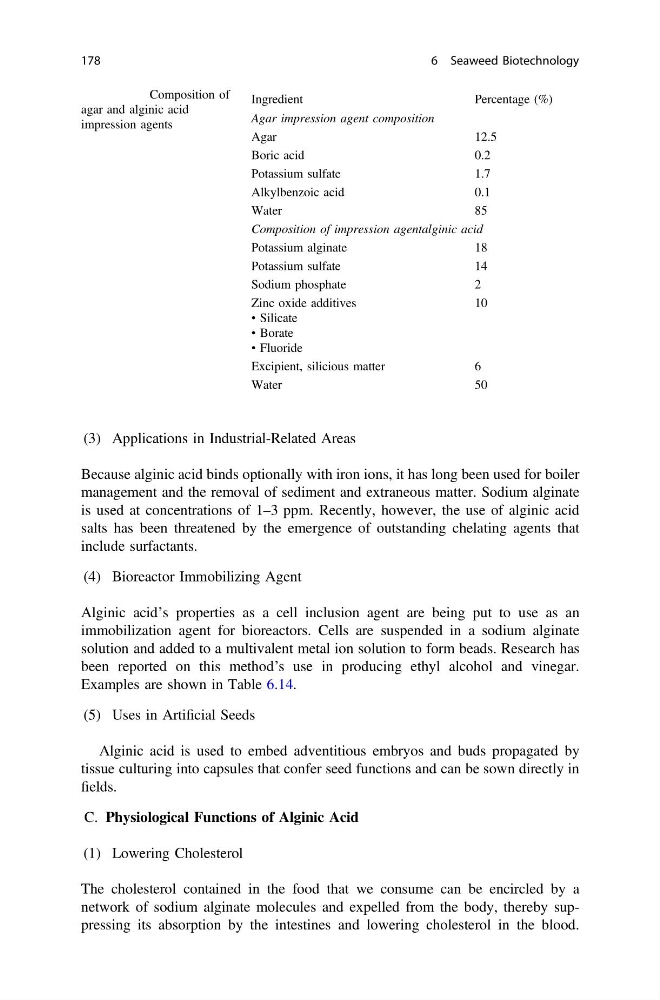
Table 6.13 Composition of
agar and alginic acid
impression agents
Ingredient
Percentage (%)
Agar impression agent composition
Agar
12.5
Boric acid
0.2
Potassium sulfate
1.7
Alkylbenzoic acid
0.1
Water
85
Composition of impression agentalginic acid
Potassium alginate
18
Potassium sulfate
14
Sodium phosphate
2
Zinc oxide additives
• Silicate
• Borate
• Fluoride
10
Excipient, silicious matter
6
Water
50
178
6 Seaweed Biotechnology
Because alginic acid binds optionally with iron ions, it has long been used for boiler
management and the removal of sediment and extraneous matter. Sodium alginate
is used at concentrations of 1–3 ppm. Recently, however, the use of alginic acid
salts has been threatened by the emergence of outstanding chelating agents that
include surfactants.
(4) Bioreactor Immobilizing Agent
Alginic acid’s properties as a cell inclusion agent are being put to use as an
immobilization agent for bioreactors. Cells are suspended in a sodium alginate
solution and added to a multivalent metal ion solution to form beads. Research has
been reported on this method’s use in producing ethyl alcohol and vinegar.
Examples are shown in Table 6.14.
(5) Uses in Artificial Seeds
Alginic acid is used to embed adventitious embryos and buds propagated by
tissue culturing into capsules that confer seed functions and can be sown directly in
fields.
C. Physiological Functions of Alginic Acid
(1) Lowering Cholesterol
The cholesterol contained in the food that we consume can be encircled by a
network of sodium alginate molecules and expelled from the body, thereby suppressing its absorption by the intestines and lowering cholesterol in the blood.
Table 6.13 Composition of
agar and alginic acid
impression agents
Ingredient
Percentage (%)
Agar impression agent composition
Agar
12.5
Boric acid
0.2
Potassium sulfate
1.7
Alkylbenzoic acid
0.1
Water
85
Composition of impression agentalginic acid
Potassium alginate
18
Potassium sulfate
14
Sodium phosphate
2
Zinc oxide additives
• Silicate
• Borate
• Fluoride
10
Excipient, silicious matter
6
Water
50
178
6 Seaweed Biotechnology