

protoplasts that have been reported to date, while Fig. 6.5 shows protoplasts from
the green alga Ulva fasciata. Most are derived from somatic cells, but in the case of
the fucales genus, large protoplast quantities of 95% or more can be obtained from
zygotes (diploid cells forming from the combination of pistil gametes) and are
currently being used in research on cell wall biosynthesis (Aruga 1990).
When cultured for 10 h in PES medium at a photosensitivity of 19.5 lE
−1 m
−2
and for 14 h in a dark room, P. yezoensis protoplasts grow from callus-like tissue
into normal leaf bodies through cell wall regeneration and repeated cell division. In
the cases of other red algae, regeneration is difficult. Green alga protoplasts
regenerate relatively easily and grow into normal organisms, but this is very difficult to accomplish with brown algae (Cheney et al. 1986; Le Gall et al. 1990;
Garcia-Reina et al. 1991; Aguirre-Lipperheide et al. 1995; Reddy et al. 2008).
In some instances, protoplasts do not regenerate even when apparently normal
P. yezoensis protoplasts have been obtained, due to protein denaturation from the
protease treatment conditions in the first stage.
For this reason, the enzymes used in protoplast production must be examined
beforehand. Attempts are currently under way to use protoplasts from this process
to induce calluses in L. japonica for suspension culturing of the cells isolated from
these calluses. It has also become possible to fix laver and sea lettuce protoplasts
with beads made from polysaccharides such as alginic acid and agarose so that
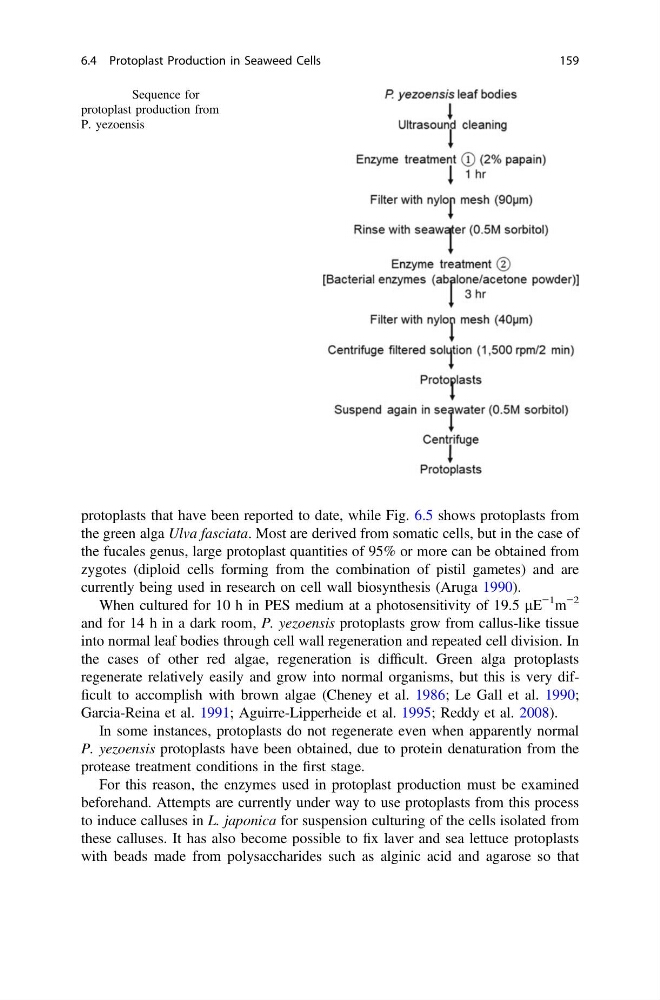
Fig. 6.5 Sequence for
protoplast production from
P. yezoensis
6.4 Protoplast Production in Seaweed Cells
159
the green alga Ulva fasciata. Most are derived from somatic cells, but in the case of
the fucales genus, large protoplast quantities of 95% or more can be obtained from
zygotes (diploid cells forming from the combination of pistil gametes) and are
currently being used in research on cell wall biosynthesis (Aruga 1990).
When cultured for 10 h in PES medium at a photosensitivity of 19.5 lE
−1 m
−2
and for 14 h in a dark room, P. yezoensis protoplasts grow from callus-like tissue
into normal leaf bodies through cell wall regeneration and repeated cell division. In
the cases of other red algae, regeneration is difficult. Green alga protoplasts
regenerate relatively easily and grow into normal organisms, but this is very difficult to accomplish with brown algae (Cheney et al. 1986; Le Gall et al. 1990;
Garcia-Reina et al. 1991; Aguirre-Lipperheide et al. 1995; Reddy et al. 2008).
In some instances, protoplasts do not regenerate even when apparently normal
P. yezoensis protoplasts have been obtained, due to protein denaturation from the
protease treatment conditions in the first stage.
For this reason, the enzymes used in protoplast production must be examined
beforehand. Attempts are currently under way to use protoplasts from this process
to induce calluses in L. japonica for suspension culturing of the cells isolated from
these calluses. It has also become possible to fix laver and sea lettuce protoplasts
with beads made from polysaccharides such as alginic acid and agarose so that
Fig. 6.5 Sequence for
protoplast production from
P. yezoensis
6.4 Protoplast Production in Seaweed Cells
159