

calluses can be induced within the beads and a leaf body grown on the bead’s
surface.
Protoplast isolation has also been attempted with leaf bodies from the red alga
P. yezoensis. Protoplast production through the use of abalone or sea slug digestive
enzymes, or with a combination of sea slug digestive enzymes combined with
dolicellulase, has not been successful, but it has been possible to isolate protoplasts
effectively through the use of extracellular enzymes from bacteria separated from
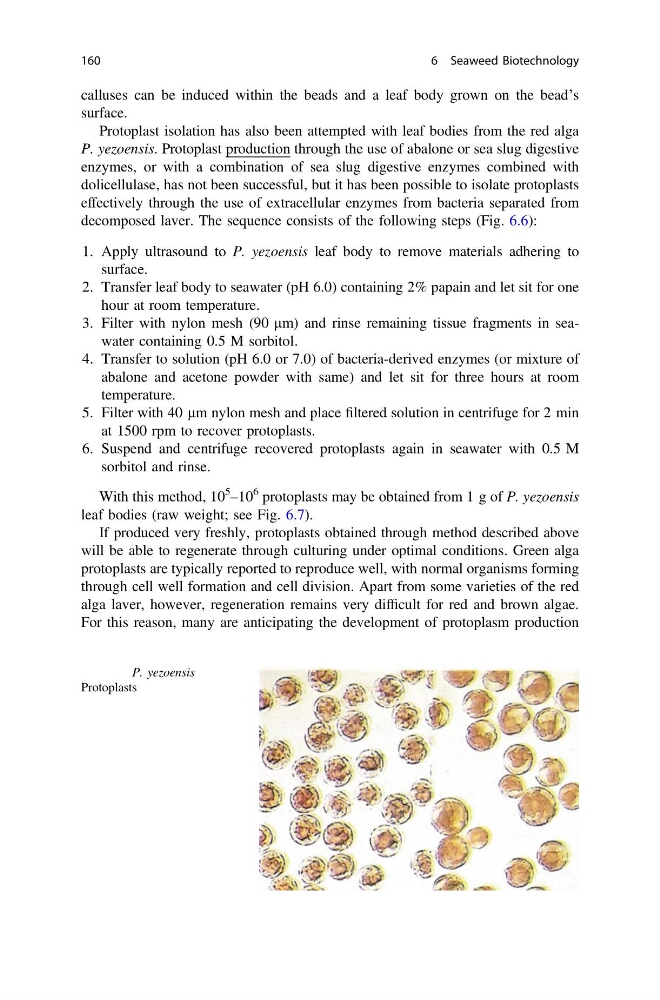
decomposed laver. The sequence consists of the following steps (Fig. 6.6):
1. Apply ultrasound to P. yezoensis leaf body to remove materials adhering to
surface.
2. Transfer leaf body to seawater (pH 6.0) containing 2% papain and let sit for one
hour at room temperature.
3. Filter with nylon mesh (90 lm) and rinse remaining tissue fragments in seawater containing 0.5 M sorbitol.
4. Transfer to solution (pH 6.0 or 7.0) of bacteria-derived enzymes (or mixture of
abalone and acetone powder with same) and let sit for three hours at room
temperature.
5. Filter with 40 lm nylon mesh and place filtered solution in centrifuge for 2 min
at 1500 rpm to recover protoplasts.
6. Suspend and centrifuge recovered protoplasts again in seawater with 0.5 M
sorbitol and rinse.
With this method, 10
5
–10
6 protoplasts may be obtained from 1 g of P. yezoensis
leaf bodies (raw weight; see Fig. 6.7).
If produced very freshly, protoplasts obtained through method described above
will be able to regenerate through culturing under optimal conditions. Green alga
protoplasts are typically reported to reproduce well, with normal organisms forming
through cell well formation and cell division. Apart from some varieties of the red
alga laver, however, regeneration remains very difficult for red and brown algae.
For this reason, many are anticipating the development of protoplasm production
Fig. 6.6 P. yezoensis
Protoplasts
160
6 Seaweed Biotechnology
surface.
Protoplast isolation has also been attempted with leaf bodies from the red alga
P. yezoensis. Protoplast production through the use of abalone or sea slug digestive
enzymes, or with a combination of sea slug digestive enzymes combined with
dolicellulase, has not been successful, but it has been possible to isolate protoplasts
effectively through the use of extracellular enzymes from bacteria separated from
decomposed laver. The sequence consists of the following steps (Fig. 6.6):
1. Apply ultrasound to P. yezoensis leaf body to remove materials adhering to
surface.
2. Transfer leaf body to seawater (pH 6.0) containing 2% papain and let sit for one
hour at room temperature.
3. Filter with nylon mesh (90 lm) and rinse remaining tissue fragments in seawater containing 0.5 M sorbitol.
4. Transfer to solution (pH 6.0 or 7.0) of bacteria-derived enzymes (or mixture of
abalone and acetone powder with same) and let sit for three hours at room
temperature.
5. Filter with 40 lm nylon mesh and place filtered solution in centrifuge for 2 min
at 1500 rpm to recover protoplasts.
6. Suspend and centrifuge recovered protoplasts again in seawater with 0.5 M
sorbitol and rinse.
With this method, 10
5
–10
6 protoplasts may be obtained from 1 g of P. yezoensis
leaf bodies (raw weight; see Fig. 6.7).
If produced very freshly, protoplasts obtained through method described above
will be able to regenerate through culturing under optimal conditions. Green alga
protoplasts are typically reported to reproduce well, with normal organisms forming
through cell well formation and cell division. Apart from some varieties of the red
alga laver, however, regeneration remains very difficult for red and brown algae.
For this reason, many are anticipating the development of protoplasm production
Fig. 6.6 P. yezoensis
Protoplasts
160
6 Seaweed Biotechnology