

later due to differences in the polysaccharides making up the (chiefly cellulose) cell
wall in all land plants and the glycosaminoglycans existing between cells.
For example, protoplasts were first obtained by breaking down alginic acid or
fucoidans in brown algae for the seaweed polysaccharides porphyran, xylan, and
mannan in laver, which is a red alga. Enzymes used to dissolve the cell wall include
those obtained from the digestive organs of marine animals that consume seaweed
(such as abalone, sea urchins, and sea slugs) and those secreted by fungi and
bacteria with seaweed decomposition capabilities. Each of these enzymes has its
own characteristics and may be used independently, but more often several
enzymes are used in combination.
As an example, this chapter will consider the protoplast separation method used
with the red alga Porphyra yezoensis. Once sterilized with antibiotics and iodine
solution, the seaweed is treated for 10 min with protease to break down proteins on
the cell wall surface, after which the seaweed is cut to fragments of 2–3 mm in
length. Around 0.5–1 g of these fragments are placed for two to four hours in a cell
wall lyase solution consisting of 2% powdered abalone midgut gland treated with
acetone, 2% macerozyme, 0.3% mannitol, and 0.5 M dextran and potassium sulfate
placed in seawater (pH 6.0, 20–22 °C). Once separated, the protoplasts are filtered
in 20 lm nylon mash and placed in a centrifuge for 5 min at 1000 rpm before the
enzyme extract is removed.
Cellulose, pectinase, and dolicellase are added to the cell wall lyase solution for
the brown algae. In the case of green alga cell wall lyase solution, the cellulase
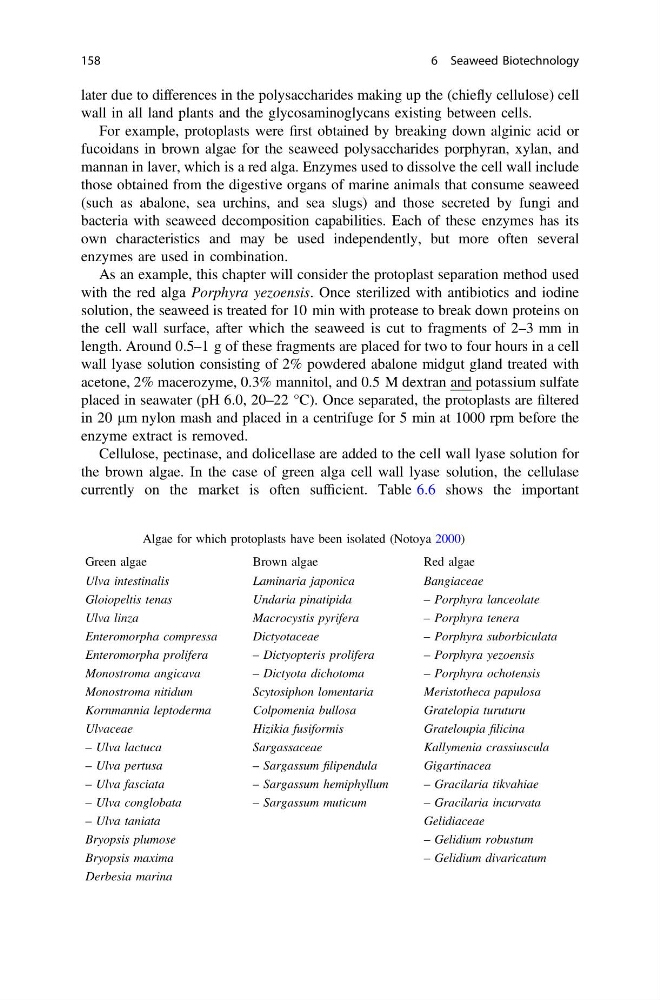
currently on the market is often sufficient. Table 6.6 shows the important
Table 6.6 Algae for which protoplasts have been isolated (Notoya 2000)
Green algae
Brown algae
Red algae
Ulva intestinalis
Laminaria japonica
Bangiaceae
Gloiopeltis tenas
Undaria pinatipida
– Porphyra lanceolate
Ulva linza
Macrocystis pyrifera
– Porphyra tenera
Enteromorpha compressa
Dictyotaceae
– Porphyra suborbiculata
Enteromorpha prolifera
– Dictyopteris prolifera
– Porphyra yezoensis
Monostroma angicava
– Dictyota dichotoma
– Porphyra ochotensis
Monostroma nitidum
Scytosiphon lomentaria
Meristotheca papulosa
Kornmannia leptoderma
Colpomenia bullosa
Gratelopia turuturu
Ulvaceae
Hizikia fusiformis
Grateloupia filicina
– Ulva lactuca
Sargassaceae
Kallymenia crassiuscula
– Ulva pertusa
– Sargassum filipendula
Gigartinacea
– Ulva fasciata
– Sargassum hemiphyllum
– Gracilaria tikvahiae
– Ulva conglobata
– Sargassum muticum
– Gracilaria incurvata
– Ulva taniata
Gelidiaceae
Bryopsis plumose
– Gelidium robustum
Bryopsis maxima
– Gelidium divaricatum
Derbesia marina
158
6 Seaweed Biotechnology
wall in all land plants and the glycosaminoglycans existing between cells.
For example, protoplasts were first obtained by breaking down alginic acid or
fucoidans in brown algae for the seaweed polysaccharides porphyran, xylan, and
mannan in laver, which is a red alga. Enzymes used to dissolve the cell wall include
those obtained from the digestive organs of marine animals that consume seaweed
(such as abalone, sea urchins, and sea slugs) and those secreted by fungi and
bacteria with seaweed decomposition capabilities. Each of these enzymes has its
own characteristics and may be used independently, but more often several
enzymes are used in combination.
As an example, this chapter will consider the protoplast separation method used
with the red alga Porphyra yezoensis. Once sterilized with antibiotics and iodine
solution, the seaweed is treated for 10 min with protease to break down proteins on
the cell wall surface, after which the seaweed is cut to fragments of 2–3 mm in
length. Around 0.5–1 g of these fragments are placed for two to four hours in a cell
wall lyase solution consisting of 2% powdered abalone midgut gland treated with
acetone, 2% macerozyme, 0.3% mannitol, and 0.5 M dextran and potassium sulfate
placed in seawater (pH 6.0, 20–22 °C). Once separated, the protoplasts are filtered
in 20 lm nylon mash and placed in a centrifuge for 5 min at 1000 rpm before the
enzyme extract is removed.
Cellulose, pectinase, and dolicellase are added to the cell wall lyase solution for
the brown algae. In the case of green alga cell wall lyase solution, the cellulase
currently on the market is often sufficient. Table 6.6 shows the important
Table 6.6 Algae for which protoplasts have been isolated (Notoya 2000)
Green algae
Brown algae
Red algae
Ulva intestinalis
Laminaria japonica
Bangiaceae
Gloiopeltis tenas
Undaria pinatipida
– Porphyra lanceolate
Ulva linza
Macrocystis pyrifera
– Porphyra tenera
Enteromorpha compressa
Dictyotaceae
– Porphyra suborbiculata
Enteromorpha prolifera
– Dictyopteris prolifera
– Porphyra yezoensis
Monostroma angicava
– Dictyota dichotoma
– Porphyra ochotensis
Monostroma nitidum
Scytosiphon lomentaria
Meristotheca papulosa
Kornmannia leptoderma
Colpomenia bullosa
Gratelopia turuturu
Ulvaceae
Hizikia fusiformis
Grateloupia filicina
– Ulva lactuca
Sargassaceae
Kallymenia crassiuscula
– Ulva pertusa
– Sargassum filipendula
Gigartinacea
– Ulva fasciata
– Sargassum hemiphyllum
– Gracilaria tikvahiae
– Ulva conglobata
– Sargassum muticum
– Gracilaria incurvata
– Ulva taniata
Gelidiaceae
Bryopsis plumose
– Gelidium robustum
Bryopsis maxima
– Gelidium divaricatum
Derbesia marina
158
6 Seaweed Biotechnology