

important agar source, Gelidium amansii, with tissue culturing techniques used to
achieve improved varieties. The advantage of tissue culturing lies in the use of the
resulting calluses, or the cells isolated from the calluses, for so-called cloning
propagation, producing numerous clones with the same traits as parents without
genetic information and acquiring numerous seeds from a particular superior parent
strain (Amano 1990).
6.4 Protoplast Production in Seaweed Cells
Among the various organisms in the population, some survive while others are
removed. This kind of selection (winnowing) or artificial hybridization has been
used for a very long time in the fields of crop and livestock breeding. Recently, the
strong desire to produce hybrids or new strains not accessible through previous
artificial hybridization or selection has drawn attention to rapid advancements in
genetic engineering and cell engineering technology. Creating somatic cell hybrids
and applying advanced gene manipulation technology to breeding requires protoplasts, or cells from which the plant cell wall has been removed.
The term “protoplast” is used to refer the protoplasmic and non-protoplasmic
cell material surrounded by a cell membrane or protoplasm membrane that is
obtained through the use of enzymes to remove the cell wall in plant tissue or
calluses.
Protoplasts may be obtained physically, depending on the species of seaweed.
Protoplasts are an essential part of breeding by cell fusion or gene manipulation,
and may also serve as important resources in explaining the cell wall formation
mechanism and examining cell differentiation and nutrition.
Seaweed protoplasts were first obtained in 1979 from the green alga Ulva
intestinalis (Millner et al. 1979). This was followed by successful examples of the
use of enzymes from land-based plants to produce protoplasts for many green algae.
Protoplast development and production for brown and red algae came relatively
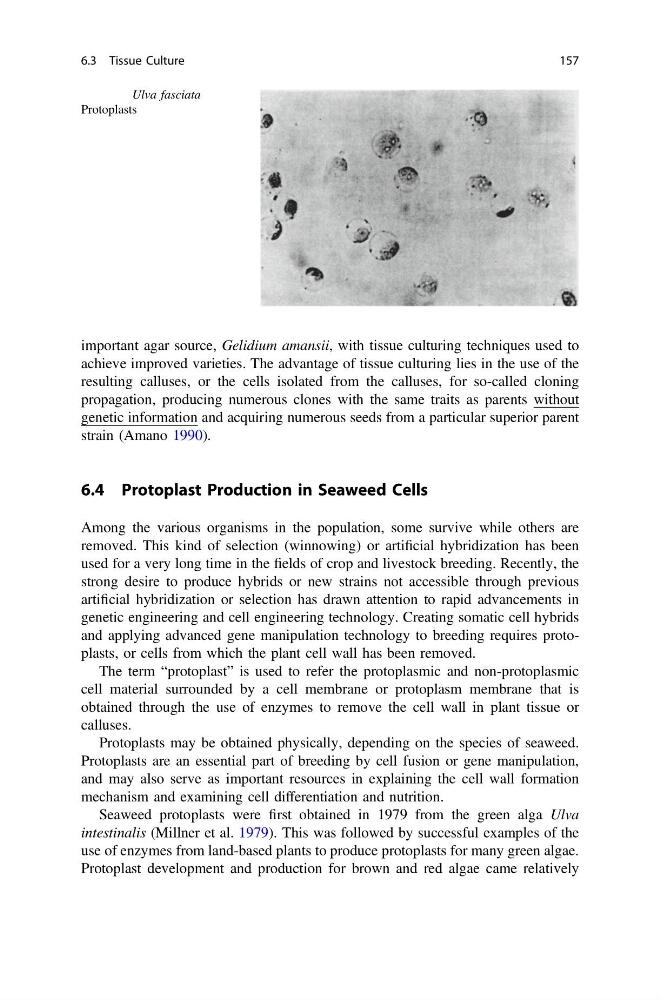
Fig. 6.4 Ulva fasciata
Protoplasts
6.3 Tissue Culture
157
achieve improved varieties. The advantage of tissue culturing lies in the use of the
resulting calluses, or the cells isolated from the calluses, for so-called cloning
propagation, producing numerous clones with the same traits as parents without
genetic information and acquiring numerous seeds from a particular superior parent
strain (Amano 1990).
6.4 Protoplast Production in Seaweed Cells
Among the various organisms in the population, some survive while others are
removed. This kind of selection (winnowing) or artificial hybridization has been
used for a very long time in the fields of crop and livestock breeding. Recently, the
strong desire to produce hybrids or new strains not accessible through previous
artificial hybridization or selection has drawn attention to rapid advancements in
genetic engineering and cell engineering technology. Creating somatic cell hybrids
and applying advanced gene manipulation technology to breeding requires protoplasts, or cells from which the plant cell wall has been removed.
The term “protoplast” is used to refer the protoplasmic and non-protoplasmic
cell material surrounded by a cell membrane or protoplasm membrane that is
obtained through the use of enzymes to remove the cell wall in plant tissue or
calluses.
Protoplasts may be obtained physically, depending on the species of seaweed.
Protoplasts are an essential part of breeding by cell fusion or gene manipulation,
and may also serve as important resources in explaining the cell wall formation
mechanism and examining cell differentiation and nutrition.
Seaweed protoplasts were first obtained in 1979 from the green alga Ulva
intestinalis (Millner et al. 1979). This was followed by successful examples of the
use of enzymes from land-based plants to produce protoplasts for many green algae.
Protoplast development and production for brown and red algae came relatively
Fig. 6.4 Ulva fasciata
Protoplasts
6.3 Tissue Culture
157