

use of plant growth regulation substances remains sparse, but is expected to develop
further going ahead.
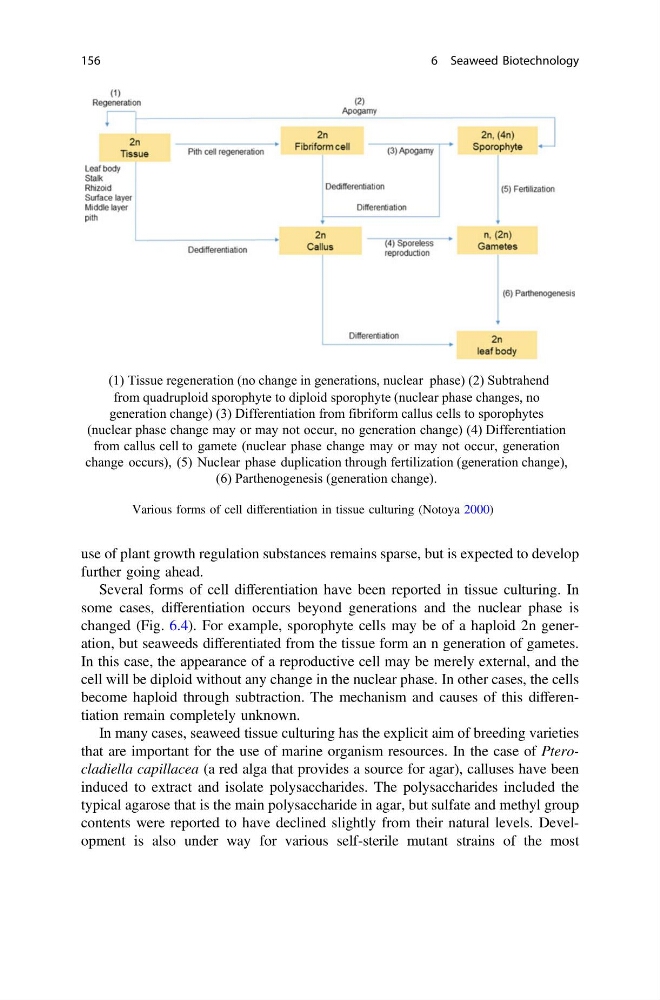
Several forms of cell differentiation have been reported in tissue culturing. In
some cases, differentiation occurs beyond generations and the nuclear phase is
changed (Fig. 6.4). For example, sporophyte cells may be of a haploid 2n generation, but seaweeds differentiated from the tissue form an n generation of gametes.
In this case, the appearance of a reproductive cell may be merely external, and the
cell will be diploid without any change in the nuclear phase. In other cases, the cells
become haploid through subtraction. The mechanism and causes of this differentiation remain completely unknown.
In many cases, seaweed tissue culturing has the explicit aim of breeding varieties
that are important for the use of marine organism resources. In the case of Pterocladiella capillacea (a red alga that provides a source for agar), calluses have been
induced to extract and isolate polysaccharides. The polysaccharides included the
typical agarose that is the main polysaccharide in agar, but sulfate and methyl group
contents were reported to have declined slightly from their natural levels. Development is also under way for various self-sterile mutant strains of the most
(1) Tissue regeneration (no change in generations, nuclear phase) (2) Subtrahend
from quadruploid sporophyte to diploid sporophyte (nuclear phase changes, no
generation change) (3) Differentiation from fibriform callus cells to sporophytes
(nuclear phase change may or may not occur, no generation change) (4) Differentiation
from callus cell to gamete (nuclear phase change may or may not occur, generation
change occurs), (5) Nuclear phase duplication through fertilization (generation change),
(6) Parthenogenesis (generation change).
Fig. 6.3 Various forms of cell differentiation in tissue culturing (Notoya 2000)
156
6 Seaweed Biotechnology
further going ahead.
Several forms of cell differentiation have been reported in tissue culturing. In
some cases, differentiation occurs beyond generations and the nuclear phase is
changed (Fig. 6.4). For example, sporophyte cells may be of a haploid 2n generation, but seaweeds differentiated from the tissue form an n generation of gametes.
In this case, the appearance of a reproductive cell may be merely external, and the
cell will be diploid without any change in the nuclear phase. In other cases, the cells
become haploid through subtraction. The mechanism and causes of this differentiation remain completely unknown.
In many cases, seaweed tissue culturing has the explicit aim of breeding varieties
that are important for the use of marine organism resources. In the case of Pterocladiella capillacea (a red alga that provides a source for agar), calluses have been
induced to extract and isolate polysaccharides. The polysaccharides included the
typical agarose that is the main polysaccharide in agar, but sulfate and methyl group
contents were reported to have declined slightly from their natural levels. Development is also under way for various self-sterile mutant strains of the most
(1) Tissue regeneration (no change in generations, nuclear phase) (2) Subtrahend
from quadruploid sporophyte to diploid sporophyte (nuclear phase changes, no
generation change) (3) Differentiation from fibriform callus cells to sporophytes
(nuclear phase change may or may not occur, no generation change) (4) Differentiation
from callus cell to gamete (nuclear phase change may or may not occur, generation
change occurs), (5) Nuclear phase duplication through fertilization (generation change),
(6) Parthenogenesis (generation change).
Fig. 6.3 Various forms of cell differentiation in tissue culturing (Notoya 2000)
156
6 Seaweed Biotechnology