

estimated by substituting the heterozygosity rates for wild and artificial seedling
populations into the equation F t = (H o − H t )/H o (Taniguchi 2000).
5.6.7 Diagonosis Parentage and Estimating Effective Size
of Artificial Seedling Populations
With microsatellite DNA polymorphs, all artificial seedlings are automatically
marked at the stage during which the parental genotype is determined (Fig. 5.11).
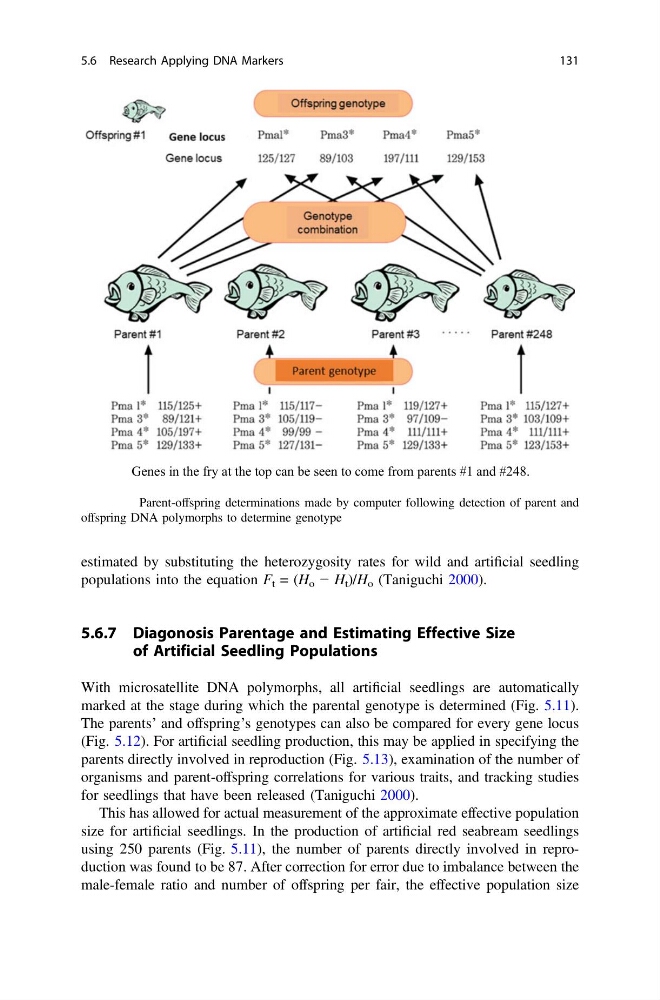
The parents’ and offspring’s genotypes can also be compared for every gene locus
(Fig. 5.12). For artificial seedling production, this may be applied in specifying the
parents directly involved in reproduction (Fig. 5.13), examination of the number of
organisms and parent-offspring correlations for various traits, and tracking studies
for seedlings that have been released (Taniguchi 2000).
This has allowed for actual measurement of the approximate effective population
size for artificial seedlings. In the production of artificial red seabream seedlings
using 250 parents (Fig. 5.11), the number of parents directly involved in reproduction was found to be 87. After correction for error due to imbalance between the
male-female ratio and number of offspring per fair, the effective population size
Genes in the fry at the top can be seen to come from parents #1 and #248.
Fig. 5.12 Parent-offspring determinations made by computer following detection of parent and
offspring DNA polymorphs to determine genotype
5.6 Research Applying DNA Markers
131
populations into the equation F t = (H o − H t )/H o (Taniguchi 2000).
5.6.7 Diagonosis Parentage and Estimating Effective Size
of Artificial Seedling Populations
With microsatellite DNA polymorphs, all artificial seedlings are automatically
marked at the stage during which the parental genotype is determined (Fig. 5.11).
The parents’ and offspring’s genotypes can also be compared for every gene locus
(Fig. 5.12). For artificial seedling production, this may be applied in specifying the
parents directly involved in reproduction (Fig. 5.13), examination of the number of
organisms and parent-offspring correlations for various traits, and tracking studies
for seedlings that have been released (Taniguchi 2000).
This has allowed for actual measurement of the approximate effective population
size for artificial seedlings. In the production of artificial red seabream seedlings
using 250 parents (Fig. 5.11), the number of parents directly involved in reproduction was found to be 87. After correction for error due to imbalance between the
male-female ratio and number of offspring per fair, the effective population size
Genes in the fry at the top can be seen to come from parents #1 and #248.
Fig. 5.12 Parent-offspring determinations made by computer following detection of parent and
offspring DNA polymorphs to determine genotype
5.6 Research Applying DNA Markers
131