

N e was estimated to be 63.7, or slightly larger than the N e standard proposed by the
FAO (Taniguchi 2000).
5.6.8 Tracking Studies for Released Fish
With microsatellite DNA polymorphs, the large number of alleles means that the
number of genotypes within a single gene locus is very large. When multiple gene
loci are combined, genotype frequency decreases greatly. The likelihood of the
same form being expressed in two individuals can be calculated with the equation
I =
P
i p i
4 +
P
i
P
j > i(2p i p j )
2 . In this case, p i and p j refer to the frequency of the ith
and jth alleles. For artificial red seabream seedling production, the observed I value
for alleles at five gene loci ranges between 3.31 Â 10
−9 and 5.76 Â 10
−9 . This
means that the likelihood of two random organisms having an identical genotype is
one in 175 million (Taniguchi 2000).
Because a determination of the genotype of parents used in producing artificial
red seabream seedlings allows for distinguishing of organisms, they can be released
into natural waters. After time has passed, wild specimens are collected, and if
organisms are found to have a genotype that is likely to have come from an artificial
seedling, it can be judged in statistical terms to have been a released specimen. This
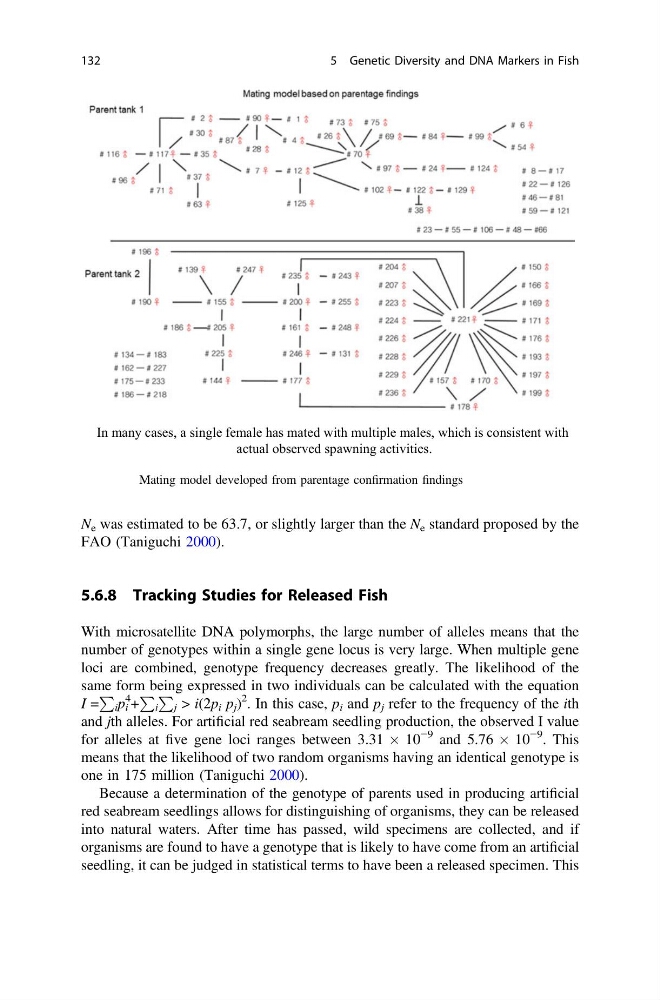
In many cases, a single female has mated with multiple males, which is consistent with
actual observed spawning activities.
Fig. 5.13 Mating model developed from parentage confirmation findings
132
5 Genetic Diversity and DNA Markers in Fish
FAO (Taniguchi 2000).
5.6.8 Tracking Studies for Released Fish
With microsatellite DNA polymorphs, the large number of alleles means that the
number of genotypes within a single gene locus is very large. When multiple gene
loci are combined, genotype frequency decreases greatly. The likelihood of the
same form being expressed in two individuals can be calculated with the equation
I =
P
i p i
4 +
P
i
P
j > i(2p i p j )
2 . In this case, p i and p j refer to the frequency of the ith
and jth alleles. For artificial red seabream seedling production, the observed I value
for alleles at five gene loci ranges between 3.31 Â 10
−9 and 5.76 Â 10
−9 . This
means that the likelihood of two random organisms having an identical genotype is
one in 175 million (Taniguchi 2000).
Because a determination of the genotype of parents used in producing artificial
red seabream seedlings allows for distinguishing of organisms, they can be released
into natural waters. After time has passed, wild specimens are collected, and if
organisms are found to have a genotype that is likely to have come from an artificial
seedling, it can be judged in statistical terms to have been a released specimen. This
In many cases, a single female has mated with multiple males, which is consistent with
actual observed spawning activities.
Fig. 5.13 Mating model developed from parentage confirmation findings
132
5 Genetic Diversity and DNA Markers in Fish