

When used in population structure analysis, this method can identify the frequency of a gene and the rate of heterozygosity with it. If a particular band is
positive, the corresponding gene is determined to be either homo or hetero, and if it
is negative it is understood to be a conjugating outside that allele. The AFLP
method is thus considered to be a superior assessment method to the microsatellite
DNA polymorph BSI in terms of evaluation of a population’s genetic diversity and
reproducibility of band detection. One problem with this approach is that the rate of
polymorph gene loci and heterozygosity may be overestimated. Also, while the
possibility of some of the appearing bands being mitochondrial DNA fragments
cannot be ruled out, the percentage appears to be negligible when compared with
the nuclear genome (Taniguchi 2000).
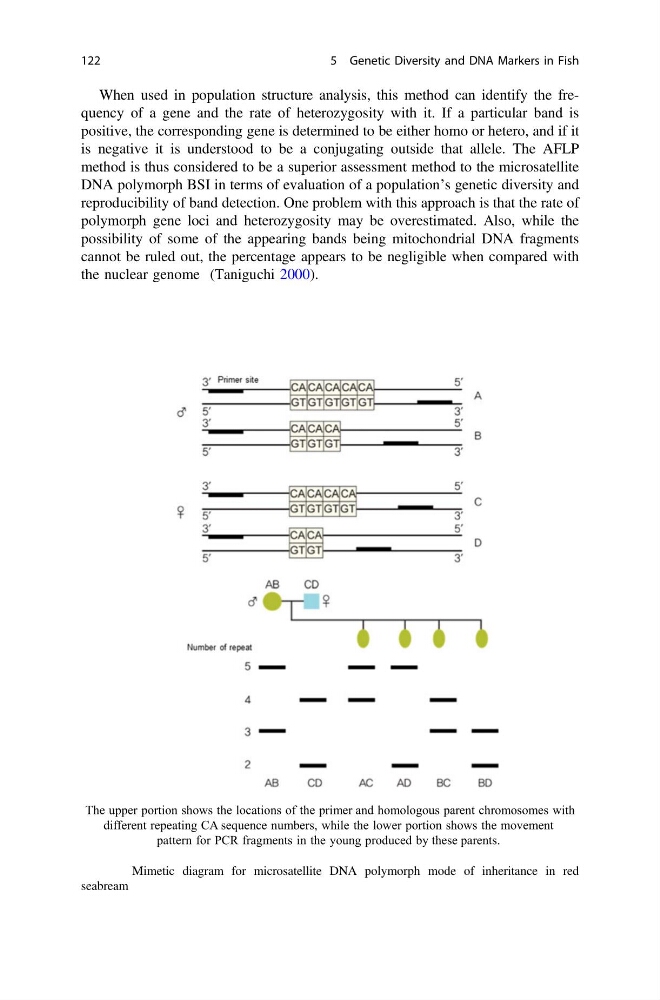
The upper portion shows the locations of the primer and homologous parent chromosomes with
different repeating CA sequence numbers, while the lower portion shows the movement
pattern for PCR fragments in the young produced by these parents.
Fig. 5.6 Mimetic diagram for microsatellite DNA polymorph mode of inheritance in red
seabream
122
5 Genetic Diversity and DNA Markers in Fish
positive, the corresponding gene is determined to be either homo or hetero, and if it
is negative it is understood to be a conjugating outside that allele. The AFLP
method is thus considered to be a superior assessment method to the microsatellite
DNA polymorph BSI in terms of evaluation of a population’s genetic diversity and
reproducibility of band detection. One problem with this approach is that the rate of
polymorph gene loci and heterozygosity may be overestimated. Also, while the
possibility of some of the appearing bands being mitochondrial DNA fragments
cannot be ruled out, the percentage appears to be negligible when compared with
the nuclear genome (Taniguchi 2000).
The upper portion shows the locations of the primer and homologous parent chromosomes with
different repeating CA sequence numbers, while the lower portion shows the movement
pattern for PCR fragments in the young produced by these parents.
Fig. 5.6 Mimetic diagram for microsatellite DNA polymorph mode of inheritance in red
seabream
122
5 Genetic Diversity and DNA Markers in Fish