

is therefore impossible to estimate the frequency of the necessary allele or the
hybridization rate during population analysis (Lynch 1990; Vos et al. 1995).
Accordingly, this approach uses the percentage of total bands that are shared by
the two individual under comparison as a band sharing index (BSI), which represents the genetic similarity between the organisms. The average sharing value is
also used as an indicator of population variability and relatedness between groups.
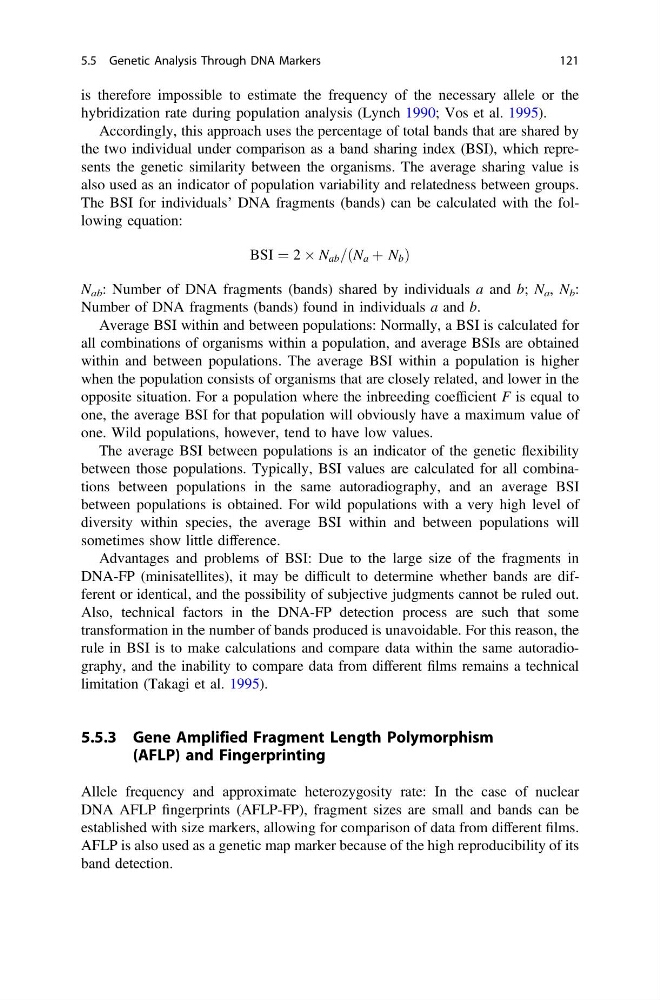
The BSI for individuals’ DNA fragments (bands) can be calculated with the following equation:
BSI ¼ 2 Â N ab = N a þ N b
ð
Þ
N ab : Number of DNA fragments (bands) shared by individuals a and b; N a , N b :
Number of DNA fragments (bands) found in individuals a and b.
Average BSI within and between populations: Normally, a BSI is calculated for
all combinations of organisms within a population, and average BSIs are obtained
within and between populations. The average BSI within a population is higher
when the population consists of organisms that are closely related, and lower in the
opposite situation. For a population where the inbreeding coefficient F is equal to
one, the average BSI for that population will obviously have a maximum value of
one. Wild populations, however, tend to have low values.
The average BSI between populations is an indicator of the genetic flexibility
between those populations. Typically, BSI values are calculated for all combinations between populations in the same autoradiography, and an average BSI
between populations is obtained. For wild populations with a very high level of
diversity within species, the average BSI within and between populations will
sometimes show little difference.
Advantages and problems of BSI: Due to the large size of the fragments in
DNA-FP (minisatellites), it may be difficult to determine whether bands are different or identical, and the possibility of subjective judgments cannot be ruled out.
Also, technical factors in the DNA-FP detection process are such that some
transformation in the number of bands produced is unavoidable. For this reason, the
rule in BSI is to make calculations and compare data within the same autoradiography, and the inability to compare data from different films remains a technical
limitation (Takagi et al. 1995).
5.5.3 Gene Amplified Fragment Length Polymorphism
(AFLP) and Fingerprinting
Allele frequency and approximate heterozygosity rate: In the case of nuclear
DNA AFLP fingerprints (AFLP-FP), fragment sizes are small and bands can be
established with size markers, allowing for comparison of data from different films.
AFLP is also used as a genetic map marker because of the high reproducibility of its
band detection.
5.5 Genetic Analysis Through DNA Markers
121
hybridization rate during population analysis (Lynch 1990; Vos et al. 1995).
Accordingly, this approach uses the percentage of total bands that are shared by
the two individual under comparison as a band sharing index (BSI), which represents the genetic similarity between the organisms. The average sharing value is
also used as an indicator of population variability and relatedness between groups.
The BSI for individuals’ DNA fragments (bands) can be calculated with the following equation:
BSI ¼ 2 Â N ab = N a þ N b
ð
Þ
N ab : Number of DNA fragments (bands) shared by individuals a and b; N a , N b :
Number of DNA fragments (bands) found in individuals a and b.
Average BSI within and between populations: Normally, a BSI is calculated for
all combinations of organisms within a population, and average BSIs are obtained
within and between populations. The average BSI within a population is higher
when the population consists of organisms that are closely related, and lower in the
opposite situation. For a population where the inbreeding coefficient F is equal to
one, the average BSI for that population will obviously have a maximum value of
one. Wild populations, however, tend to have low values.
The average BSI between populations is an indicator of the genetic flexibility
between those populations. Typically, BSI values are calculated for all combinations between populations in the same autoradiography, and an average BSI
between populations is obtained. For wild populations with a very high level of
diversity within species, the average BSI within and between populations will
sometimes show little difference.
Advantages and problems of BSI: Due to the large size of the fragments in
DNA-FP (minisatellites), it may be difficult to determine whether bands are different or identical, and the possibility of subjective judgments cannot be ruled out.
Also, technical factors in the DNA-FP detection process are such that some
transformation in the number of bands produced is unavoidable. For this reason, the
rule in BSI is to make calculations and compare data within the same autoradiography, and the inability to compare data from different films remains a technical
limitation (Takagi et al. 1995).
5.5.3 Gene Amplified Fragment Length Polymorphism
(AFLP) and Fingerprinting
Allele frequency and approximate heterozygosity rate: In the case of nuclear
DNA AFLP fingerprints (AFLP-FP), fragment sizes are small and bands can be
established with size markers, allowing for comparison of data from different films.
AFLP is also used as a genetic map marker because of the high reproducibility of its
band detection.
5.5 Genetic Analysis Through DNA Markers
121