

also been created by selecting and combining superior body parts from different
species, such as the sphinx, sirens, mermaids, and centaurs. Typically, the term
chimera refers to an organism composed of two or more kinds of genetically
different cells. In some cases, the different cells are mixed in a mosaic structure; in
others, cells of the same time assemble to form specific parts of the body.
While approaches such as cutting are already in widespread use in plant
breeding, it has also recently become possible to perform something similar with
eggs or embryos in the midst of genesis through microsurgery under a microscope.
In terms of breeding science value, it is now possible to assemble superior functions
from different animals in one body, just as the ancestor of modern humans sought to
do. Contrary to their expectations, it is also possible to combine only the most
inferior parts of each body, as in the case of heterosis breeding. In terms of fish,
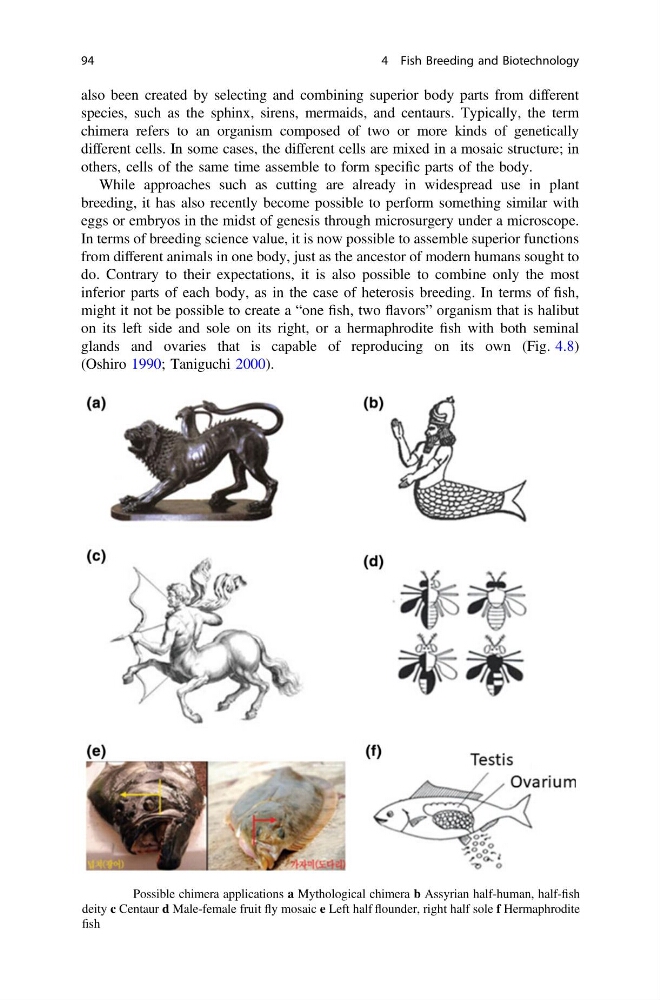
might it not be possible to create a “one fish, two flavors” organism that is halibut
on its left side and sole on its right, or a hermaphrodite fish with both seminal
glands and ovaries that is capable of reproducing on its own (Fig. 4.8)
(Oshiro 1990; Taniguchi 2000).
Fig. 4.8 Possible chimera applications a Mythological chimera b Assyrian half-human, half-fish
deity c Centaur d Male-female fruit fly mosaic e Left half flounder, right half sole f Hermaphrodite
fish
94
4 Fish Breeding and Biotechnology
species, such as the sphinx, sirens, mermaids, and centaurs. Typically, the term
chimera refers to an organism composed of two or more kinds of genetically
different cells. In some cases, the different cells are mixed in a mosaic structure; in
others, cells of the same time assemble to form specific parts of the body.
While approaches such as cutting are already in widespread use in plant
breeding, it has also recently become possible to perform something similar with
eggs or embryos in the midst of genesis through microsurgery under a microscope.
In terms of breeding science value, it is now possible to assemble superior functions
from different animals in one body, just as the ancestor of modern humans sought to
do. Contrary to their expectations, it is also possible to combine only the most
inferior parts of each body, as in the case of heterosis breeding. In terms of fish,
might it not be possible to create a “one fish, two flavors” organism that is halibut
on its left side and sole on its right, or a hermaphrodite fish with both seminal
glands and ovaries that is capable of reproducing on its own (Fig. 4.8)
(Oshiro 1990; Taniguchi 2000).
Fig. 4.8 Possible chimera applications a Mythological chimera b Assyrian half-human, half-fish
deity c Centaur d Male-female fruit fly mosaic e Left half flounder, right half sole f Hermaphrodite
fish
94
4 Fish Breeding and Biotechnology