

E. Making Transgenic Organisms
The first step in making transgenic organisms is to create an organism with a
new genome through cell fusion. Unlike with the chimera, all cells in the organism
may have the same genetic composition. If it is not possible to obtain both gametes
of different species, or if fertilization is physically impossible because the sperm
cannot pass through the micropyle, one may fuse somatic cells from the two species
and culture them to select hybrid cells with stable nuclei (genomes). While it is
possible to reproduce an organism from one cell in plants, it is typically not possible
with animals (including fish). The organism is thus produced by transplanting the
hybrid cell nucleus into an egg with its nucleus previous removed and applying a
parthenogenic stimulus (Krimpenfort and Berns 1992; Regal 1994; Weeks et al.
2010).
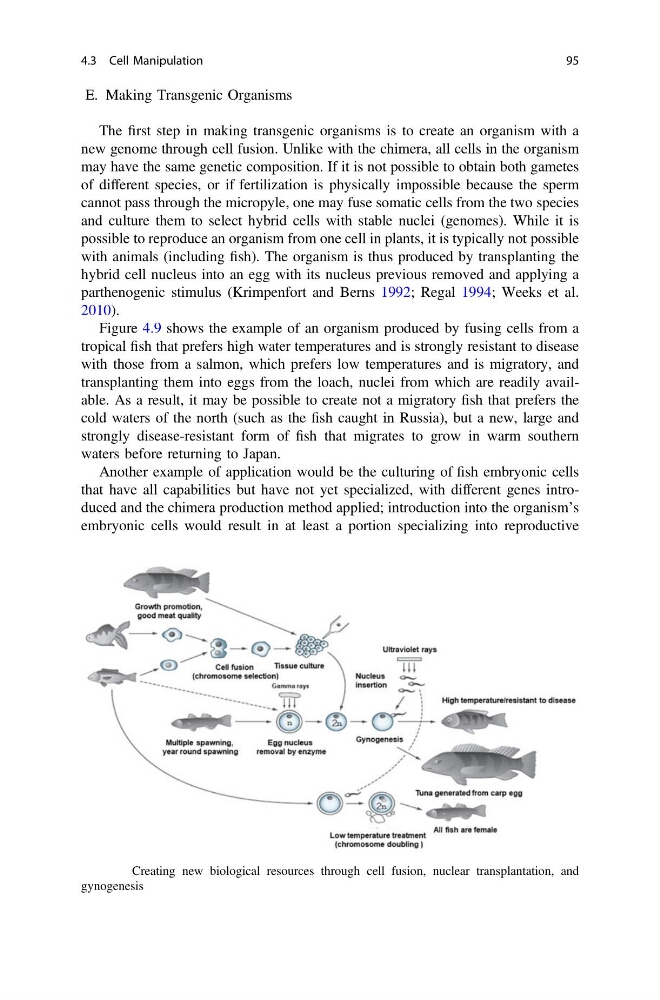
Figure 4.9 shows the example of an organism produced by fusing cells from a
tropical fish that prefers high water temperatures and is strongly resistant to disease
with those from a salmon, which prefers low temperatures and is migratory, and
transplanting them into eggs from the loach, nuclei from which are readily available. As a result, it may be possible to create not a migratory fish that prefers the
cold waters of the north (such as the fish caught in Russia), but a new, large and
strongly disease-resistant form of fish that migrates to grow in warm southern
waters before returning to Japan.
Another example of application would be the culturing of fish embryonic cells
that have all capabilities but have not yet specialized, with different genes introduced and the chimera production method applied; introduction into the organism’s
embryonic cells would result in at least a portion specializing into reproductive
Fig. 4.9 Creating new biological resources through cell fusion, nuclear transplantation, and
gynogenesis
4.3 Cell Manipulation
95
The first step in making transgenic organisms is to create an organism with a
new genome through cell fusion. Unlike with the chimera, all cells in the organism
may have the same genetic composition. If it is not possible to obtain both gametes
of different species, or if fertilization is physically impossible because the sperm
cannot pass through the micropyle, one may fuse somatic cells from the two species
and culture them to select hybrid cells with stable nuclei (genomes). While it is
possible to reproduce an organism from one cell in plants, it is typically not possible
with animals (including fish). The organism is thus produced by transplanting the
hybrid cell nucleus into an egg with its nucleus previous removed and applying a
parthenogenic stimulus (Krimpenfort and Berns 1992; Regal 1994; Weeks et al.
2010).
Figure 4.9 shows the example of an organism produced by fusing cells from a
tropical fish that prefers high water temperatures and is strongly resistant to disease
with those from a salmon, which prefers low temperatures and is migratory, and
transplanting them into eggs from the loach, nuclei from which are readily available. As a result, it may be possible to create not a migratory fish that prefers the
cold waters of the north (such as the fish caught in Russia), but a new, large and
strongly disease-resistant form of fish that migrates to grow in warm southern
waters before returning to Japan.
Another example of application would be the culturing of fish embryonic cells
that have all capabilities but have not yet specialized, with different genes introduced and the chimera production method applied; introduction into the organism’s
embryonic cells would result in at least a portion specializing into reproductive
Fig. 4.9 Creating new biological resources through cell fusion, nuclear transplantation, and
gynogenesis
4.3 Cell Manipulation
95