

C. Creating Nucleus/Cytoplasm Hybrids
The products of nuclear transplantation may be viewed more precisely as
nucleus/cytoplasm hybrids than as a clone population. Successful nuclear transplantations were carried out with amphibians in Great Britain in the 1950s and
1960s and with fish in China in the 1980s. In a series of nuclear transplantation
experiments conducted with fish, the organisms produced from eggs that had their
nuclei extracted and were transplanted with somatic cell nuclei from different
species showed not only traits from the species that provided the nucleus, but also
some traits from the species providing the eggs. From this, cytoplasmic genes
(genetic expression outside the nucleus in the cytoplasm—in the mitochondria, for
example) are thought to be involved. In some cases, however, a portion of the
ookaryon chromosomes remains due to incomplete micropipette extraction of the
nucleus. In China, however, the organism produced was described as a
nucleus/cytoplasm hybrid to emphasize the effects of heterosis (a phenomenon in
which the first hybrid generation grows to be larger than its parents) due to nucleus
and cytoplasm interaction (Mukai et al. 1978; Becraft and Taylor 1989).
D. Chimeras
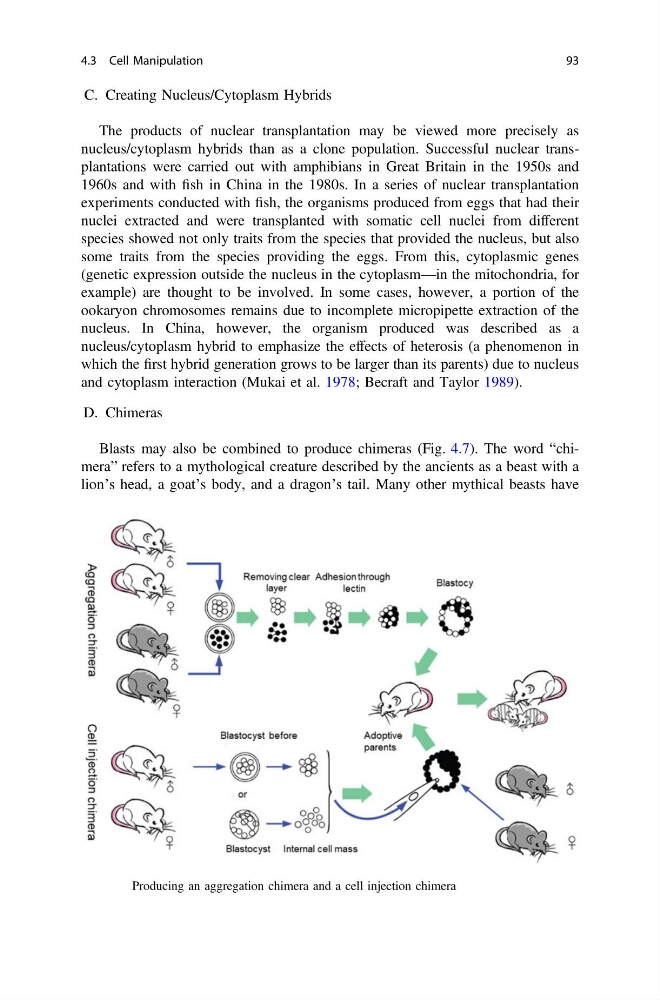
Blasts may also be combined to produce chimeras (Fig. 4.7). The word “chimera” refers to a mythological creature described by the ancients as a beast with a
lion’s head, a goat’s body, and a dragon’s tail. Many other mythical beasts have
Fig. 4.7 Producing an aggregation chimera and a cell injection chimera
4.3 Cell Manipulation
93
The products of nuclear transplantation may be viewed more precisely as
nucleus/cytoplasm hybrids than as a clone population. Successful nuclear transplantations were carried out with amphibians in Great Britain in the 1950s and
1960s and with fish in China in the 1980s. In a series of nuclear transplantation
experiments conducted with fish, the organisms produced from eggs that had their
nuclei extracted and were transplanted with somatic cell nuclei from different
species showed not only traits from the species that provided the nucleus, but also
some traits from the species providing the eggs. From this, cytoplasmic genes
(genetic expression outside the nucleus in the cytoplasm—in the mitochondria, for
example) are thought to be involved. In some cases, however, a portion of the
ookaryon chromosomes remains due to incomplete micropipette extraction of the
nucleus. In China, however, the organism produced was described as a
nucleus/cytoplasm hybrid to emphasize the effects of heterosis (a phenomenon in
which the first hybrid generation grows to be larger than its parents) due to nucleus
and cytoplasm interaction (Mukai et al. 1978; Becraft and Taylor 1989).
D. Chimeras
Blasts may also be combined to produce chimeras (Fig. 4.7). The word “chimera” refers to a mythological creature described by the ancients as a beast with a
lion’s head, a goat’s body, and a dragon’s tail. Many other mythical beasts have
Fig. 4.7 Producing an aggregation chimera and a cell injection chimera
4.3 Cell Manipulation
93